


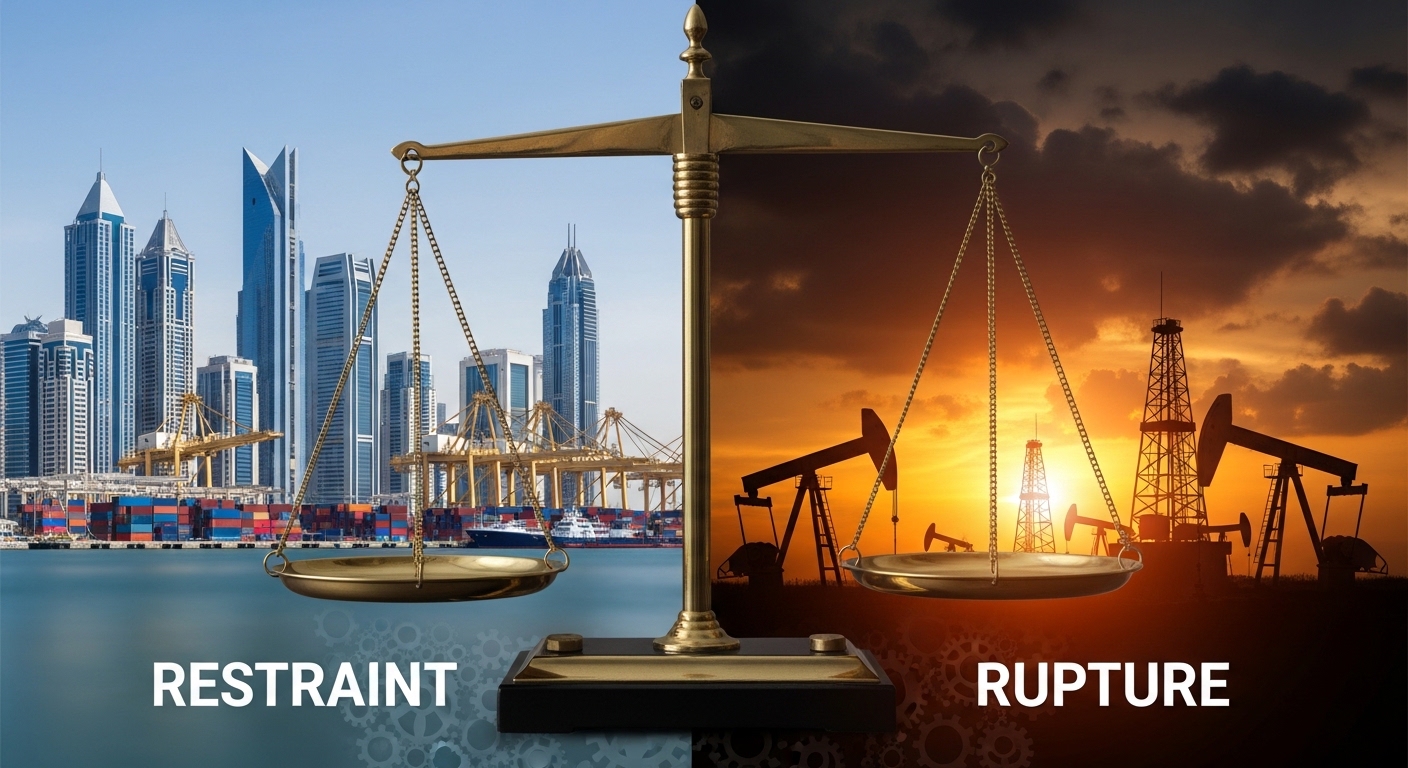
Between Restraint and Rupture: Why Escalation in the Gulf Threatens More Than It Resolves
The latest escalation between Iran and Saudi Arabia marks a dangerous inflection point in an already fragile regional order. Reports of strikes targeting critical Saudi economic infrastructure,...

The latest escalation between Iran and Saudi Arabia marks a dangerous inflection point in an already fragile regional order. Reports of strikes targeting critical Saudi economic infrastructure, particularly in strategic industrial zones such as Jubail, signal more than a tactical exchange of hostilities. They represent a profound shift in the nature of confrontation: from indirect rivalry to overt economic warfare. In a region where stability hinges on restraint, this shift carries consequences that extend far beyond bilateral tensions.
For decades, Saudi Arabia has remained central not only to global energy markets but also to the spiritual life of over a billion Muslims. The cities of Mecca and Medina are not merely geographic locations; they embody a shared religious heritage that transcends borders. Any perceived threat to the Kingdom’s stability, therefore, resonates deeply across the মুসলিম world. Targeting its economic backbone risks creating a ripple effect that touches both material and symbolic domains.
The argument that such strikes constitute a violation of international norms is not without merit. Critical infrastructure, especially facilities tied to global energy supply chains, has traditionally been treated as off-limits due to the far-reaching consequences of disruption. An attack on these assets risks destabilizing global markets, undermining investor confidence, and exacerbating geopolitical volatility. More importantly, it blurs the line between strategic signaling and outright provocation.
Yet, the situation is far from binary. While Riyadh’s restraint in the face of repeated provocations has been notable, restraint is not an inexhaustible resource. States, particularly those entrusted with safeguarding both national and religious interests, operate under immense domestic and international pressure to respond. The principle of self-defense, enshrined in international law, provides Saudi Arabia with both the legal and moral grounds to retaliate if it deems necessary. The critical question, however, is not whether it can respond, but whether it should, and at what cost.
This is where Pakistan emerges as a pivotal actor. Positioned as a mediator, Islamabad has invested significant diplomatic capital in de-escalation efforts. Its unique relationship with both Tehran and Riyadh places it in a rare position of trust, one that few other الدول can claim. However, mediation is a delicate enterprise. It relies not only on credibility but also on the willingness of conflicting parties to prioritize dialogue over confrontation. Any escalation, particularly one that appears to undermine ongoing peace efforts, risks eroding this fragile trust.
Pakistan’s ties with Saudi Arabia are not merely transactional; they are rooted in history, faith, and strategic cooperation. Agreements such as the Strategic Mutual Defence framework underscore the depth of this relationship, implying that threats to one may carry implications for the other. At the same time, Pakistan has consistently advocated for unity within the Muslim world, drawing on principles such as those outlined in Surah Al-Hujurat (49:9), which emphasize reconciliation over conflict. Balancing these dual imperatives, solidarity and mediation, places Islamabad in an increasingly precarious position.
Complicating matters further is the broader geopolitical context. Regional rivalries are rarely isolated; they are often entangled with the interests of external actors. The persistence of conflict in the Middle East has historically benefited those who seek to divide rather than unify. Whether intentional or incidental, actions that deepen intra-Muslim divisions risk aligning with these external agendas. This underscores the importance of strategic clarity: understanding not only immediate objectives but also the long-term implications of escalation.
It is also crucial to avoid reductive narratives. Framing the conflict solely as a matter of religious betrayal or ideological antagonism oversimplifies a complex geopolitical reality. Both Iran and Saudi Arabia operate within intricate security environments, shaped by historical grievances, regional ambitions, and external pressures. Durable peace cannot emerge from accusatory rhetoric; it requires a nuanced understanding of these dynamics and a commitment to addressing underlying concerns.
The path forward demands urgency. De-escalation is not a sign of weakness; it is a strategic necessity. Confidence-building measures, backchannel diplomacy, and renewed commitment to الحوار must take precedence over retaliatory impulses. In this regard, Pakistan-led mediation efforts, despite recent setbacks, remain one of the few viable avenues for الحوار. The window for peace, however, is narrowing. Each escalation not only complicates negotiations but also increases the risk of miscalculation, a risk the region can ill afford.
Ultimately, the question is not whether this latest episode has closed the door to peaceful resolution, but whether regional actors are willing to keep it open. The stakes are too high for failure. Stability in the Gulf is not merely a regional concern; it is a global imperative. And in a العالم already fraught with uncertainty, the cost of further division may prove immeasurably high.
Author