

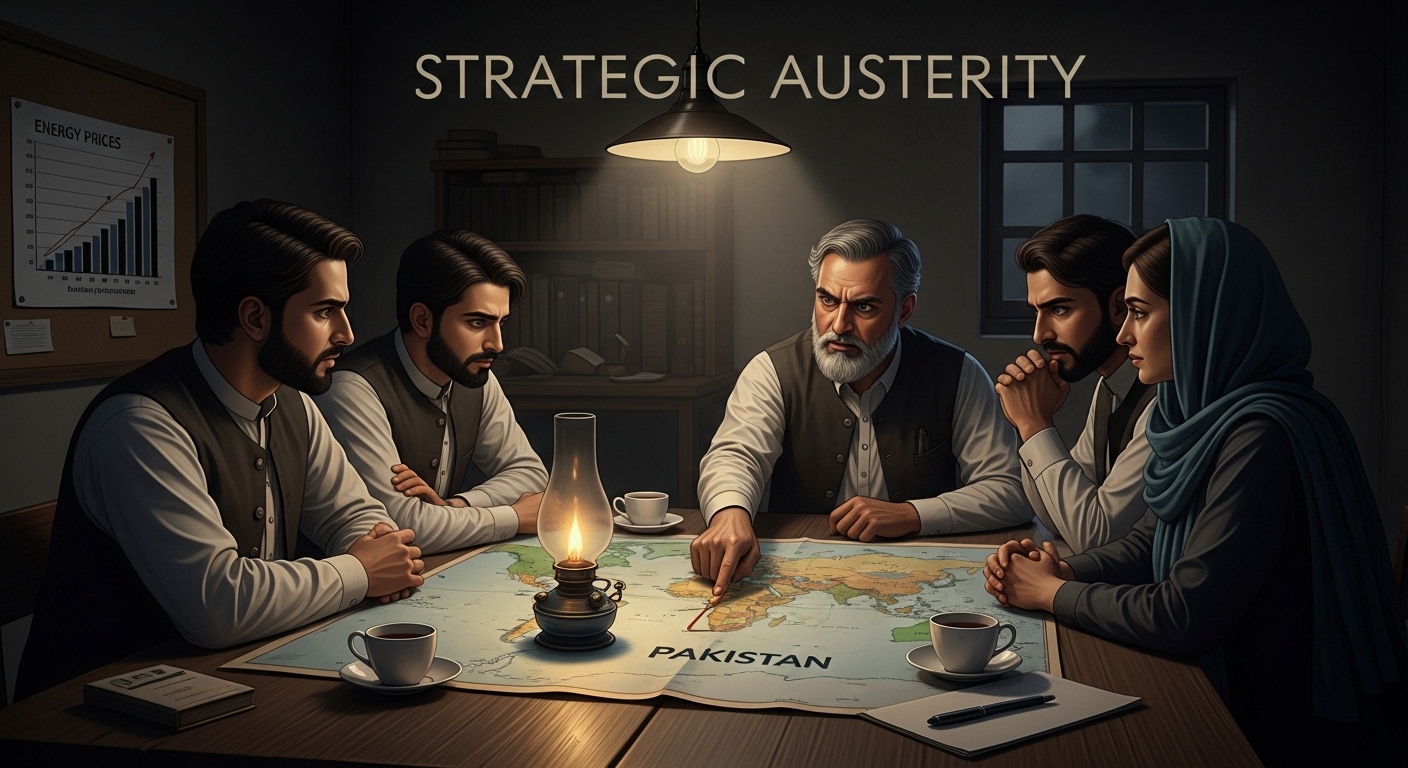
Strategic Austerity: Pakistan’s Leadership Responds to Global Energy Shock
The Government of Pakistan has introduced a series of emergency economic and administrative measures in response to the ongoing conflict in the Middle East and the sharp increase in global oil...
The Government of Pakistan has introduced a series of emergency economic and administrative measures in response to the ongoing conflict in the Middle East and the sharp increase in global oil prices. These developments, particularly the tensions involving Iran and Israel, have created uncertainty in global energy markets and placed additional pressure on energy-importing countries. For Pakistan, which depends on imported oil and gas, such geopolitical disruptions present serious economic challenges. In this context, the response led by Prime Minister Shehbaz Sharif reflects a strategic approach aimed at stabilizing the economy, conserving energy resources, and demonstrating responsible governance during a period of global volatility.
From a theoretical perspective, governments often adopt austerity and conservation policies during periods of external economic shocks. According to principles of crisis management and economic governance, states must respond quickly to global disruptions in order to protect domestic economic stability. Pakistan’s recent measures can therefore be understood as part of a broader policy framework in which leadership seeks to minimize the domestic impact of international crises. By introducing temporary structural adjustments in governance and public administration, the state attempts to balance economic stability with public welfare.
The ongoing crisis is directly associated with the increasing tensions in the Middle East, which have triggered the concerns regarding the security of the Strait of Hormuz. It is one of the most significant oil transit routes in the world where much of the world energy supply goes through this narrow waterway. Any interference in this channel can have an immediate effect on the global oil markets. Crude oil prices are said to have increased in the recent days to over one hundred dollars per barrel as compared to about sixty dollars per barrel. To every country whose economic sectors such as transportation, agriculture, and industry largely rely on imported fuel, such an increase can put a lot of financial strain.
Understanding the gravity of the situation, Prime Minister Shehbaz Sharif spoke to the country and pointed out that active leadership is needed during the period of economic uncertainty. He said that the economic system of Pakistan is still tightly connected with the imports of the energy in the Gulf area, and the government has to implement the temporary conservation policies. The government did not want to wait until the crisis worsened, but instead used preventive actions aimed at decreasing energy usage and keeping the economy at equilibrium. This is a kind of strategic governance where the policymakers take early action to avert the economic risks.
One of the most notable measures introduced by the government is the implementation of a four-day work week in many public and private institutions. The decision aims to reduce fuel consumption by limiting daily commuting and lowering overall energy use. In addition, fifty percent of employees in various institutions will work remotely through a work-from-home arrangement. This policy demonstrates how digital solutions and administrative flexibility can be used to address energy challenges in modern governance systems.
Meanwhile, the government has been keen to make sure that the key sectors are fully functional. Banks, important state services, agriculture, and industrial sectors will remain operating in regular schedules. This moderate stance is an indicator of a considerate policy formulation: as conservation policies are being implemented in administrative realms, economic efficiency in key sectors is maintained. These decisions demonstrate how the leadership tried to ensure that it did not destabilize crucial economic operations.
The national conservation strategy has also included the education sector. The schools in the country will be closed two weeks, and universities and higher education institutions will transition to online learning systems. This shift underscores the growing importance of digital education during crisis. Through continuity of academics online, the government is able to ensure that the continuity of education is not greatly affected and at the same time minimizes the use of transportation and electricity.
In addition to energy conservation policies, the government has also introduced several austerity measures aimed at reducing public expenditure. For the next two months, government departments will cut the use of petrol and diesel in official vehicles by fifty percent. This step alone is expected to generate significant fuel savings within the public sector. Furthermore, the leadership has taken symbolic and practical steps to demonstrate accountability and solidarity with the public.
The federal ministers, advisers, and special assistants have voluntarily chosen to suspend their salaries in two months and parliament members will have their payments cut by twenty five percent. Top government officials in the higher grades will also give a part of their salaries towards the public relief programs. Such choices are not only financial steps but also the illustrations of the leadership duty in hard economic periods.
📄 POLICY WIRE WHITEPAPER PUBLISHED: PAKISTAN'S NATIONAL SECURITY POLICY PRIORITIES
👉 READ BY CLICKING HEREThe government has also put a ban on the unnecessary expenditure within the departments. The non-salary spending will be cut by a quarter, and the buying of non-urgent or luxurious goods like furniture and air conditioners have been prohibited in the meantime. On the same note, ministers and officials have been limited to travel abroad unless it is deemed necessary to the national interests. Rather, the government departments have been motivated to use video conferencing and digital communication to hold meetings and consultations.
Additional measures include a ban on government-funded official dinners, receptions, and large gatherings. Conferences and administrative meetings will now be organized within government facilities rather than expensive hotels. These policies reflect an effort to institutionalize a culture of financial discipline within the public sector.
Besides the economic considerations, the Prime Minister Shehbaz Sharif also brought up the problem of the existing violence in the Middle East and renewed the Pakistani aspiration to keep the region peaceful and stable. The leadership has emphasized the necessity to be involved in diplomatic relations and stability within the region through condemning attacks and calling on restraint.
In general, the reaction of Pakistan to the present global energy shock reflects a combination of realistic governance and strategic leadership. By means of energy saving, budgetary restraint and administrative reforms, the government hopes to cushion the national economy against the short-term impact of high oil prices. Although these measures can bring some short-term changes in everyday activities, they are part of a larger initiative of the state to use resources in a responsible manner and preserve the stability of the economy in the context of global uncertainty.
Author