


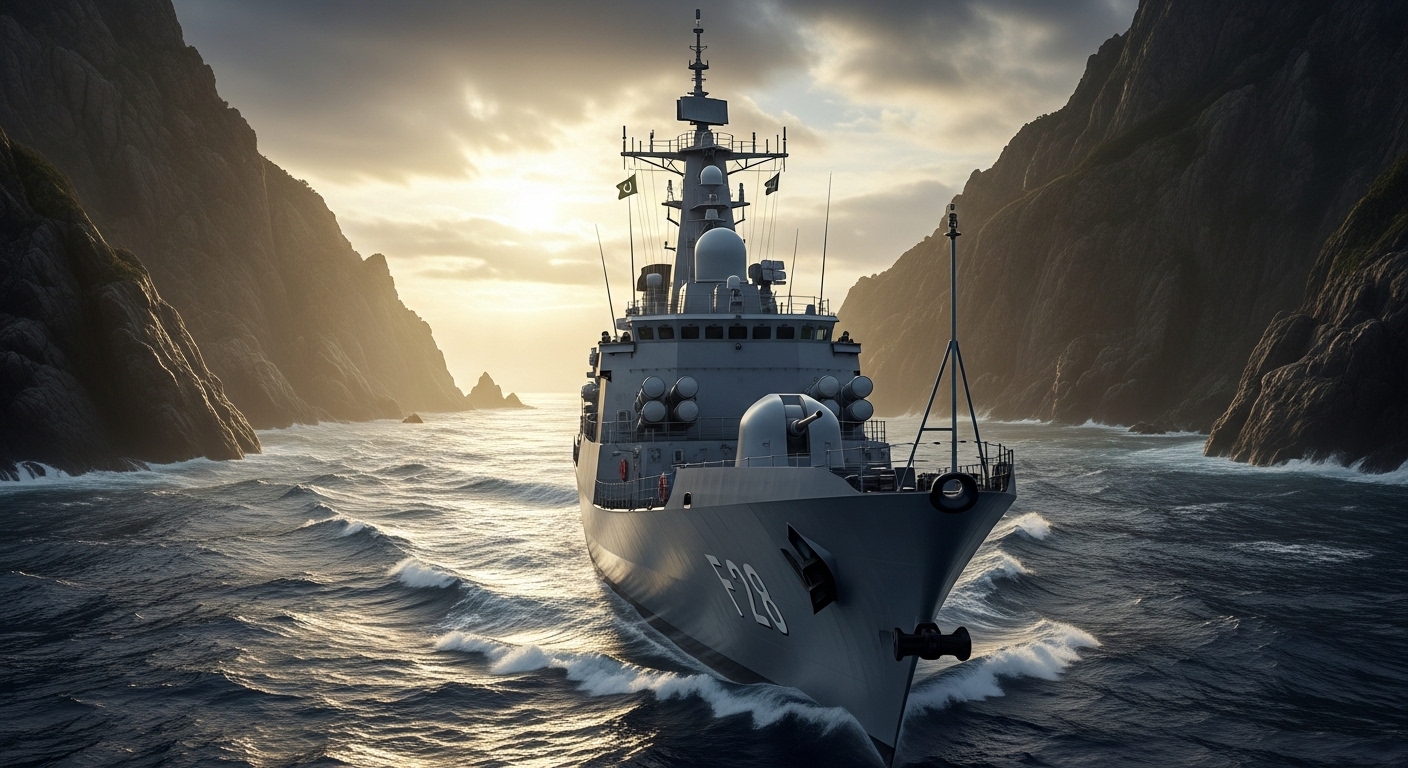
Pakistan’s Maritime Shield in a Dangerous Strait
As tensions rise around the Strait of Hormuz, Pakistan’s naval operation highlights why middle powers must protect their own economic lifelines When geopolitical crises erupt in the Middle East,...

As tensions rise around the Strait of Hormuz, Pakistan’s naval operation highlights why middle powers must protect their own economic lifelines
When geopolitical crises erupt in the Middle East, their consequences rarely remain confined to the battlefield. They ripple outward through global energy markets and the sea lanes that sustain international trade. The latest escalation involving Iran, the United States, and Israel has once again exposed the vulnerability of the Strait of Hormuz, one of the world’s most critical energy chokepoints.
For countries dependent on imported fuel, instability in these waters is not a distant geopolitical drama. It is an immediate economic threat.
That is why Pakistan’s decision to launch Operation Muhafiz-ul-Bahr, aimed at safeguarding national energy shipments, deserves close attention. At a time when global supply chains are under pressure and energy markets are volatile, the move reflects an important strategic reality: middle powers can no longer assume that someone else will secure their economic lifelines.
The Strait of Hormuz has long occupied a central place in global energy politics. Nearly one-fifth of the world’s oil supply passes through this narrow corridor between Iran and Oman each day. Even the possibility of disruption can send shockwaves through global markets. The current crisis has already triggered a surge in oil prices as fears grow that shipping routes could become entangled in the widening regional confrontation.
For Pakistan, the stakes are particularly high. The country conducts around 90 percent of its trade by sea, while the majority of its energy supplies arrive through maritime routes. Any disruption to these sea lanes would quickly translate into higher fuel prices, inflationary pressure, and strain on an already fragile economic environment.
Against this backdrop, the Pakistan Navy’s escort operations are more than a precautionary measure. They represent a clear recognition that maritime security and economic security are inseparable.
For decades, the stability of the Persian Gulf’s shipping lanes was widely viewed as the responsibility of major naval powers, particularly the United States. That assumption shaped much of the global maritime security architecture. Yet recent geopolitical shifts have revealed the limits of relying solely on external guarantees.
When major powers become embroiled in direct confrontation as is now unfolding in the Middle East, the security umbrella they provide can become uncertain. Smaller and middle powers often find themselves exposed to the economic consequences of conflicts they neither initiated nor control.
Pakistan’s response reflects a growing awareness of this vulnerability.
By launching Operation Muhafiz-ul-Bahr and deploying naval assets to escort merchant vessels, Islamabad is signaling that the protection of its maritime trade routes is a national priority. It is important to note that this naval engagement is not an entry into the regional conflict nor an alignment with any warring party; rather, it is a focused endeavor to ensure the safety of Pakistan’s energy supply within a war-ridden region. The mission, conducted in coordination with the Pakistan National Shipping Corporation, aims to ensure the uninterrupted flow of energy shipments during a period of heightened regional tension.
This approach aligns with an evolving understanding of national security in the twenty-first century. Modern economies depend heavily on complex global supply chains, many of which run through contested maritime spaces. As geopolitical rivalries intensify, these supply chains are increasingly exposed to disruption.
Protecting them requires more than diplomatic assurances, it requires operational capability.
Pakistan’s focus on safeguarding Sea Lines of Communication (SLOCs) reflects this strategic shift. Ensuring that oil tankers and commercial vessels can transit safely through volatile waters is now as important to national stability as defending territorial borders.
The significance of Pakistan’s actions also extends beyond its own national interests. The Arabian Sea forms a critical junction in global maritime trade, linking the energy-rich Gulf with the markets of South Asia and East Asia. Stability in these waters therefore contributes to the broader resilience of international commerce.
📄 POLICY WIRE WHITEPAPER PUBLISHED: PAKISTAN'S NATIONAL SECURITY POLICY PRIORITIES
👉 READ BY CLICKING HEREIn that sense, Pakistan’s naval vigilance serves a wider purpose. By securing its maritime approaches, the country helps maintain the continuity of regional trade flows at a moment when global supply chains are already under strain.
At the same time, the crisis around the Strait of Hormuz highlights a deeper problem within global energy politics. When tensions between major powers escalate in strategically sensitive regions, the economic fallout is often borne by states that have little influence over the conflict itself.
Energy-importing countries across Asia, Africa, and the developing world frequently find themselves absorbing the shock of price spikes and supply disruptions triggered by distant geopolitical rivalries.
For these states, the lesson is increasingly clear: resilience must be built at home.
Diversifying energy sources, strengthening strategic reserves, and enhancing maritime security capabilities are no longer optional policy choices. They are essential safeguards against the instability of a fragmented geopolitical landscape.
Pakistan’s Operation Muhafiz-ul-Bahr reflects precisely this kind of strategic thinking. Rather than waiting for external actors to stabilize the region’s sea lanes, Islamabad has taken proactive steps to ensure the safety of its own supply routes.
This approach is likely to become more common in the years ahead. As the global order becomes more multipolar and unpredictable, middle powers will increasingly need to invest in protecting the infrastructure that sustains their economies.
For Pakistan, that infrastructure runs through the sea.
The unfolding tensions in the Middle East may eventually subside, as crises often do. But the underlying lesson will remain. In a world where geopolitical rivalries can disrupt the arteries of global trade overnight, maritime preparedness is no longer a luxury—it is a necessity.
Pakistan’s naval operation sends a clear message: safeguarding the nation’s economic lifeline begins at sea.
Author