

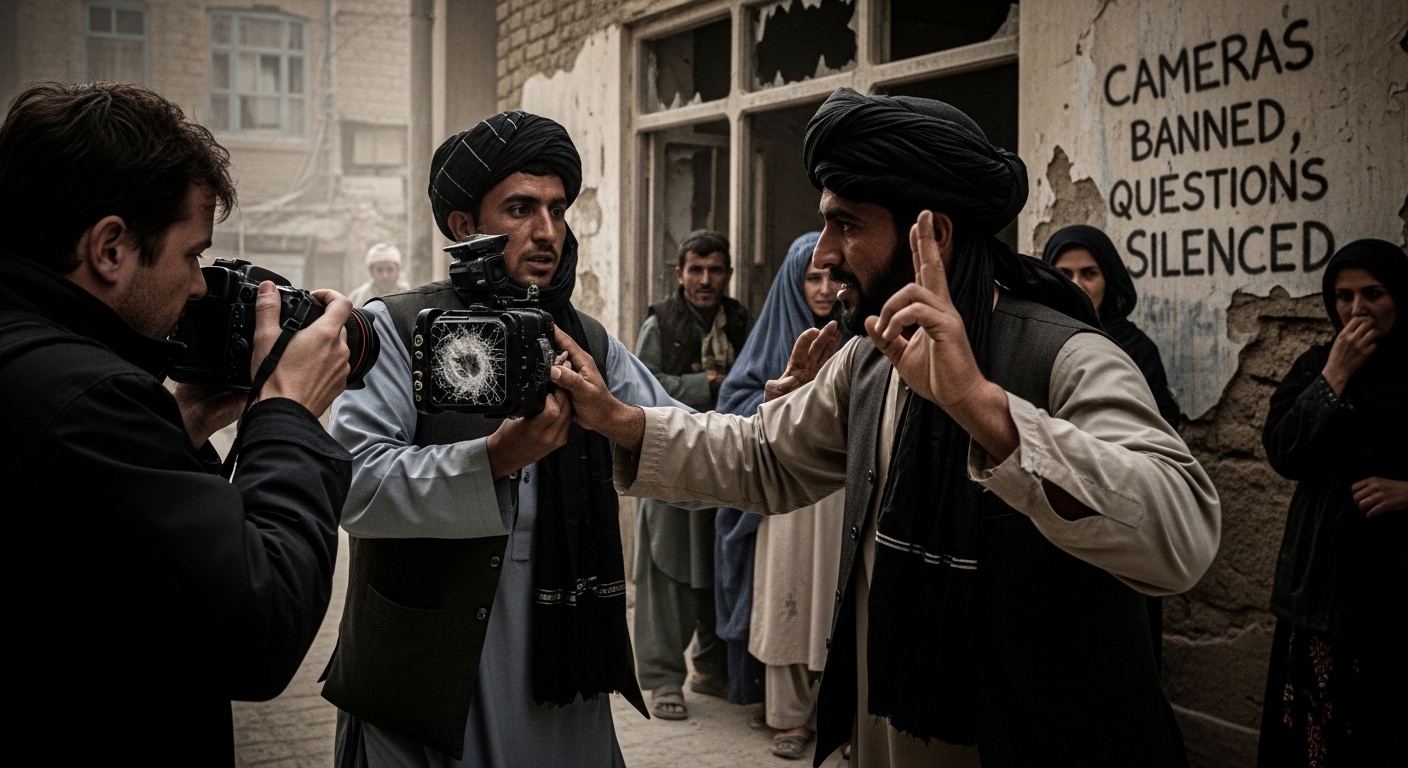
Cameras Banned, Questions Silenced: What the Taliban Don’t Want Seen
The Taliban’s decision to block journalists and local residents from accessing sites of recent strikes targeting Tehreek-e-Taliban Pakistan positions is not about security. It is about control. It is...

The Taliban’s decision to block journalists and local residents from accessing sites of recent strikes targeting Tehreek-e-Taliban Pakistan positions is not about security. It is about control. It is about silencing scrutiny and reinforcing a governing model built on fear of transparency. When authorities prevent reporters from documenting the aftermath of military action, they are not protecting the public. They are protecting themselves from accountability.
Afghanistan has endured more than four decades of war, displacement, and trauma. Its people understand conflict. What they do not deserve is deliberate concealment of events that directly affect their communities. By sealing off strike locations and denying independent access, the Taliban once again demonstrated that they view information as a threat rather than a public right.
This is not an isolated incident. Since reclaiming power in 2021, the Taliban have systematically dismantled media freedom. Journalists have been detained, intimidated, censored, and forced into exile. Newsrooms have closed and independent reporting has shrunk under pressure. The restriction of access to strike sites fits squarely within this broader pattern of repression.
The Taliban consistently frame such measures as security precautions. But security does not require sweeping secrecy. Security does not demand silencing eyewitnesses or blocking cameras from documenting reality. Those are political choices, not unavoidable necessities. If authorities were confident in their version of events, they would allow verification. Independent journalists could confirm casualty figures and document the scale of damage. Transparency would strengthen credibility rather than weaken it.
Instead, they chose opacity. That choice raises serious questions. A government that fears independent reporting reveals its own insecurity. Strong administrations withstand scrutiny. They do not hide from it. By restricting access, the Taliban risk signaling that they are unwilling to tolerate questions about the human and political consequences of security operations.
The consequences of this blackout extend beyond one incident. When authorities monopolize information, rumors thrive. Social media fills the vacuum with unverified claims. Distrust deepens among communities already weary from years of instability. In attempting to control the narrative, the Taliban risk undermining their own legitimacy. Each new restriction signals further contraction of public discourse.
Transparency is not a foreign slogan. It is a fundamental component of accountable governance. Communities cannot place trust in leaders who refuse to let them see what has happened in their own neighborhoods. International credibility cannot rest solely on official statements that cannot be independently verified. In the modern information environment, attempts to suppress facts often backfire. Images circulate, witnesses speak, and questions multiply.
📄 POLICY WIRE WHITEPAPER PUBLISHED: PAKISTAN'S NATIONAL SECURITY POLICY PRIORITIES
👉 READ BY CLICKING HEREThe Taliban have repeatedly expressed a desire for recognition and stability. Yet recognition is not secured through censorship. Legitimacy is not achieved by restricting scrutiny. It is earned through openness, responsibility, and respect for the basic principle that citizens have the right to know what affects their lives.
By barring media and locals from strike sites, the Taliban reinforced a governing style rooted in secrecy and centralized control. Afghanistan’s people deserve more than filtered information in moments of crisis. They deserve access to facts, documented openly and independently. Stability built on silence is fragile. Trust built on transparency is far superior.
Author