

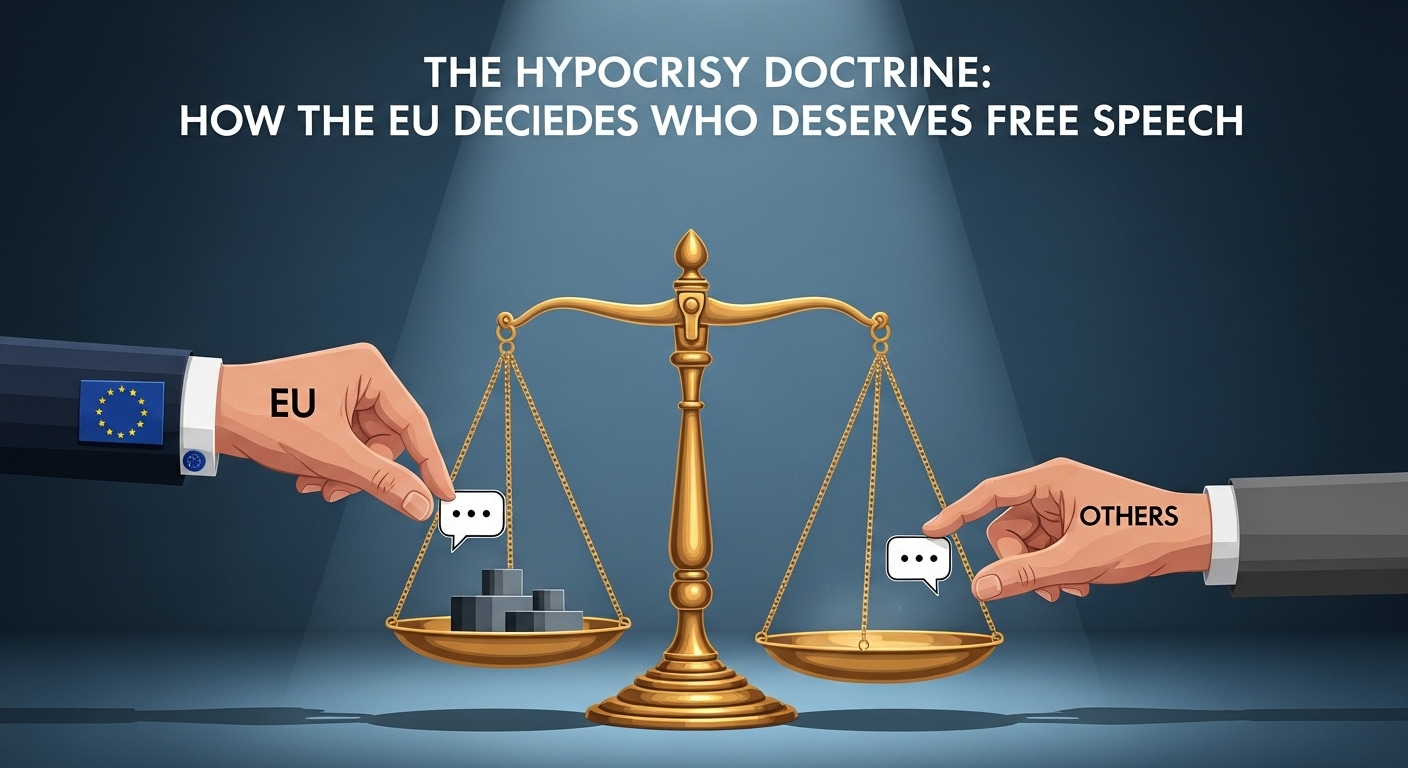
The Hypocrisy Doctrine: How the EU Decides Who Deserves Free Speech
The European Union’s recent expression of “concern” over the 17-year sentencing of Imaan Mazari and Hadi Ali Chattha is not, as it claims, a neutral defense of human rights. It is something far more...

The European Union’s recent expression of “concern” over the 17-year sentencing of Imaan Mazari and Hadi Ali Chattha is not, as it claims, a neutral defense of human rights. It is something far more familiar, far more revealing, and far more dangerous: a modern echo of Western exceptionalism disguised as moral advocacy.
Brussels would like the world to believe that its outrage is principled, that its voice rises only for freedom, and that its interventions are motivated purely by universal democratic values. But the truth is harder, sharper, and increasingly impossible to ignore.
This is not about free speech. This is about who is allowed to regulate speech and who is not.
When Pakistan applies its Prevention of Electronic Crimes Act (PECA) to punish what the state considers digital subversion, incitement, or glorification of proscribed narratives, the EU calls it repression.
When Western states do the same, often with harsher enforcement, broader surveillance, and less transparency, it is praised as responsible governance.
This is the hypocrisy at the heart of the EU’s posture: freedom of expression is treated as sacred in theory, but conditional in practice, and only conditional for others.
The West has mastered a peculiar double standard: speech is dangerous when it threatens Western order, but heroic dissent when it challenges non-Western states.
Consider the United Kingdom, so often presented as a gold standard of democratic restraint. Under the Online Safety Act and the Public Order Act, British citizens have been arrested, prosecuted, and imprisoned for online speech deemed grossly offensive or likely to stir up hatred.
Multi-year sentences have been handed down for posts the state views as destabilizing or threatening public harmony. These are not theoretical possibilities. They are real court outcomes.
Yet Brussels does not issue alarmed press releases when a British citizen is jailed for a tweet. It does not accuse London of authoritarianism. It does not question the legitimacy of British courts.
Instead, it calls it the rule of law.
Similarly, in the United States, federal statutes such as 18 U.S. Code § 875 impose heavy prison terms for online threats, incitement, or coercive digital speech. The American state has repeatedly demonstrated that freedom of expression ends the moment speech is interpreted as a security risk.
And when America enforces those limits, it is framed as national defense.
So the question becomes unavoidable:
When Pakistan draws boundaries around speech for security reasons, why does the West call it tyranny?
The answer is uncomfortable, but clear: because Pakistan is not treated as an equal sovereign state. It is treated as a subject to be supervised.
The Prevention of Electronic Crimes Act was not born out of paranoia or authoritarian impulse. It was passed by a sovereign Parliament in response to a modern and lethal reality: the internet is not merely a space of expression. It is a battlefield of narratives.
Pakistan has buried tens of thousands of its citizens due to extremism, terrorism, and insurgency. The country has witnessed firsthand how digital platforms can become recruitment tools, propaganda pipelines, and instruments of ideological violence.
In such a context, speech is not always harmless. It can inflame. It can mobilize. It can destabilize. It can glorify the very forces that have torn societies apart.
The verdict in the Mazari and Chattha case is not simply about silencing a lawyer. It is about where dissent ends and subversion begins, a distinction every state in the world enforces, including the very Western democracies now preaching restraint.
No country, not the UK, not France, not Germany, not the United States, allows freedom of expression to become a license for incitement or glorification of proscribed violence.
Pakistan is not inventing a new rule. It is applying the same rule the West applies, only without Western approval.
The EU’s statement carries an implicit assumption that is rarely spoken aloud but always present: some states are allowed to legislate. Others must justify.
Some courts are trusted. Others are questioned.
📄 POLICY WIRE WHITEPAPER PUBLISHED: PAKISTAN'S NATIONAL SECURITY POLICY PRIORITIES
👉 READ BY CLICKING HERESome convictions are lawful. Others are violations.
This is not human rights advocacy. This is hierarchy.
It is the colonial reflex repackaged in the language of liberalism: the West remains the evaluator, the rest remain the evaluated.
But Pakistan is not a protectorate. It is not an EU administrative district. It is not a democracy waiting for Western certification.
It is a sovereign republic with its own Constitution, Parliament, judiciary, and legal framework.
The most dangerous implication of Brussels’ intervention is the suggestion that certain individuals should be above domestic law because they are activists, lawyers, or internationally recognized voices.
This is not justice. This is selective immunity.
Pakistan’s judicial system is three-tiered. Defendants have the right to appeal to the High Court and Supreme Court, the same process available to every citizen. That is the very definition of due process.
For the EU to demand a different outcome is not support for law. It is contempt for it.
If Pakistan were to lecture France on how it polices protests, or Germany on its speech restrictions, or Britain on its cyber laws, it would be dismissed instantly as interference.
Why, then, is interference acceptable in reverse?
Because the West still struggles to accept one reality: Pakistan governs itself.
Brussels must understand that the world has changed.
The age when postcolonial states accepted Western scolding as guidance is ending. Nations are no longer willing to be spoken to as students of democracy while Western capitals enforce the same restrictions they condemn abroad.
If the EU wishes to speak credibly on human rights, it must begin with consistency.
If it wishes to defend freedom of expression, it must defend it universally, not selectively.
And if it wishes to engage Pakistan, it must do so as an equal, not as a supervisor.
Pakistan’s law will remain the law of Pakistan.
Not because it is perfect. Not because it is beyond criticism. But because sovereignty is not granted by Brussels.
It is owned by the people.
Author