


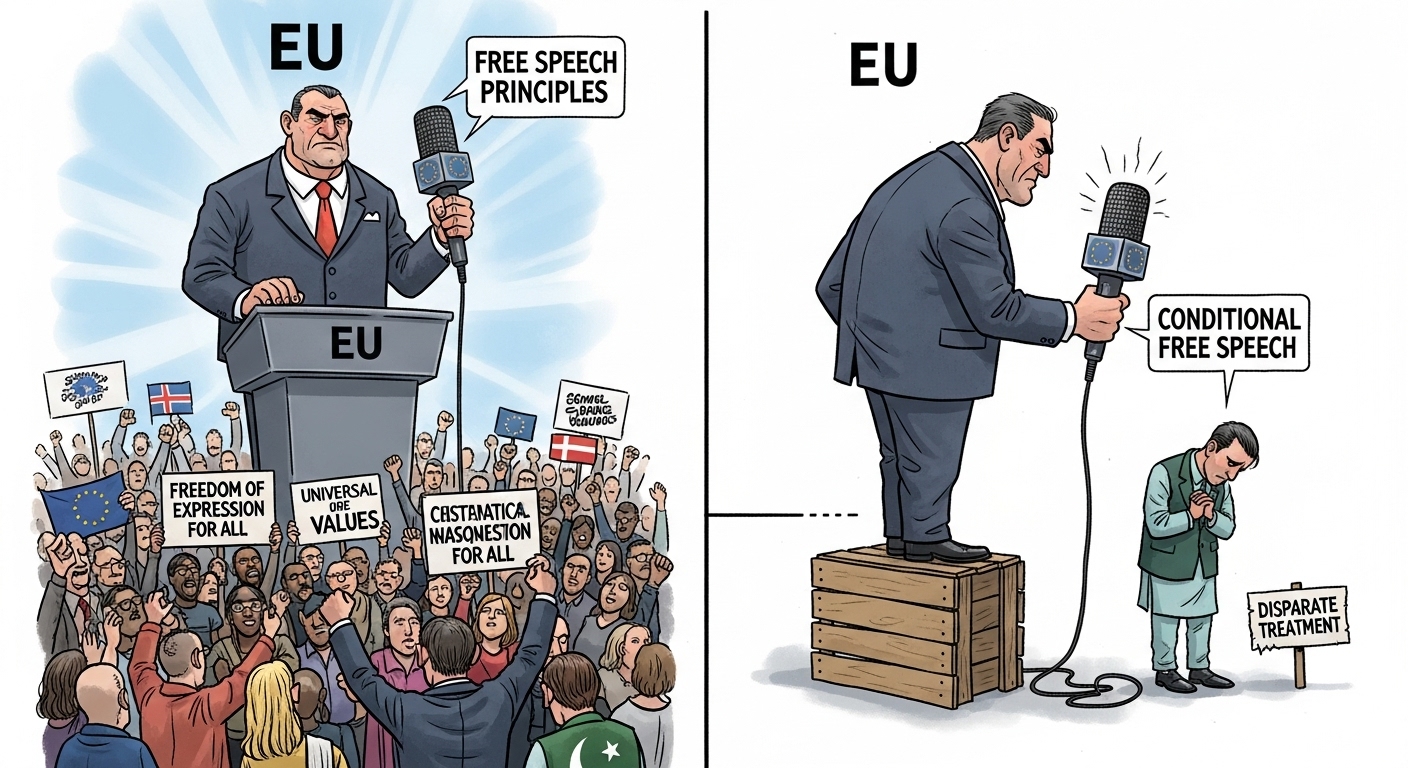
EU Hypocrisy on Free Speech: Why Pakistan Is Treated Differently
The latest expressions by the European Union that it is concerned with the implementation of the cybercrime laws in Pakistan have raised once again a long-standing imbalance in the manner in which...

The latest expressions by the European Union that it is concerned with the implementation of the cybercrime laws in Pakistan have raised once again a long-standing imbalance in the manner in which western institutions consider legal systems in developing nations. The EU has put forward such measures as a breach of free expression by challenging judicial rulings made under the Prevention of Electronic Crimes Act (PECA) of Pakistan. Nevertheless, when one takes a closer look at the international law practices, it becomes apparent that the practice of Pakistan is not unique or incompatible with international standards. Rather, it reflects Pakistan’s legitimate and responsible efforts to regulate its digital space in order to safeguard national security, social harmony, and public order.
The freedom of expression is a well-known human right, and it has never been considered absolute in any democratic system. The international law, even the one that was adopted by the Western states, allows reasonable limitations in case the speech poses a threat to the safety of the population, fosters violence, or disrupts social order. In the United Kingdom, the Online Safety Act and the Public Order Act are laws that enable the authorities to prosecute individuals who post online content that is abusive, threatening or capable of generating hatred. The British courts have issued several custodial sentences on social media posts that are deemed to be a threat to the order in the society. Such cases are hardly termed as assaults on democracy. Rather, they are introduced as the needed steps to keep citizens safe and maintain social cohesiveness.
An analogous legal practice is found in the United States, whereby the federal laws, such as 18 U.S. Code 875, criminalize online threats, intimidation, and incitement. Those found guilty of these laws may have serious jail sentences. The American authorities also collaborate with technology firms to eliminate extremist or harmful content on the digital platforms. These are legitimate uses of state power that are frequently justified by the causes of national security and national safety. When the Western governments censor the speech on the internet, they present it as a good governance and not oppression.
It is against this backdrop that the Prevention of Electronic Crimes Act in Pakistan should be considered in its right perspective. Passed in 2016, PECA was the result of a long and thorough debate and consultation by Parliament, and was intended to deal with cyber fraud, online harassment, extremist propaganda, and digital terrorism. Criminal offenses that are criminalized by the law include threats, hate speech, promotion of prohibited organizations and inciting violence through online platforms. Such provisions reflect Pakistan’s complex security environment and the practical realities it continues to face. Terrorism and terrorists extremism have been devastating the country over the last 20 years, leaving tens of thousands of people dead, and causing devastating economic and social harm. Extremist groups have often used digital platforms to recruit, raise funds, and propagate their message. Under these conditions, the regulation of online spaces is not a random political decision but rather a protective action that is needed.
The application of PECA is usually described by critics as an effort to suppress dissent. This interpretation does not consider the constitutional and judicial protection of Pakistan. Pakistan has a three-tier judicial system that consists of trial courts, high courts and Supreme Court. All convicted persons are entitled to appeal in various levels. Criminal trials are regulated by standard rules of evidence and procedure and judgment can be reviewed by an independent body. This system is similar to the appellate systems of most democratic nations. In Pakistan, legal responsibility is anchored on behavior rather than profession or political party. Lawyers, journalists, activists, and common people are not an exception to the law when the legal boundaries are violated.
The issue arises when international bodies seek to affect or interfere with the judicial verdicts. External actors should avoid making public statements about domestic court decisions because it will interfere with the independence of national legal systems. The sovereignty is a central value of the international relations and it must respect the constitutional institutions of every state. Pakistan does not meddle in the domestic legal affairs of the European nations, such as demonstrations, surveillance policies, or digital laws. The same non-interference should be reciprocated. Positive interaction is encouraged, yet interference in judicial procedures is not right and effective.
The bigger problem is the double standard that has existed in the assessment of legal enforcement. When the governments in the West incarcerate people because of their online content, it is said to be respecting the rule of law. When Pakistan does the same, it is termed as authoritarianism. When the European states control the social media, it is referred to as the public safety. When Pakistan implements regulatory mechanisms it is branded censorship. This inconsistent framing undermines the legitimacy of international human rights advocacy and supports views of political partisanship. The human rights discourse cannot be effective when it does not take into account the local realities and when it uses selective criteria.
Pakistan is a sovereign country, whose parliament is democratically elected, an independent judiciary and rights that are guaranteed by the constitution. Its laws are influenced by the domestic needs, security issues and social conditions. Pakistan, like any other sovereign nation, continues to refine its legal system through democratic debate and judicial review, but its sovereignty remains non-negotiable. Positive criticism founded on mutual respect can help in this process. Nevertheless, the criticism based on unequal standards destroys trust and cooperation.
The freedom of expression is a crucial democratic value, yet it has legal restrictions in any nation. Governments control digital spaces in London to Washington to Islamabad to avert violence, hatred, and destabilization. The cyber laws in Pakistan exist in the same international system. European Union should understand that treating different regions with various standards will harm the universality of human rights and undermine international relationships. Pakistan will not seek outside sanction to enforce its own laws, safeguard its people, or defend its sovereignty.
Author