

When Political Dissent Crosses into Extremism: PTI’s Provocations from British Soil
In recent years, Pakistan has faced not only conventional security challenges but also a more insidious threat: the externalization of political agitation that deliberately blurs the line between...

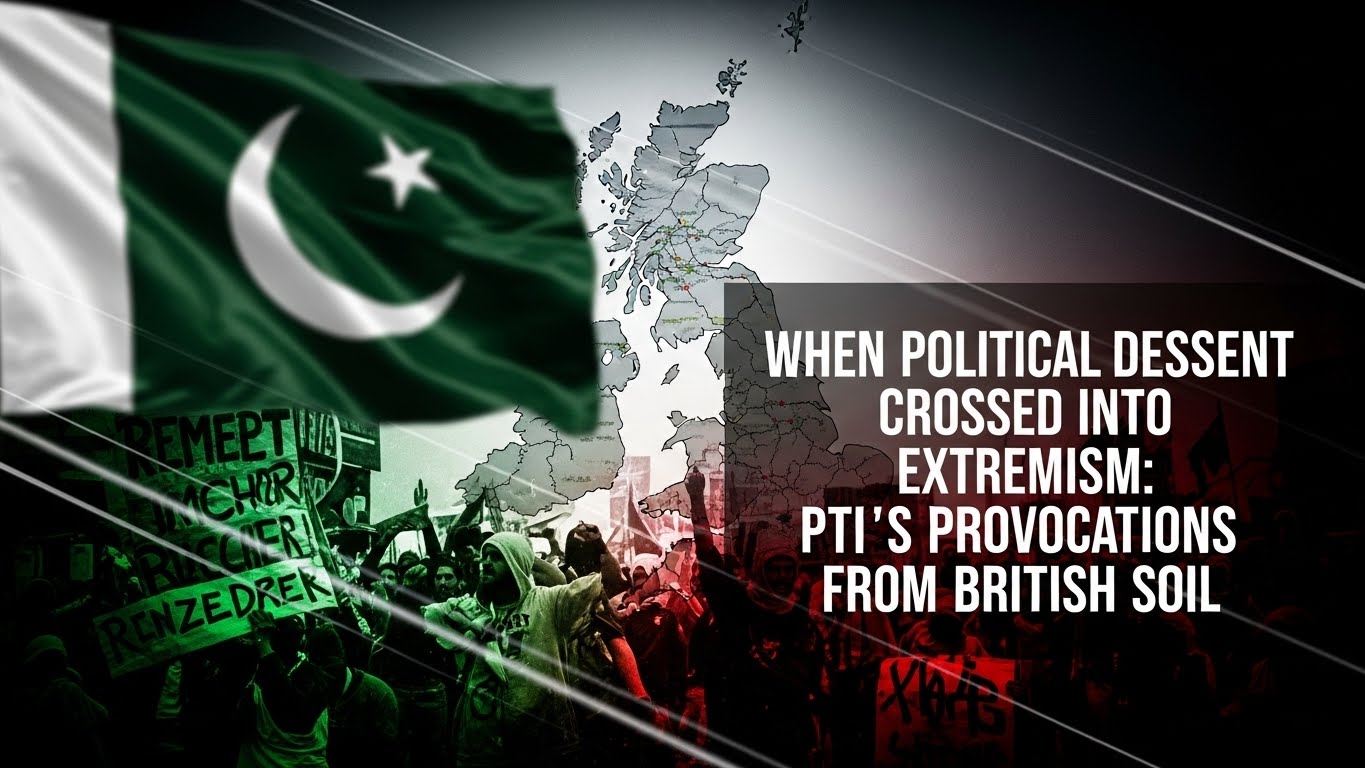
In recent years, Pakistan has faced not only conventional security challenges but also a more insidious threat: the externalization of political agitation that deliberately blurs the line between dissent and extremism. The latest episode involving Pakistan Tehreek-e-Insaf’s (PTI) UK chapter marks a dangerous escalation, one that raises serious questions about political responsibility, international law, and the misuse of foreign soil for incitement against a sovereign state.
For an extended period, fugitive digital agitators and self-styled “activists” linked to PTI have exploited the permissive environment of social media platforms and overseas jurisdictions, particularly the United Kingdom, to disseminate anti-Pakistan and anti-military narratives. These campaigns have gone far beyond criticism of policy or governance. They have increasingly mirrored the language, symbolism, and tactics historically associated with extremist propaganda targeting state institutions, undermining civil-military cohesion, and eroding Pakistan’s international standing.
This troubling trend reached a critical inflection point on December 23, 2025, when a video circulated from the official X (formerly Twitter) account of PTI UK. In the footage, protesters were seen issuing explicit threats of assassination against Pakistan’s Field Marshal, including a chilling call for a car bomb attack. A female speaker in the video openly incited violence, invoking methods indistinguishable from terrorist rhetoric.
Such statements cannot be dismissed as emotional outbursts or political hyperbole. Under any credible legal or moral framework, publicly advocating targeted assassination through explosives constitutes direct incitement to terrorism. This is not protected speech. It is criminal conduct.
More alarming was the systematic amplification of this content by PTI-linked social media networks. Official and semi-official accounts shared and circulated the video, transforming an isolated provocation into a coordinated digital campaign. This deliberate amplification underscores intent and intent is central to both domestic and international counter-terrorism law.
From a legal standpoint, these actions stand in clear violation of United Nations Security Council Resolution 1373, which obligates all states to prevent and suppress incitement, financing, and support for terrorism. The UK itself is bound by its Counter-Terrorism Act 2006, which criminalizes encouragement and glorification of terrorism, including statements likely to be understood as inducement to violent acts.
Pakistan has rightly conveyed grave concern over the misuse of British territory for speeches that openly threaten violence against its senior military leadership. These concerns are not political posturing; they are grounded in international legal obligations and the universally accepted principle that no state may allow its territory to be used to endanger another.
The episode also exposes a stark contradiction at the heart of PTI’s political posture. While the party publicly claims to seek dialogue, reconciliation, and democratic norms, its overseas affiliates engage in rhetoric that directly undermines the Pakistani state and legitimizes violence. This duplicity erodes any residual credibility PTI seeks to maintain as a responsible political actor.
📄 POLICY WIRE WHITEPAPER PUBLISHED: PAKISTAN'S NATIONAL SECURITY POLICY PRIORITIES
👉 READ BY CLICKING HEREAccording to reliable sources, Pakistan has formally demanded that those involved be identified, investigated, and prosecuted under applicable UK law. This is neither extraordinary nor confrontational, it is a standard expectation between responsible states confronting cross-border extremism.
Ultimately, this incident is not merely about PTI. It is a test case for the international community, particularly the United Kingdom, on whether counter-terrorism commitments are applied consistently or selectively. Democracies are not weakened by enforcing the law against incitement; they are weakened when they tolerate it.
Pakistan’s current government and military leadership have demonstrated restraint, institutional maturity, and commitment to constitutional order during a period of significant internal and external pressure. That stability must not be undermined by political actors who, having failed within democratic and legal frameworks, resort to intimidation and extremist language abroad.
Political disagreement is legitimate. Incitement to murder is not. The international system and the credibility of counter-terrorism norms depends on recognizing that distinction and acting decisively upon it.
Author