

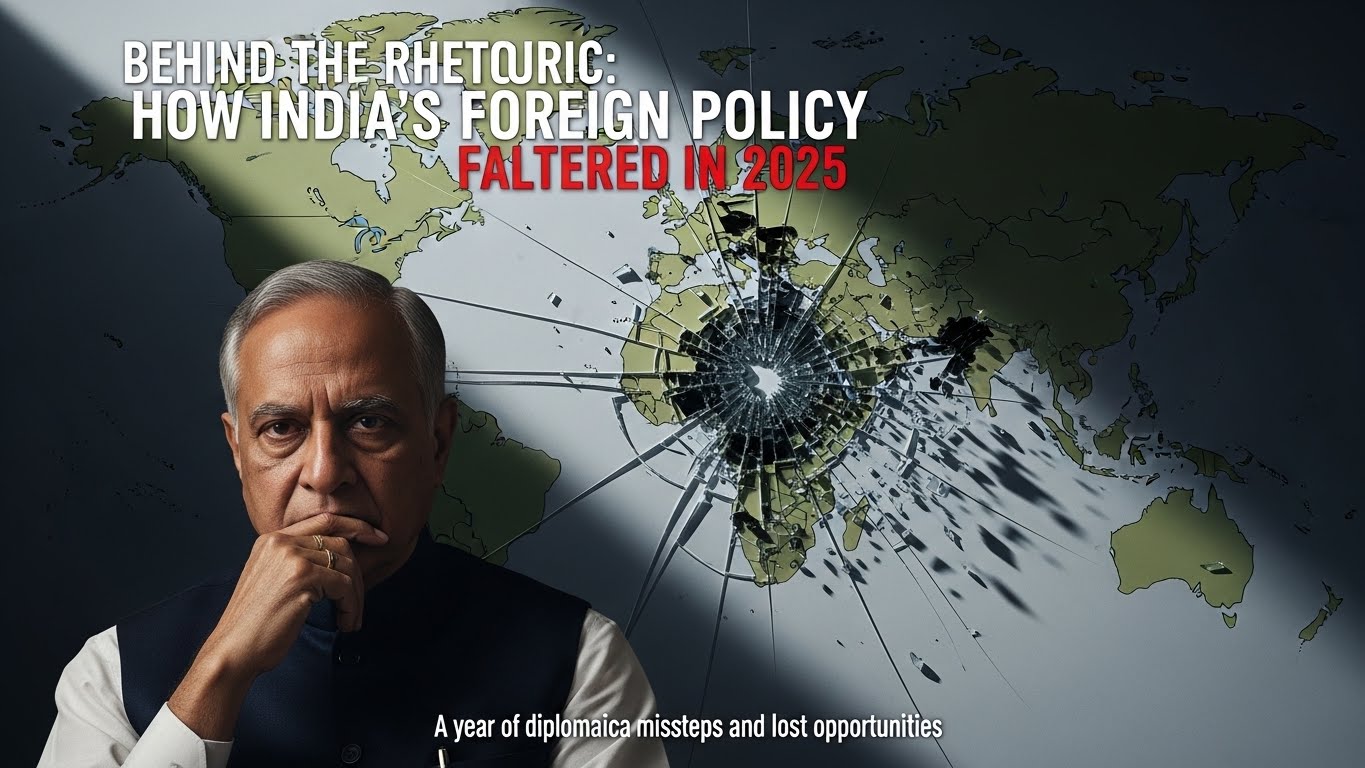
Behind the Rhetoric: How India’s Foreign Policy Faltered in 2025
The year 2025 was aggressively projected by New Delhi as proof of India’s arrival as a decisive global power. Instead, it became a year that stripped away the illusion. Beneath the choreography of...

The year 2025 was aggressively projected by New Delhi as proof of India’s arrival as a decisive global power. Instead, it became a year that stripped away the illusion. Beneath the choreography of summits, slogans, and self-congratulatory narratives, India’s foreign policy showed deep fractures. Diplomatic credibility eroded, economic leverage weakened, and strategic coherence collapsed. What emerged was not the portrait of a rising power, but that of a state overextended by ambition and constrained by its own contradictions.
The most damaging failures appeared in trade and economic diplomacy. Rather than repairing relations with Washington, India experienced its most punishing bilateral downturn in decades. The Trump administration’s imposition of a 25 percent reciprocal tariff on Indian exports struck directly at labor-intensive industries that employ millions. Apparel, gems and jewelry, and seafood processing sectors faced canceled contracts and declining orders. Export hubs in Gujarat, Maharashtra, and Tamil Nadu reported factory slowdowns and layoffs, exposing the fragility of India’s export-led growth claims.
These losses compounded earlier policy failures, including the withdrawal of India’s Generalized System of Preferences status, which had covered approximately 5.6 billion dollars in annual exports. By 2025, India was simultaneously hit by tariffs on goods and tightening U.S. immigration restrictions. This dual pressure weakened India’s two most critical foreign-exchange pillars. With annual remittances exceeding 100 billion dollars, reduced mobility for Indian professionals directly undermined household incomes, domestic consumption, and currency stability. The crisis was not accidental. It was the result of strategic miscalculation and diplomatic inertia.
Energy security exposed similar vulnerabilities. India’s increased reliance on discounted Russian crude, valued at roughly 52 billion dollars, was initially promoted as strategic foresight. That narrative collapsed when a 25 percent U.S. surcharge transformed these imports into a fiscal and diplomatic liability. Reducing Russian oil imports risked domestic fuel inflation. Continuing them invited sanctions exposure. New Delhi offered no clear policy direction, revealing that India’s energy planning remains dependent on external political tolerance rather than long-term resilience.
Trade diplomacy repeatedly failed to match its own promises. While agreements were concluded with the United Kingdom, Oman, and New Zealand, these deals carried limited strategic weight. Meanwhile, negotiations with the United States and the European Union, the world’s most consequential markets, remained unresolved despite repeated commitments to finalize them in 2025. The contrast between constant announcements and absent outcomes further eroded India’s credibility.
Relations with Russia and China highlighted the emptiness of symbolic engagement. Publicized displays of warmth at multilateral forums did not translate into substantive cooperation. The India-Russia summit concluded without meaningful progress in defense production, nuclear energy, or space collaboration, despite years of rhetoric about strategic depth. With China, limited confidence-building steps such as restoring flights and visas failed to address unresolved military tensions. The detention of an Indian passenger from Arunachal Pradesh in Shanghai demonstrated that political symbolism had done nothing to correct the underlying power imbalance.
At the global level, India’s strategic relevance diminished rather than expanded. The 2025 U.S. National Security Strategy confined India to a narrow functional role linked to Indo-Pacific logistics and critical minerals. Earlier language portraying India as a leading global power quietly disappeared. Simultaneous signals of potential U.S.–China accommodation intensified concerns that India is being sidelined in Asia’s evolving power balance.
India’s neighborhood reflected the sharpest decline. The April 2025 false flag in Pahalgam, deep inside Kashmir, punctured long-standing claims of restored deterrence. India’s military response failed to secure diplomatic backing. International reactions were limited to generic condemnations, while unresolved reports of aircraft losses damaged India’s narrative control and credibility.
Regional influence continued to shrink. Relations deteriorated with Türkiye and Azerbaijan, while the announcement of a Saudi-Pakistan mutual defense pact marked a serious strategic setback. Political instability in Bangladesh and youth-driven unrest in Nepal further revealed India’s declining ability to shape outcomes in its immediate vicinity. Engagement with the Taliban, despite ideological contradictions and security risks, reinforced perceptions of inconsistency rather than pragmatism.
What 2025 ultimately exposed was the collapse of India’s foreign-policy model. Highly publicized summits and rhetorical claims of moral leadership delivered no tangible gains in trade access, strategic security, or regional trust. The shift in slogans could not conceal a foreign policy driven by spectacle rather than substance.
The lesson is unavoidable. Ambition without alignment, projection without delivery, and symbolism without substance do not produce leadership. They accelerate decline. India’s foreign policy is no longer constrained primarily by external hostility, but by internal misjudgment and strategic incoherence. Without a fundamental course correction, India’s claim to global power status will remain not only unfulfilled, but increasingly indefensible.
Author