


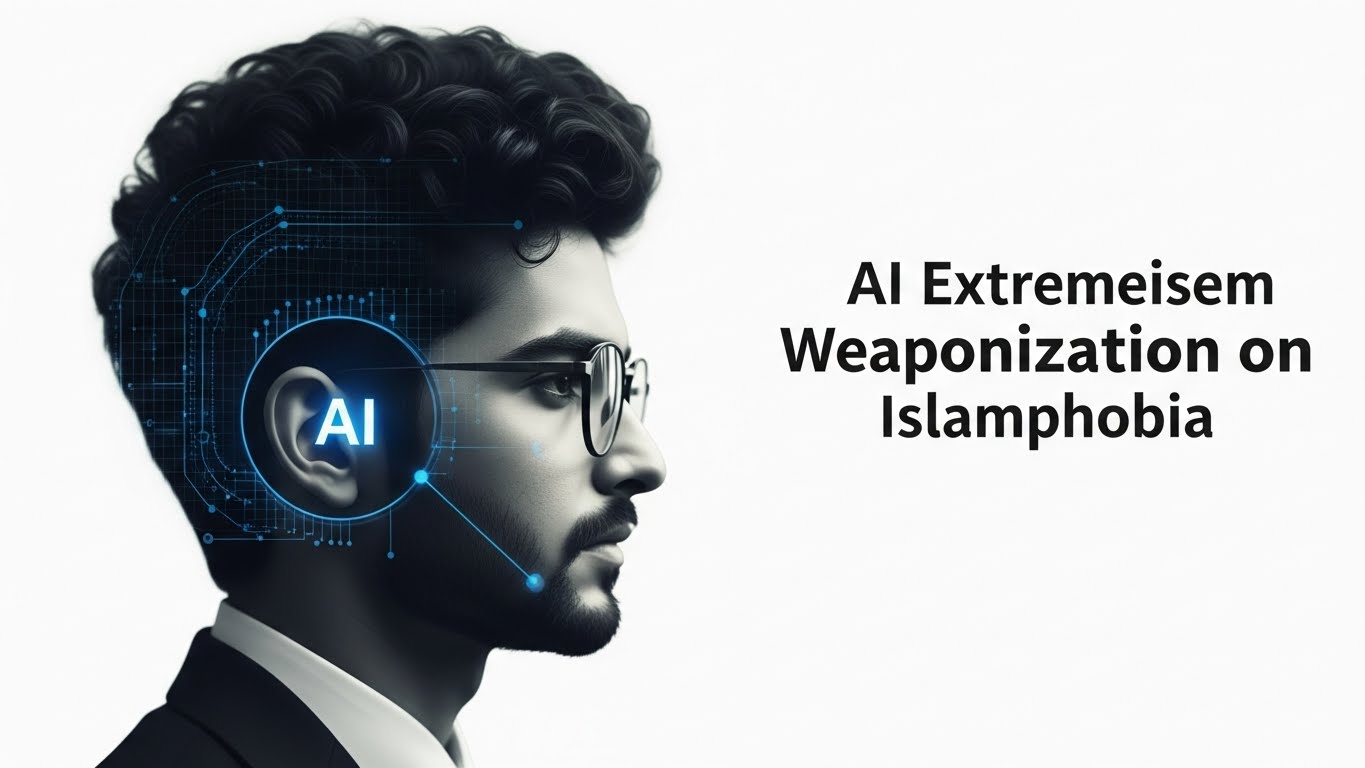
AI, Extremism, and the Weaponization of Hate: Islamophobia in India
Introduction: When Technology Fuels Hate We live in an era where technology shapes nearly every aspect of life. Artificial intelligence, often celebrated for efficiency and innovation, is...

Introduction: When Technology Fuels Hate
We live in an era where technology shapes nearly every aspect of life. Artificial intelligence, often celebrated for efficiency and innovation, is increasingly being weaponized to spread hatred. A recent U.S.-based study highlights a disturbing trend: India now leads the world in AI-generated Islamophobic content. This is not accidental. AI tools are being deliberately used to manipulate narratives, inflame tensions, and deepen divisions between communities.
The Study: Hate at Scale
The American research analyzed millions of social media posts, AI-generated memes, and automated commentary produced over the past year. Its findings were stark. Much of today’s Islamophobia is no longer organic or spontaneous; instead, it is systematically engineered using AI.
These tools generate text, images, and even deepfake videos designed to provoke anger, reinforce stereotypes, and delegitimize Muslim communities. India ranked highest in the production and circulation of such content. Analysts attribute this to a convergence of political ideology, rapid technological adoption, and the rise of Hindu nationalist sentiment.
AI functions as a force multiplier for extremist movements, allowing a small number of actors to reach millions almost instantly, often without accountability or traceability.
From Digital Hate to Real-World Violence
AI-driven Islamophobia does not remain confined to online spaces. It spills into the real world, resulting in harassment, discrimination, and violence.
A striking example occurred during a public awards ceremony in India, where a BJP supporter, Natesh Kumar, forcibly removed the niqab of a Muslim woman as she accepted her award. The incident was recorded and circulated widely online. Many observers recognized it as a calculated provocation aimed at energizing hardline Hindutva supporters and normalizing public intimidation of religious minorities.
Experts warn that AI-generated hate content conditions audiences to see harassment as justified or routine. When real-world incidents occur, they are recycled online as supposed “proof,” reinforcing extremist beliefs. This feedback loop allows digital propaganda and physical intimidation to continuously reinforce one another.
Hindutva and the Political Context
AI-driven Islamophobia in India cannot be separated from its political environment. The Hindutva movement, rooted in exclusionary nationalism, has aggressively adopted digital platforms to mobilize supporters and marginalize minorities.
AI amplifies these efforts by pushing tailored narratives into spaces traditional media never reached. Bias no longer appears only in news headlines; it quietly infiltrates everyday conversations, social feeds, and community discourse.
Figures like Natesh Kumar sit at the intersection of online propaganda and offline action. Their behavior illustrates how digital hate campaigns translate into visible acts of intimidation, blurring the line between virtual extremism and public life.
The Role of AI in Modern Extremism
AI is no longer a passive tool; it is central to modern extremist strategies. Unlike traditional propaganda, AI can:
Produce massive volumes of content rapidly
Customize messages for specific audiences
Evade content moderation systems
Create an illusion of mass consensus
Memes, fake videos, and automated posts can overwhelm social media platforms in minutes, making extremist views appear mainstream.
Researchers warn that without intervention, AI will increasingly be used to inflame communal tensions, influence elections, and rationalize violence. Its anonymity and speed make it particularly dangerous.
Recommendations and Global Implications
The U.S. study calls for a multi-layered response to AI-driven Islamophobia:
Stronger detection systems on digital platforms
Enforceable legal frameworks to hold perpetrators accountable
Public awareness campaigns to improve digital literacy and resistance to manipulation
The issue is not confined to India. AI-powered propaganda crosses borders effortlessly, influencing public opinion and social stability worldwide. Policymakers, technology companies, and international watchdogs must understand how such hate is produced, normalized, and weaponized if democratic values are to be preserved.
A Warning from History
History offers a familiar lesson: political actors have long exploited fear and identity to consolidate power. AI has merely accelerated the process. Outrage can now be manufactured at scale, turning isolated incidents into viral flashpoints.
Acts such as forcibly removing religious clothing in public are not isolated events; they are part of a broader pattern in which hatred is constructed, justified, and celebrated through coordinated digital ecosystems.
Conclusion: Technology, Ideology, and Responsibility
AI-driven Islamophobia in India is not simply a technological issue—it is a societal warning. Technology itself is neutral, but when placed in the hands of extremists, it can rapidly destabilize social cohesion.
The case of Natesh Kumar demonstrates how online hatred inevitably manifests offline. Digital bigotry spills into physical spaces, reinforcing cycles of fear, exclusion, and intimidation.
There is no single solution. Addressing this challenge requires:
Robust technological safeguards
Genuine political accountability
Stronger legal protections
An informed and vigilant public
AI and extremism together magnify prejudice, turning hate into coordinated action. Ignoring this threat risks far more than social media chaos—it endangers pluralism, democracy, and social peace itself. India, and the world, cannot afford indifference.
Author