


Introduction: A Necessary Line on National Security
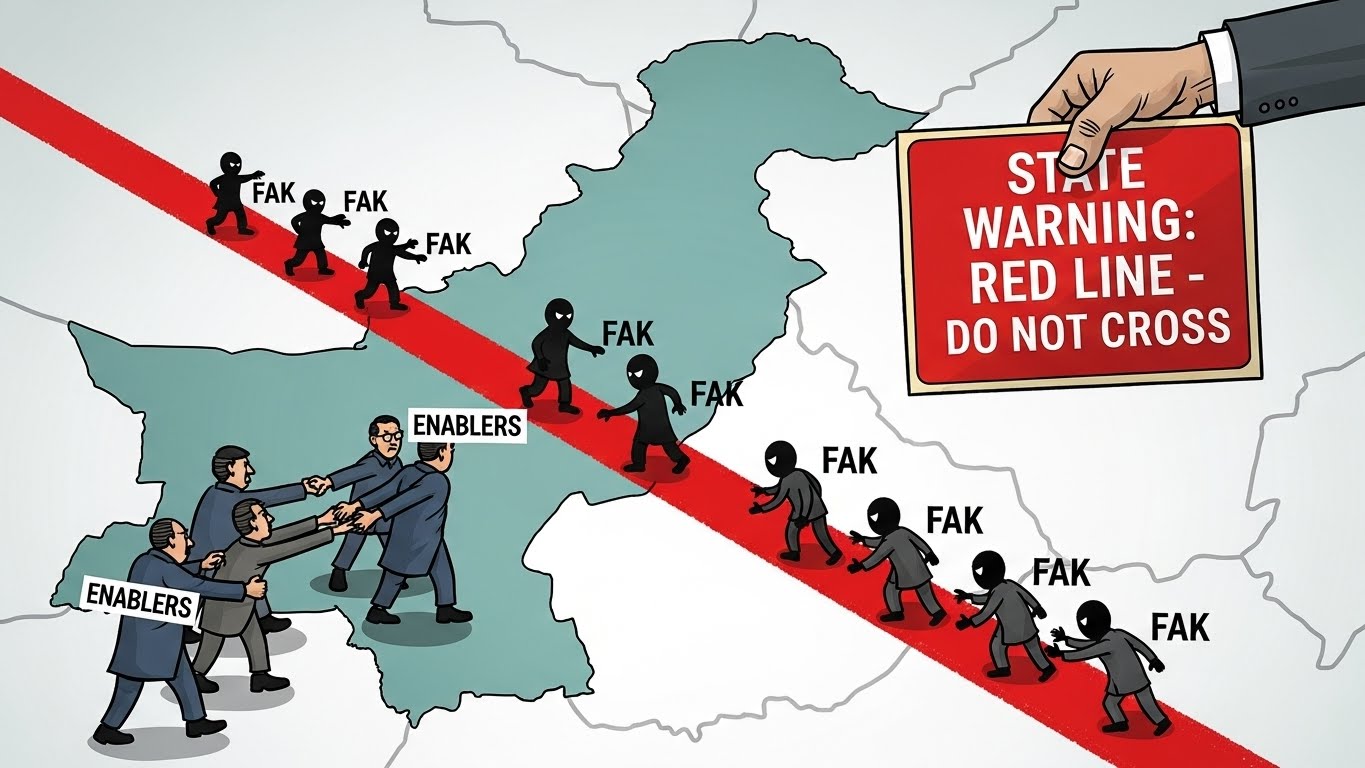
Pakistan has once again drawn a clear and necessary red line on national security. Speaking at the National Ulema Conference in Islamabad on December 10, Chief of Army Staff Field Marshal Asim Munir delivered a message that was both strategic and unequivocal: no threat to Pakistan’s sovereignty will be tolerated, and Fitnah-al-Khawarij (FAK) will be confronted as the existential danger it represents.
Among the most consequential assertions was the disclosure that approximately 70 percent of FAK fighters are Afghan nationals. This statement cuts through years of ambiguity surrounding the group’s composition, command structure, and external sanctuaries. It reinforces what Pakistan’s security institutions have long maintained: FAK is not merely a domestic militant outfit, but a transnational terrorist enterprise operating with cross-border depth, ideological cover, and logistical support.
This reality fundamentally changes how the threat must be understood—and how it must be countered.
FAK: A Direct Challenge to the Pakistani State
Field Marshal Asim Munir correctly framed the FAK not as a fringe extremist group, but as a direct challenge to the Pakistani state. The organization has consistently targeted civilians, security forces, infrastructure, and religious minorities, while falsely cloaking its violence in religious language.
By reaffirming that the authority to declare jihad rests solely with the state, not with individuals or armed groups, the COAS emphasized a core constitutional and Islamic principle. This distinction is critical. The FAK’s ideological narrative thrives on eroding state authority, presenting vigilantism and violence as religious obligation. Pakistan’s position dismantles this claim at its foundation.
The presence of religious scholars at the National Ulema Conference further strengthened this stance, aligning faith with constitutional order rather than extremist distortion.
The Afghan Dimension Cannot Be Ignored
Pakistan’s repeated calls on the Afghan Taliban to prevent their territory from being used against Pakistan are neither rhetorical nor new. They are grounded in an expanding body of evidence—much of it documented by regional and international investigative outlets—showing that FAK leadership and fighters operate freely from within Afghanistan.
Investigations indicate that senior FAK commanders, including Noor Wali Mehsud and Hafiz Gul Bahadur, move between Kabul, Kunar, Khost, Paktia, and Paktika, while maintaining operational links with Pakistan’s former tribal districts. Reports that Afghan Taliban fighters have joined FAK factions further complicate an already volatile security environment.
Against this backdrop, the COAS’s warning that Kabul must choose between Pakistan and the FAK is neither aggressive nor unreasonable. It is a diplomatic articulation of a basic security principle: no sovereign state can tolerate armed groups using a neighboring country as a rear base for violence.
Restoring the Writ of the State
Pakistan’s insistence on restoring the writ of the state across all territories is both legitimate and overdue. Over the past two decades, the country has paid a staggering price for terrorism—tens of thousands of lives lost, economic damage running into billions of dollars, and enduring social trauma.
Today’s posture reflects institutional learning. There is no appetite for ambiguity, appeasement, or selective tolerance. The military, in coordination with civilian law enforcement agencies, has made clear that both conventional and unconventional threats will be met with full preparedness.
This clarity is particularly vital at a time when Pakistan faces simultaneous pressures on both its eastern and western borders. Modernizing defensive capabilities is not an act of militarism; it is a strategic necessity shaped by geography, geopolitics, and the evolving nature of warfare.
The Role of the Current Government
The alignment between Pakistan’s civilian leadership and its military institutions represents a key strength of the current moment. National security policy cannot function in silos. Coherence between diplomatic messaging and operational readiness sends a unified signal—both domestically and internationally—that Pakistan’s core institutions are aligned.
This unity is essential not only for deterrence, but for internal stability. A fragmented state invites exploitation; a cohesive one denies it.
A Message Beyond Pakistan
Field Marshal Asim Munir’s remarks were not directed solely at the FAK. They were also a message to regional stakeholders and the international community. Pakistan is asserting its right to self-defense within the framework of international law and regional stability.
If terrorist groups are allowed to operate with impunity across borders, the consequences will not remain confined to Pakistan. Extremism does not respect boundaries; it spreads, adapts, and destabilizes entire regions.
Conclusion: Sovereignty Is Non-Negotiable
Pakistan’s message is ultimately simple and firm: sovereignty is non-negotiable, and violence masquerading as ideology will not be tolerated. The FAK’s foreign composition, reliance on Afghan sanctuaries, and rejection of state authority place it squarely outside any acceptable political or religious framework.
By confronting this reality head-on, Pakistan’s military and government are not escalating conflict—they are closing a dangerous chapter of denial. In doing so, they reaffirm a foundational principle of any functioning nation-state: peace is secured not by surrendering authority to armed groups, but by enforcing the rule of law, defending borders, and standing firm against terrorism in all its forms.
Author