


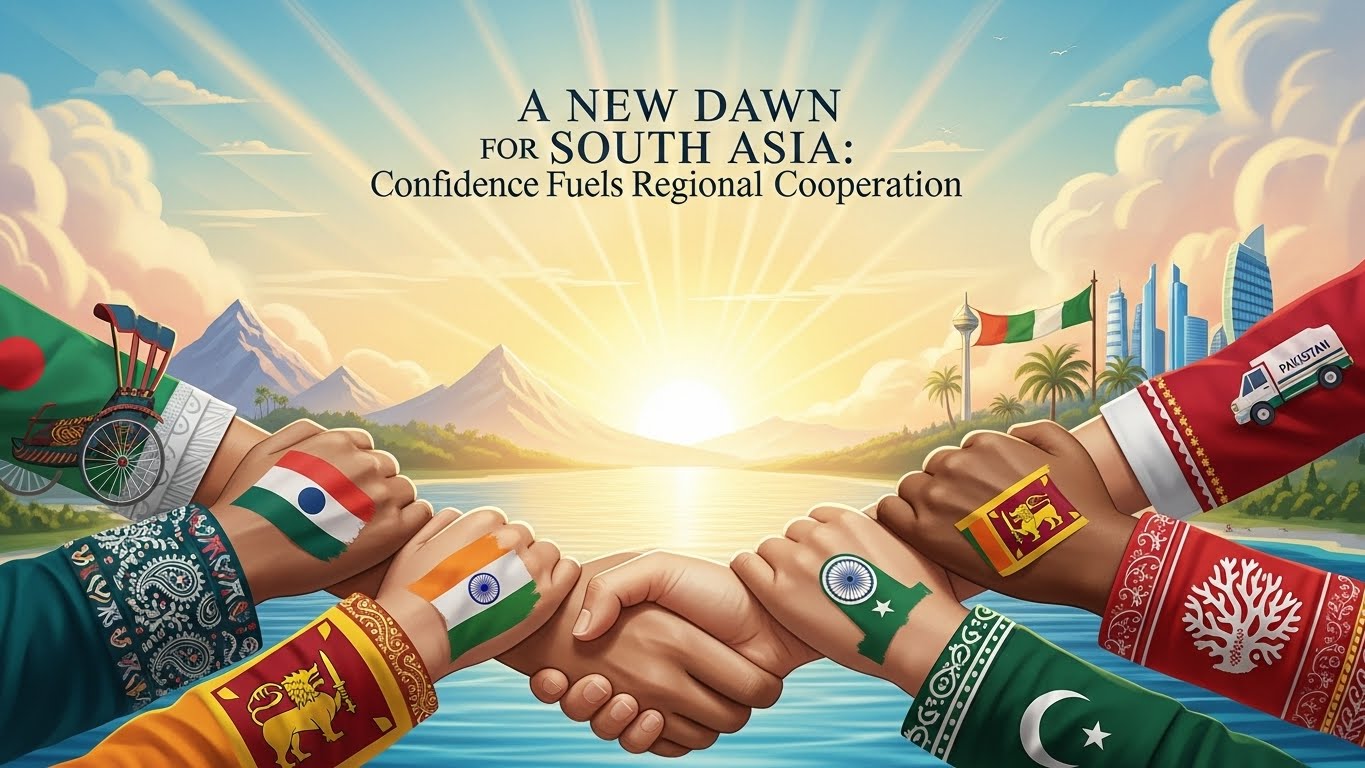
A New Dawn for South Asia: Confidence Fuels Regional Cooperation
In the context of South Asia’s complex geopolitical landscape, Pakistan’s recent rise in confidence offers a promising new chapter for regional cooperation. This shift in perspective was...

In the context of South Asia’s complex geopolitical landscape, Pakistan’s recent rise in confidence offers a promising new chapter for regional cooperation. This shift in perspective was clearly outlined by Ishaq Dar, Pakistan’s deputy prime minister and foreign minister, during the Islamabad Conclave earlier this month. Dar’s call for rethinking how South Asia approaches key issues like security, trade, climate change, and connectivity signals a bold new vision for the region, one that moves beyond old rivalries to embrace practical cooperation and economic integration.
This optimistic outlook for South Asia stems from Pakistan’s growing political stability and its proactive foreign policy approach. Pakistan’s leadership has navigated a path that has led to a clearer, more stable political environment. The recent political developments in Pakistan, including the shift in power and the formation of a new government, have helped create a more predictable policy landscape. This new stability has empowered the state to make decisions that prioritize long-term national stability and regional cooperation, rather than disruption or volatility.
On the economic front, Pakistan has made significant strides. The country’s economy has surpassed the US$400 billion mark, with a notable increase in its nominal GDP to around US$411 billion for this financial year. Inflation has decreased to an historic low of just 0.3 percent, which marks a dramatic shift from previous years of economic instability. These improvements reflect the government’s effective economic management and its commitment to stabilizing the economy. Moreover, Pakistan has made strides in fiscal discipline, achieving a primary surplus of 1.3 percent of GDP in 2025. These advancements in fiscal and economic stability provide a strong foundation for Pakistan to contribute to regional prosperity and security.
Pakistan’s foreign policy has also undergone a significant recalibration. Although the country has faced cross border conflict, such as the war with India, Pakistan’s response highlighted its ability to safeguard its interests while maintaining regional peace. The conflict’s resolution showcased Pakistan’s capability to deter aggression without escalating tensions, signaling its growing confidence on the international stage. In his speech at the Islamabad Conclave, Dar emphasized that Pakistan’s foreign policy now aims for greater regional multilateral engagement and economic interdependence, moving away from the historically reactive, security-driven approach to a more proactive strategy of collaboration.
This shift marks a significant transformation in Pakistan’s regional role, with a focus on multilateralism, economic connectivity, and disaster management. Dar’s remarks about the importance of building cooperative frameworks for trade, climate adaptation, and disaster response highlight the region’s shared challenges, and Pakistan’s readiness to lead these efforts. Pakistan’s renewed commitment to regional economic integration could foster stronger ties between South Asian nations, ensuring collective progress in the face of shared challenges.
The potential for cooperation within South Asia is immense, particularly in areas such as infrastructure development, trade, and climate action. Pakistan’s strategic geographic position and growing economic resilience make it an essential player in fostering these connections. Strengthening regional trade and connectivity can lead to greater economic self-sufficiency for South Asia, reducing the region’s dependence on external powers and reinforcing its position in the global economy.
Additionally, addressing climate change is a critical area where South Asian countries can collaborate, given their shared exposure to the impacts of extreme weather events and rising sea levels. Pakistan’s call for disaster response mechanisms and collaborative climate action shows its understanding of the urgency of these issues. By taking a leadership role in these efforts, Pakistan can help catalyze regional cooperation that benefits all South Asian nations, ensuring greater stability and resilience in the face of global challenges.
📄 POLICY WIRE WHITEPAPER PUBLISHED: PAKISTAN'S NATIONAL SECURITY POLICY PRIORITIES
👉 READ BY CLICKING HEREThe road to a cooperative South Asia will require sustained effort, long-term vision, and commitment from all countries in the region. While challenges remain, including overcoming historical tensions and ensuring the equitable distribution of benefits from cooperation, the potential rewards are worth the effort. Pakistan, with its increasing political stability, robust economic growth, and renewed foreign policy outlook, is poised to play a leading role in this transformation.
In conclusion, Pakistan’s rising confidence, supported by political and economic stability, can serve as a powerful force in shaping a cooperative South Asia. Through proactive engagement on issues like trade, security, climate change, and connectivity, Pakistan has the opportunity to steer the region toward greater cooperation and shared prosperity. The vision outlined by Ishaq Dar at the Islamabad Conclave offers a clear path forward, one that prioritizes regional integration, mutual growth, and collective security.
Because after all:
“A united tomorrow begins with the courage to build bridges today.”
Author