

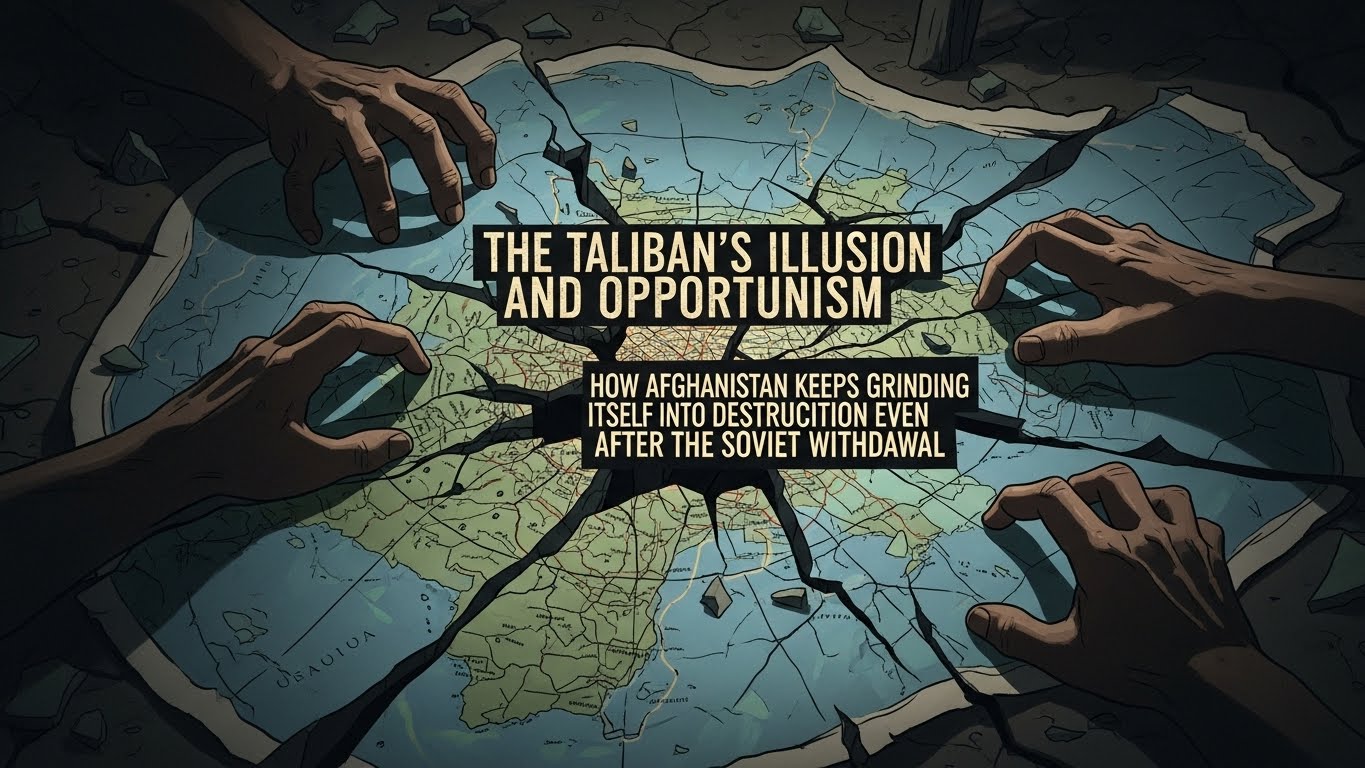
The Taliban’s Illusion and Opportunism: How Afghanistan Keeps Grinding Itself into Destruction Even After the Soviet Withdrawal
When the last Soviet convoy rolled out of Afghanistan in February 1989, the country seemed poised for a new chapter. The 10‑year Soviet‑Afghan war had left a shattered landscape, a devastated economy...

When the last Soviet convoy rolled out of Afghanistan in February 1989, the country seemed poised for a new chapter. The 10‑year Soviet‑Afghan war had left a shattered landscape, a devastated economy and a fragmented polity, but it also offered a rare moment of hope: the superpower that had propped up a socialist government was gone, and the Afghan people could finally chart their own destiny.
Instead, the power vacuum was seized by a movement that has turned “reconstruction” into a recurring nightmare. The Taliban, a group that first emerged in the early 1990s from the chaos of the mujahideen war, has cultivated an illusion of control while practising a ruthless form of opportunism. Their strategy was based on projecting an image of religious rectitude and self-reliance, then systematically sabotaging any development that threatens their grip. Now it has become a destructive illusion that outlives the Cold War era. Taliban’s illusion and opportunism have kept Afghanistan grinding itself into ruin long after the Soviet troops left.
From Soviet Occupation to Civil War, The Soviet‑Afghan War (1979‑1989)
The Soviet Union intervened in December 1979 to prop up the communist government of the People’s Democratic Party of Afghanistan (PDPA). Over the next decade, an estimated 15,000 Soviet troops and up to 2 million Afghans (combatants and civilians) lost their lives. The war devastated the country’s infrastructure: roads, bridges, schools and hospitals were repeatedly bombed; agricultural fields were scorched; and the already fragile state apparatus collapsed.
The Power Vacuum and Rise of Taliban (1989‑1996)
The Soviet withdrawal left a power vacuum that the mujahideen, an umbrella term for various Islamist factions filled with a patchwork of local militias. Rival warlords fought for control of Kabul, turning the capital into a battlefield. By 1992, a loose coalition of mujahideen leaders was declared, but fighting continued, creating the perfect breeding ground for a new, more radical force.
The Taliban (“students”) emerged from religious schools in Kandahar, promising security, order and the implementation of Sharia law. Within two years they captured Kabul (1996) and by 1998 controlled roughly 90 % of Afghan territory. Their early rule was marked by brutal enforcement of a strict moral code: public executions, the destruction of the Bamiyan Buddhas (2001), and the systematic exclusion of women from public life.
The Illusion of Power and Myth of Self Reliance: How the Taliban Projects Legitimacy
Since their return to power in August 2021, the Taliban have repeatedly described themselves as the “Islamic Emirate of Afghanistan,” a phrase that evokes a sense of timeless, divine authority. In speeches, senior leaders such as Hibatullah Akhundzada invoke religious duty to “protect the land and its people.” The narrative is carefully crafted for domestic consumption: the Taliban present themselves as the only force capable of restoring stability after decades of war. A cornerstone of the Taliban’s propaganda is the claim that Afghanistan will become self‑sufficient, without foreign aid. Yet the reality on the ground tells a different story. Taliban are reportedly getting support from the US to run the affairs.
Opportunistic Governance: The Mechanics of Destruction
Taliban would announce grandiose schemes, secure external funding, then either abandon them or demand extortion “fees” in the name of security from investors/firms, leaving the work unfinished and the population disillusioned. After creating issues with neighbours, opportunism again played its role and Taliban went to New Delhi for trade ignoring the geopolitical compulsions of Afghanistan being a landlocked country.
After the Doha accord, which paved the way for the exit of US Forces from Afghanistan, the world expected that a full stop to narcotics production would be done by the Taliban as was done by Mullah Omar after the Taliban took over Kabul in the past, but Afghanistan remains the world’s largest producer of opium. Opium cultivation increased by 12 % in 2023 and dropped in 2025 with the main factor being crop failure. Still, Taliban earnings are based on the crop which is used to fund its military apparatus and to pay salaries to its fighters, creating a perverse incentive to preserve the drug trade rather than diversify the economy.
Instead of stabilizing the country after withdrawal of Soviet and then US Forces, Taliban entered into skirmishes with Iran and neighboring countries, providing safe havens to groups carrying out destruction in Pakistan—the very country which helped Afghanistan, especially the Taliban, against the demands of the world with hope that they would bring stability and prosperity, which was not possible with tribes and warlords in control.
Suppression of Civil Society
Freedom of expression, women’s rights and independent NGOs have been systematically curtailed. The Taliban’s Ministry for the Propagation of Virtue and the Prevention of Vice has issued decrees banning female education beyond the sixth grade, restricting women from working in most sectors, and requiring NGOs to obtain a “religious clearance” before operating. The result is a crippled civil society that cannot organize opposition or channel international assistance efficiently.
Humanitarian Crisis: The Human Face of the Taliban’s Opportunism
After gaining power in Kabul, Taliban resorted to military rhetoric and started conflicts with neighbors with the notion that if two superpowers cannot survive, then anyone else is a piece of cake. Taliban neither produced a conducive environment for the economy nor peace for its population. The UNHCR reports that over 5 million Afghans are internally displaced, with another 2 million living as refugees in neighboring Iran and Pakistan. The majority of displaced persons are women and children, who face heightened risks of gender‑based violence and exploitation. Taliban support to terrorist groups in neighboring countries is attributed to the presence of a large number of refugees.
📄 POLICY WIRE WHITEPAPER PUBLISHED: PAKISTAN'S NATIONAL SECURITY POLICY PRIORITIES
👉 READ BY CLICKING HERERegional Implications: A Domino Effect
Pakistan shares a 2,430‑km border with Afghanistan (the Durand Line). The Taliban’s continued support for the Tehreek‑e‑Taliban Pakistan (TTP) has forced Islamabad to adopt a hard-line stance, leading to repeated closures of the Torkham and Chaman border crossings. According to the Pakistan Ministry of Commerce, these closures cost Afghanistan an estimated US $2.5 million per day in lost trade, while also hurting Pakistani traders who rely on Afghan transit routes. Instead of improving relations with Islamabad, the Taliban Regime in Kabul looked towards New Delhi, ignoring the ground realities and trying to secure unrealistic trade deals.
Iran, already grappling with severe drought, has warned that the Taliban’s upstream water diversion projects on the Helmand River threaten the livelihoods of millions of Iranians in the Sistan‑Baluchestan region. In 2023, Tehran expelled over 300,000 Afghan refugees, citing security and resource pressures.
China’s interests in Afghanistan are primarily economic (the Belt and Road Initiative) and security‑related (preventing the spread of Uyghur militancy). Beijing has maintained a low-profile engagement, offering limited humanitarian aid while pressing the Taliban to curb extremist groups. However, Chinese projects remain stalled due to security concerns and the Taliban’s opaque fiscal demands.
The Taliban’s presence along the Amu Darya and Panj rivers worries Uzbekistan, Turkmenistan and Tajikistan, which fear increased drug trafficking and the spill-over of militant activity. In 2024, Tajik border forces exchanged fire with Taliban patrols near the Panj River after the Taliban attempted to divert water for a local irrigation project, prompting a brief diplomatic standoff.
Conclusion
The Soviet withdrawal in 1989 removed a foreign occupier but did not fill the void of governance in Afghanistan. The Taliban’s rise, their subsequent return to power in 2021, and their continued reliance on illusion and opportunism have turned the country into a grinding machine of destruction, one that perpetuates poverty, fuels humanitarian catastrophe and destabilises the wider region.
The illusion of power projected through grandiose promises, rhetoric and symbolic projects masks a reality of fiscal insolvency, systematic repression and reliance on illicit economies. Opportunistic governance, manifested in forced taxation, the drug trade, and the deliberate sabotage of development, ensures that any progress is short‑lived and reversible.
Breaking this cycle will require more than diplomatic statements. It demands a coordinated, conditional engagement strategy that ties tangible improvements in governance and human rights to the gradual easing of sanctions and the release of frozen assets. It also calls for sustained support for grassroots development, particularly in education and agriculture, and the establishment of equitable regional water agreements.
Only by confronting the Taliban’s illusion with concrete, verifiable actions and by empowering ordinary Afghans to rebuild their own communities can the grinding cycle of destruction be halted. The international community, regional neighbours and Afghan civil society all have roles to play, but the first step must be to stop rewarding opportunism and start rewarding genuine, accountable reconstruction.
Author