


Fact Check: Did Chaudhry Anwar-ul-Haq Admit the Delhi Red Fort Blast?
In another dramatic display of how fake news can fuel local animosity, a few Indian news outlets recently reported a video clip that had been edited and transliterated of former Azad Jammu &...

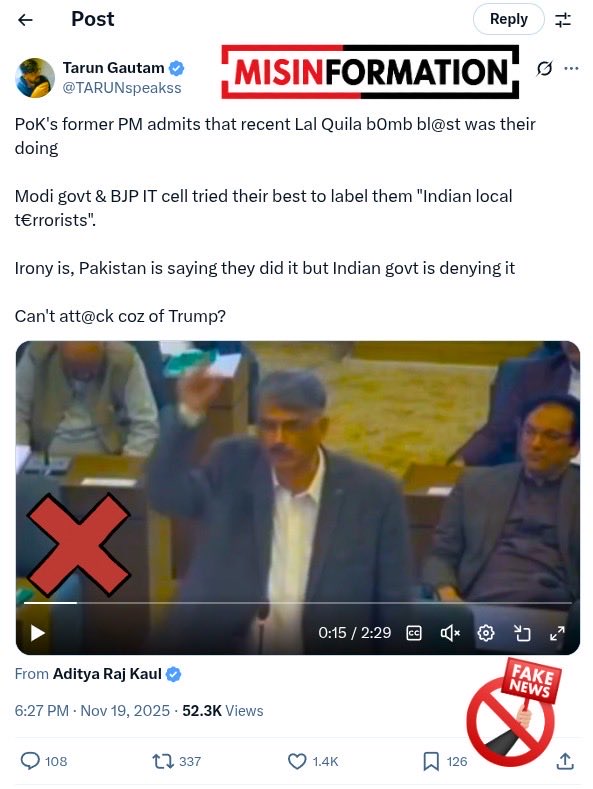
In another dramatic display of how fake news can fuel local animosity, a few Indian news outlets recently reported a video clip that had been edited and transliterated of former Azad Jammu & Kashmir (AJ&K) Prime Minister, Chaudhry Anwar-ul-Haq. These media outlets alleged falsely that he had acknowledged that the recent Red Fort/Delhi blast was planned by Pakistan. The doctored video quickly spread in the Indian television media and social sites, eliciting outrage, political commentary and widespread speculation. But upon closer scrutiny of the initial video and the situation, what emerges is quite a different narrative; one that outright shows a tendency of sensationalism and misrepresentation in some areas of the Indian media spectrum.
The Clipped Clip and the Claimed Clip.
The controversy had started with the aired short, selectively edited clip of Chaudhry Anwar-ul-Haq by the Indian channels. In the distorted version he allegedly said that Pakistan was behind the Red Fort attack and that India could not tell how many dead bodies there were. This was an outright misrepresentation of this image. Anwar-ul-Haq had in the original, unedited copy of his comments, been in fact making a critique of Indian media accounts and drawing attention to the manner in which Indian political parties tend to take advantage of a crisis to serve domestic purposes. This was implied in his commentary that Indian outlets are overstating or putting blame without thinking- not that Pakistan had anything to do with the blast. Cropping down the sentences around and adding a false translation, Indian channels transformed the condemnation of their own media into the alleged Pakistani involvement.
Mistranslation as the Disinformation tool.
Another most outrageous part of this episode was the deliberate mistranslation of Urdu phrases. The message which was displayed on Indian screens was quite different as compared to what was being said. For example:
- Rhetoric utterances concerning India’s inflated reporting were translated into literal admissions of the Pakistani culpability by Indian media.
- The term that was used to denounce Indian sensationalism- that Indian media tends to exaggerate the number of people killed- was perverted to: India could not count the dead bodies. This perversion is not an accident.
Rhetorical manipulation has turned into a common strategy to create controversy and solidify existing accounts, in particular, in the context of India-Pakistan relations, where sensationalism can be a widely used approach to gain audience. Mistranslation, in this instance, was used as a tactic to advance the story that the Red Fort blast was master headed by Pakistan, even after, there was no evidence supporting the claim that Pakistan had anything to do with the blast.
What Makes Such Disinformation So Viral.
The rate at which the clipped video went viral among the Indian media signal more issues that lie deeper in the system and influence how political news are reported in the area.
- Hyper ego nationalistic media rivalry: In the environment of dozens of 24/7 news stations that compete against each other in the rating war, dramatic headlines and banners of breaking news often overpower the aspect of accuracy. Sensational allegations, more so against Pakistan, often attract huge viewership.
- Securitization of the security incidents: Incidents of terror in India are quickly integrated into the political accounts. To ruling parties, there is the benefit of unifying by accusing Pakistan. To the opposition parties, it turns to be a weapon to criticize the security policies of the government. Such a manipulated video is a convenient tool in both dynamics.
- Emotion stories prevail over facts: The blast incident in Delhi/red fort was a very disturbing occurrence. Even disproven statements can sound persuasive in emotionally loaded situations even to audiences already preconditioned by years of partisan rhetoric.
- Influence on the general opinion and political debate: Although the false information was soon refuted by independent critics and reporters who understand the Urdu language, the damage was already partially inflicted. The clips spread faster than clarification and this is a classic example of misinformation overtaking truth.
- Influencing the Negative Public Opinion: Most viewers who did not know about the manipulation absorbed the fake news that a Pakistani leader confessed to the attack. This kind of disinformation deepens the hostility and increases the lack of trust between the two nuclear armed neighbors.
- Stoking Cross-border Tensions: Falsehoods particularly on security and terrorism may increase diplomatic strains. Even informal accounts are capable of powerfully impacting political anticipations, forming masses feeling, and compelling governments into aggressive adopting.
Position and Response of Pakistan
Pakistan did not own up the attack and it has formally denounced the violence. No Pakistani official has made any statement to put the blame on their country. The so-called confession is only possible because it was manipulated by the press. The real remarks of Chaudhry Anwar-ul-Haq were those defending Pakistan, not a condemnation. He pointed out the long history of Indian media publishing fake news regarding Pakistan, particularly when there is a crisis occurring. The viral clip, which was refuted, was generally known as one more piece of fake information.
Such episode is not a onetime misunderstanding; it is a pattern that has become well documented previously with Indian media spreading unsubstantiated or twisted rumors during periods of national security emergencies. Past examples include: Uri attack in 2016 Misreporting. Funky theatrics about Balakot airstrike victims. False news after different events in Kashmir. All these stories usually fail to stand on closer scrutiny by independent analysts but the impression on the masses is considerable.
The Importance of Accurate Reporting.
The bombing of the Red Fort/Delhi is a grave incident that requires responsible journalism. Using a tragedy to advance fake news only brings down responsibility and prevents real investigations.
The misinformation that Chaudhry Anwar-ul-Haq had confessed that Pakistan had been involved in the Red Fort/Delhi blast is a disturbing development: using misinformation as a political and media tool. Indian media were able to produce a narrative that was harmful, and whose foundation was not on the truth, through selective editing and mistranslation. Such practices are not only unethical but also unsafe in a region that is already bridled in conflict, mistrust and polarization among political parties. They misrepresent the general consciousness, create unwarranted tensions and may subtle the efforts made to establish diplomatic relations. It is a lesson to us all, in an age when truth telling is more in than ever, of the role the media must play in doing its job, not to inflame or mislead, but to clarify and distort not, and to report truth, not sensationalism.
Author