


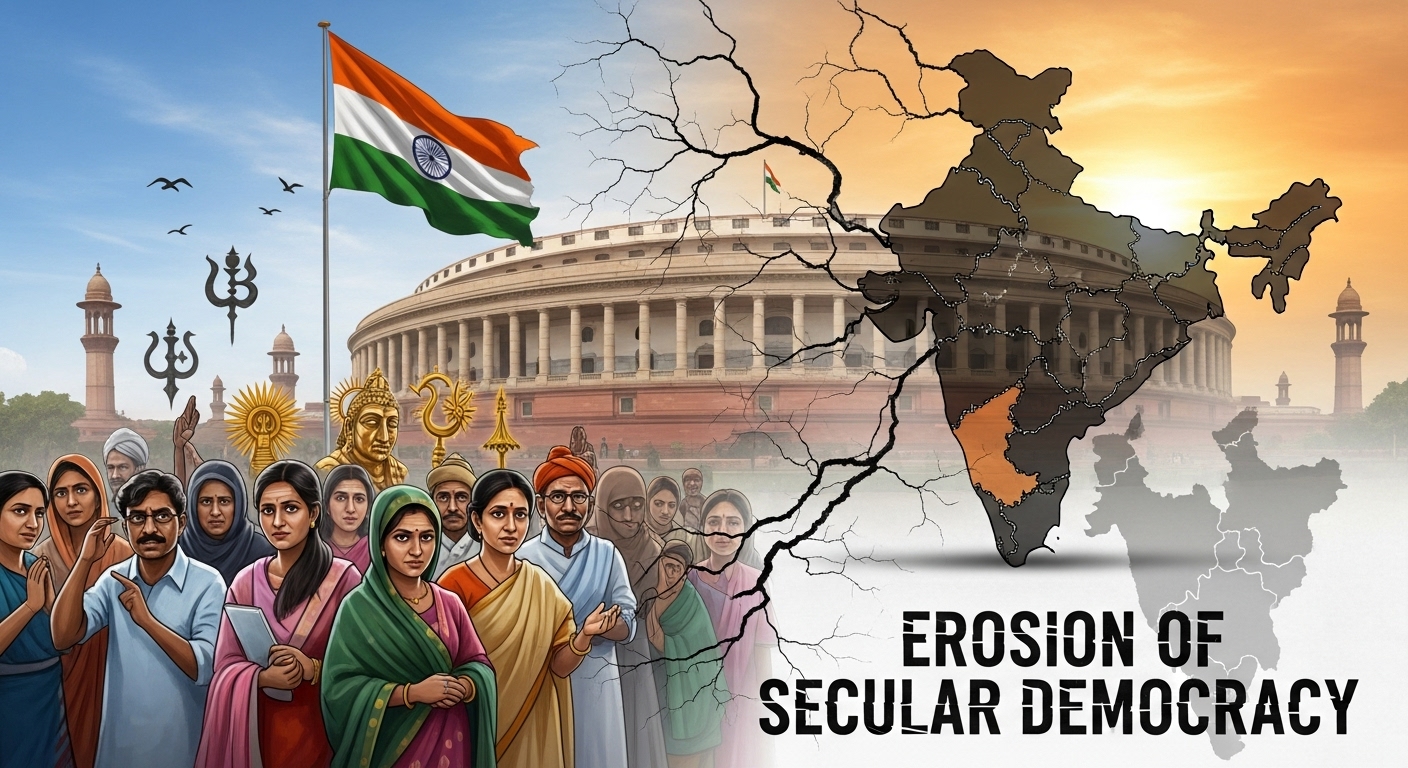
How Modi’s Mandate Accelerates the Erosion of Secular Democracy
When the results of Bihar’s election flashed across television screens, the celebrations inside the Bharatiya Janata Party (BJP) headquarters looked predictable, firecrackers, sweets, drums, and the...

When the results of Bihar’s election flashed across television screens, the celebrations inside the Bharatiya Janata Party (BJP) headquarters looked predictable, firecrackers, sweets, drums, and the triumphant chants that have become routine under Narendra Modi’s rule. Yet behind this spectacle of victory was a more troubling reality. Another state had slipped under the weight of Modi’s expanding political machinery, a machinery that thrives on polarization and the systematic weakening of India’s secular foundations.
For Modi’s supporters, the result was simply more evidence that he is the unchallenged face of Indian politics. But beyond the glow of the celebrations, a far more unsettling story was unfolding. Each electoral win under Modi does not merely strengthen a political party, it accelerates the ideological transformation of the republic. With every mandate, the India envisioned by its founders drifts further away, replaced by a majoritarian state where dissent is suspect and minorities feel increasingly excluded. What was once a crack in the democratic fabric has now widened into a clear and dangerous fault line.
A Republic Rewritten
There was a time when India wore its secular identity like a badge of honor. It was the rare post-colonial nation that refused to define itself by one religion. It promised equality to more than a billion citizens of hundreds of cultures and dozens of faiths. That promise, etched into the Constitution, was not just an ideal but a guiding star.
Today, that star is dim.
The shift did not begin in Bihar, nor will it end there. It began when the Citizenship Amendment Act (CAA) introduced religion into the question of citizenship for the first time in independent India. Muslims, nearly 200 million people, were deliberately excluded. When protests erupted across the country, more than 30 young protesters were killed and thousands detained. Students who carried books were met with batons. For the first time, a generation felt that dissent itself had become suspicious.
As the smoke from the streets cleared, it became evident that CAA was not just another policy. It was a declaration, subtle in language, bold in intent, that India had stepped away from the foundation on which it once stood.
Numbers That Tell a Different Story
While the political narrative was being shaped through speeches and slogans, the ground reality was being recorded in quieter places, through reports, surveys, and troubling statistics.
A 2024 study by India Hate Lab reported 1,165 verified hate-speech incidents, a staggering 74% rise from the previous year. These were not rogue remarks made in obscure corners; they were public events, rallies, digital campaigns, and televised slurs. Nearly 80% of them occurred in BJP-ruled states, and two-thirds targeted Muslims.
The violence born from such hatred is equally chilling. Between 2015 and 2022, India documented at least 86 lynchings and over 700 injuries related to cow vigilantism. 97% of these attacks took place after Modi first assumed office in 2014. Videos of mobs beating unarmed men, many of them Muslim or Dalit, circulated freely online as if they were scenes from a parallel justice system.
These are not mere numbers. They are a reflection of a society being reshaped through fear and hostility, where minorities live with the knowledge that the wrong rumor, the wrong street, or even the wrong meal can cost them their life.
Institutions Under Pressure
For a long time, India’s institutions served as buffers, imperfect, yes, but resilient. Courts, media, universities, and civil services offered at least some protection against political excess. But recent years have shown a steady erosion of this independence.
The Status of Policing in India Report revealed that nearly two-thirds of police personnel believe Muslims are “naturally prone to crime.” Muslims reported the highest levels of fear of police across communities. When the police, a community’s first line of protection, see a religious minority as inherently suspect, that minority becomes vulnerable in ways that laws alone cannot remedy.
Meanwhile, digital platforms, instead of acting as neutral spaces, have become fertile ground for hate. A 2024 investigation found that Meta approved political ads containing violent anti-Muslim rhetoric even during election periods. On television, over 70% of prime-time debates were found to frame Muslims as threats, invaders, or outsiders. News studios, once loud defenders of democracy, often resemble arenas built to amplify hatred.
📄 POLICY WIRE WHITEPAPER PUBLISHED: PAKISTAN'S NATIONAL SECURITY POLICY PRIORITIES
👉 READ BY CLICKING HEREThis institutional tilt is not accidental. It mirrors the political climate in which challenging the ruling ideology comes with real consequences. Journalists face criminal cases. Activists face arrests. Students are labeled “anti-national.” The message is clear: resistance will be punished.
The Human Story Behind the Numbers
In villages, towns, and cities across India, these national trends take on human form. A Muslim family who has lived in a neighborhood for generations now instructs their children not to stay out late. A young Dalit man stops carrying leather tools because mobs have mistaken them for cow slaughter instruments. Interfaith couples abandon the idea of a civil marriage because vigilante groups track court records.
India’s pluralism was never perfect, but it was lived, through food, language, festivals, and friendships. Today, that everyday coexistence is becoming fragile. Suspicion is growing where trust once existed. People self-censor conversations that were once normal. Walls, visible and invisible, rise slowly between communities.
This is how a society changes: not just through laws, but through silence, fear, and the slow retreat of the human spirit.
Bihar’s Result: A Triumph or a Warning?
When the BJP’s alliance swept Bihar, political analysts framed it as a masterclass in strategy. But the deeper implications are far more unsettling. Each victory gives the ruling party more confidence to push forward its ideological agenda. Each triumph tells them that majoritarian politics works. Each success reinforces the belief that pluralism is expendable, collateral damage in the pursuit of a homogenous national identity.
And the opposition, fragmented and weary, seems unable to counter this momentum.
Modi stands today as the so-called most powerful Indian leader in decades. But his rise has cast a long shadow over the republic. As his political dominance grows, India’s secular identity weakens. The balance has tilted. And the consequences are already becoming visible.
A Future at Stake
Countries do not lose their character overnight. Democracies do not crumble in a single election. What happens instead is erosion, quiet, subtle, persistent. Secular India is not collapsing with a bang; it is fading with each hateful slogan, each discriminatory law, each violent mob, and each institutional surrender.
If this trajectory continues, historians may one day write that India did not abandon secularism, it simply outgrew it, or perhaps forgot why it mattered.
But for millions of Indians who believed in the pluralistic dream of the republic, the loss is deeply personal. It is the loss of a home that once belonged to everyone. And in the echo of every election victory, that loss becomes a little more permanent.
Author