
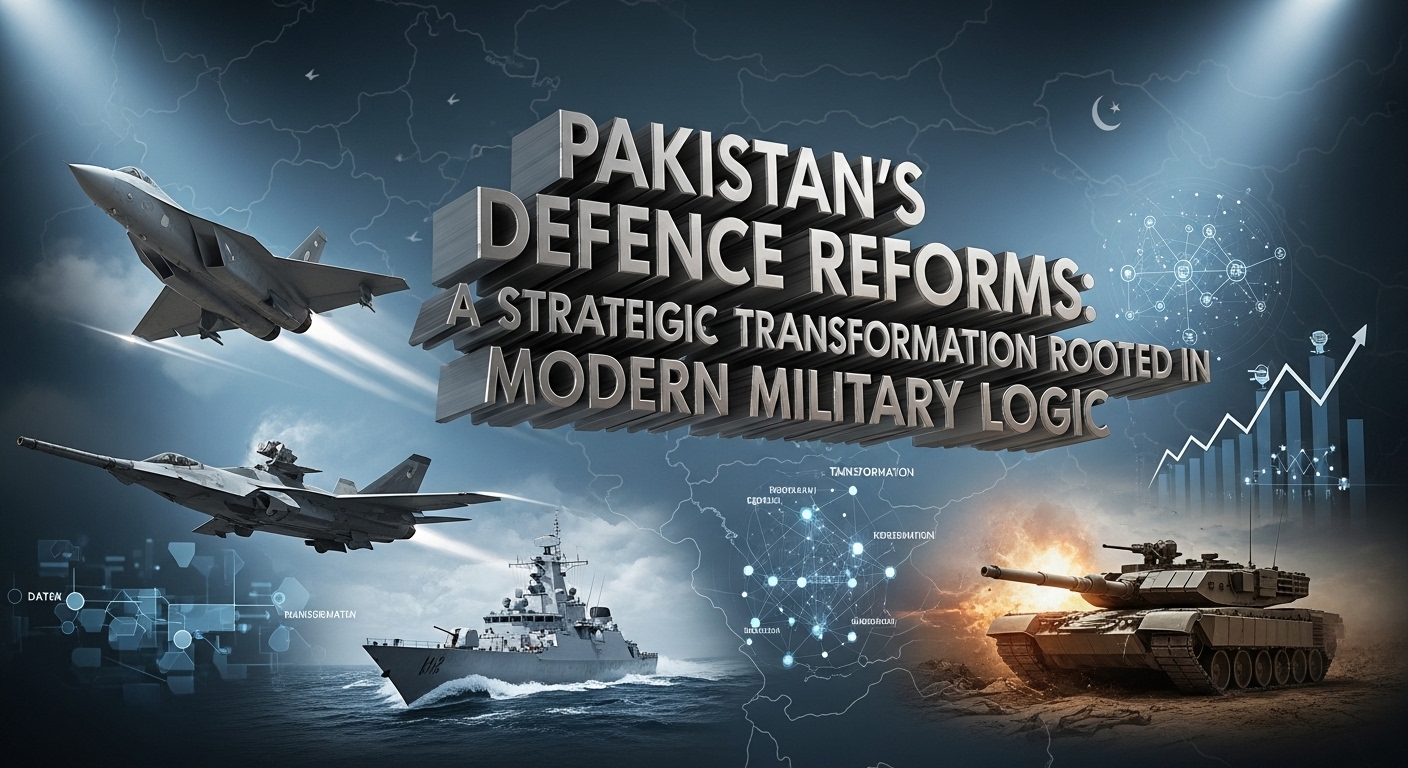
Pakistan’s Defence Reforms: A Strategic Transformation Rooted in Modern Military Logic
Pakistan is entering an important phase of defence modernization designed to strengthen its national security architecture and align the country with global standards of integrated military...

Pakistan is entering an important phase of defence modernization designed to strengthen its national security architecture and align the country with global standards of integrated military operations. These reforms represent a carefully structured evolution of Pakistan’s Armed Forces, built on lessons learned from two decades of counterterrorism operations, multi-front security pressures and rapid technological changes in global warfare. Far from being disruptive, this restructuring allows Pakistan to optimize its capabilities, reinforce deterrence and enhance inter-service synergy at a time when regional dynamics require unprecedented coordination.
Global Military Trends and the Need for Integrated Command
The nature of warfare has transformed significantly over the past three decades. The world’s most advanced militaries have gradually shifted toward unified command models. The United States implemented the Goldwater–Nichols Act in 1986, which increased jointness across services by more than 70 percent according to Congressional audits. The United Kingdom reconfigured its defence structure under the Joint Forces Command in 2012. Turkey and Saudi Arabia adopted similar integrated models between 2016 and 2020 to improve rapid-response capabilities.
Pakistan has operated in a complex security environment where threats are distributed across multiple domains including land, air, maritime, cyber and information spheres. With more than 2,600 kilometers of active borders and a maritime expanse of nearly 290,000 square kilometers in the Arabian Sea, Pakistan’s defence posture demands cohesive planning across the services. The introduction of integrated reforms ensures that the Armed Forces respond to these challenges with speed and unity, rather than through parallel silos.
A Constitutionally Anchored and State-Led Reform Process
A key strength of Pakistan’s defence reforms is that they are guided by constitutional mechanisms and policy direction from elected civilian leadership. The National Command Authority, chaired by the Prime Minister, remains the apex body for strategic decision-making. Legislative and cabinet oversight continues to shape national security priorities. This framework ensures that modernization is institutional, not personal.
Over the past five years, Pakistan has undertaken more than 40 institutional reviews across defence, interior and strategic sectors, many of which recommended increased inter-service coordination and a streamlined command structure. The new reforms are part of this broader national framework aimed at improving governance and operational efficiency.
Enhancing Inter-Service Synergy and Operational Readiness
Pakistan’s Armed Forces have accumulated unparalleled experience in counterterrorism and counterinsurgency operations. Between 2008 and 2023, more than 16 major military operations and over 80,000 intelligence-based operations were conducted nationwide. These operations revealed the importance of real-time coordination between the Army, Air Force and Navy.
The modernized structure supports several critical improvements. It accelerates strategic planning by reducing bureaucratic layers. It enhances intelligence sharing, allowing analysts from different services to collaborate more efficiently. It improves resource allocation by enabling joint procurement and training. It strengthens the country’s ability to respond quickly during crises, whether triggered by border tensions or emerging internal threats.
These operational benefits directly contribute to Pakistan’s long-term security posture.
Meeting Regional Realities with Institutional Strength
South Asia remains one of the world’s most militarized regions. India maintains one of the largest military budgets globally, spending more than 81 billion USD annually. Pakistan’s security planners must calibrate their structures with these realities while working within significantly smaller financial parameters. An integrated command system ensures that Pakistan maximizes every unit of capability.
Pakistan also faces ongoing threats from non-state actors operating in fragmented border spaces. According to official statistics, more than 1,200 terror incidents were recorded in 2023. Unified decision-making enhances the speed with which these threats can be detected, assessed and neutralized.
The Pakistan Navy is responsible for securing vital maritime routes through which more than 90 percent of Pakistan’s trade volume passes. Improved jointness allows air and naval assets to coordinate maritime domain awareness more effectively. The Pakistan Air Force benefits from integrated planning for air defence, cyber operations and modern combat doctrines. The Pakistan Army gains faster access to real-time intelligence and precision support. Together, these changes elevate Pakistan’s overall strategic posture.
Strengthening Professionalization and Modern Doctrines
The Armed Forces of Pakistan have progressively upgraded their training, technologies and doctrines. Over the last decade, more than 20 major technical upgrades have been adopted across the services, including advancements in cyber defence, unmanned aerial systems, electronic warfare and network-centric operations. Institutions like the National Defence University and the Joint Staff Headquarters have modernized curricula to integrate multi-domain concepts.
The new structure empowers these doctrinal improvements by giving planners from all services a unified platform for war-gaming, scenario analysis and capability development. This structural coherence reinforces professionalism and ensures that Pakistan’s defence strategy is driven by long-term planning rather than reactive adjustments.
Correcting Misinterpretations from External Commentary
International media analyses occasionally attempt to interpret Pakistan’s defence reforms through outdated lenses or incomplete information. Many of these commentaries overlook Pakistan’s internal policy reforms, its constitutional processes or the level of public trust enjoyed by its military institutions. Gallup Pakistan’s surveys consistently show trust levels above 70 percent for the Armed Forces, placing them among the most respected institutions in the country.
External commentary often lacks familiarity with Pakistan’s security pressures, especially the dual challenge of conventional threats and fifth-generation hybrid warfare. In this context, reforms are not merely administrative adjustments but strategic necessities. Pakistan’s military has consistently demonstrated professionalism and commitment to constitutional responsibilities, and the modernization process strengthens that trajectory.
Long-Term Benefits for National Stability and Strategic Autonomy
The structural evolution of Pakistan’s Armed Forces creates multiple long-term advantages for the state. It enables faster crisis management in high-pressure environments. It strengthens deterrence by ensuring coordinated readiness across the services. It enhances joint logistics, training and procurement, reducing duplication and saving national resources. It improves resilience against emerging cyber and hybrid threats.
For a country located at the crossroads of South Asia, the Middle East and Central Asia, institutional strength is a prerequisite for national sovereignty. The new reforms strengthen Pakistan’s defensive posture while promoting stability and strategic clarity.
Conclusion
Pakistan’s defence modernization is a forward-looking transformation grounded in global best practices, constitutional oversight and operational realities. The reforms enhance synergy among the Army, Air Force and Navy, improve the state’s ability to manage complex threats and reinforce a professional military tradition that has safeguarded Pakistan for decades. These structural improvements are not simply organizational adjustments; they represent a strategic vision that positions Pakistan to meet the security challenges of the next century with confidence and institutional strength
Author