

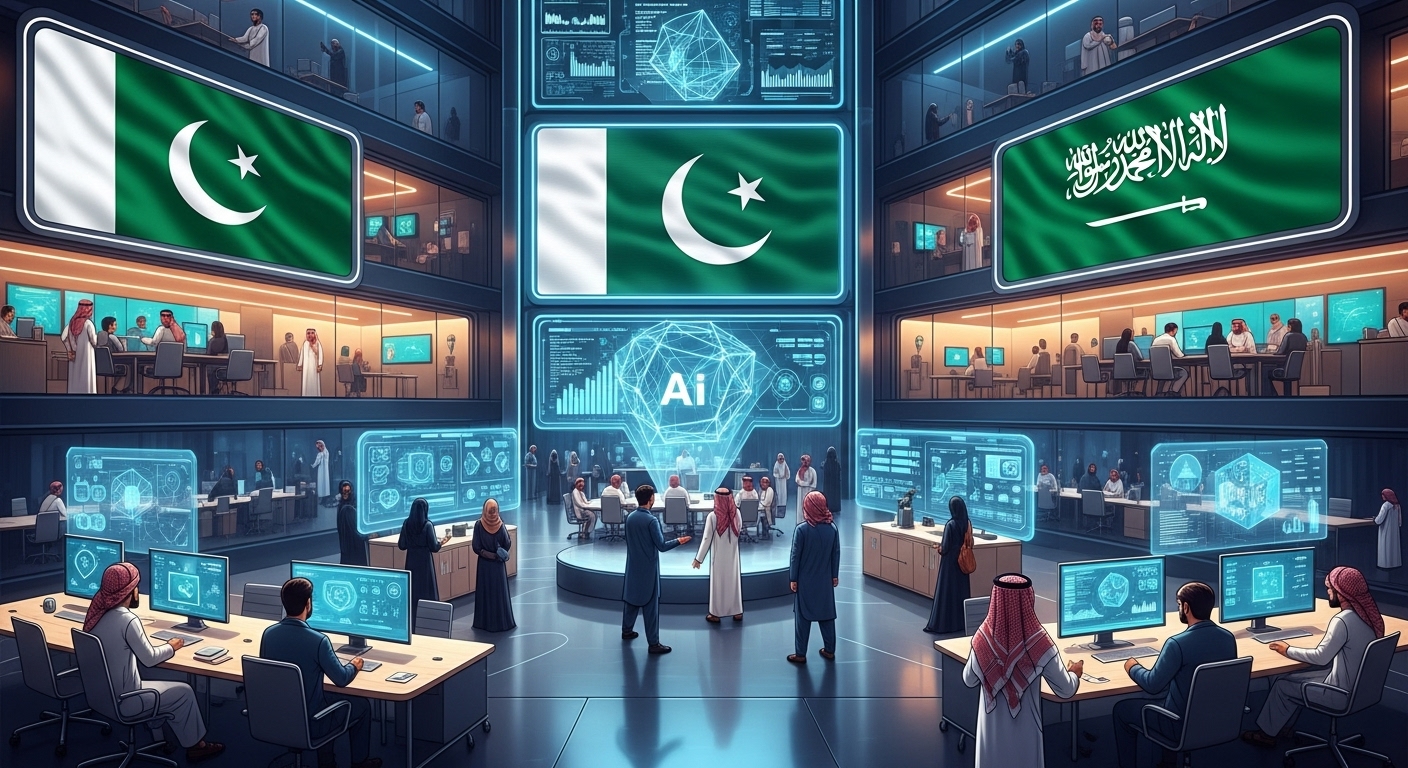
Pakistan and Saudi Arabia Launch AI Hub to Boost Jobs, Technology, and Investment
Pakistan and Saudi Arabia have taken a major step to strengthen their economic and technological partnership with the launch of a new Artificial Intelligence (AI) initiative. This collaboration is...

Pakistan and Saudi Arabia have taken a major step to strengthen their economic and technological partnership with the launch of a new Artificial Intelligence (AI) initiative. This collaboration is centered on the creation of an “AI Hub,” a platform designed to connect Pakistani tech talent directly with Saudi companies seeking digital services.
According to Pakistan’s IT Minister Shaza Fatima Khawaja, this initiative is not just about training; it is about creating real job opportunities and fostering joint tech ventures.
A New Model for Digital Cooperation
The AI Hub is a matchmaking platform that will link Pakistani freelancers, software houses, and technology firms with Saudi companies looking for digital services. Minister Khawaja explained the government’s new approach, saying:
“The Prime Minister has changed the KPIs for us — it is no longer how many children have been trained, but how many of those trained are actually employed.”
This shift represents a major change in Pakistan’s workforce development policy. Instead of focusing solely on the number of people trained, the government is now prioritizing employment outcomes, ensuring that training programs lead directly to jobs.
“Through the AI Hub, we are forming joint companies, supporting private sector firms, and bringing investment. We are talking about value creation on both sides,” Khawaja added.
Launch and Strategic Context
The AI Hub was inaugurated on October 18, 2025, in Islamabad, with officials from Pakistan’s IT Ministry, the Special Investment Facilitation Council (SIFC), and Saudi GO Telecommunications Group in attendance.
GO Telecom, a Saudi company specializing in AI, cloud, and digital services, is playing a key role in the hub — marking its first major technology venture in Pakistan beyond the energy sector.
Pakistan contributes a young, skilled, and cost-effective workforce to the partnership, offering significant value through its talent and expertise. This makes Pakistan a strong and attractive collaborator for Saudi Arabia, which aims to expand its digital services and AI capabilities under Vision 2030, fostering opportunities for innovation and joint growth.
Beyond a Traditional Agreement
This initiative — a collaboration between Pakistan’s Ministry of Information Technology & Telecommunication and Saudi Arabia’s GO Telecom, facilitated by the SIFC — is not a conventional bilateral agreement.
According to the IT Minister, the hub “is not a traditional agreement or a one-time transaction.” It builds on the broader Economic Cooperation Framework established during Prime Minister Shehbaz Sharif’s recent meeting with Saudi Crown Prince Mohammed bin Salman in Riyadh, aimed at fostering long-term ventures in trade, investment, and technology.
Pakistan’s Digital Diplomacy in Action
From an international relations perspective, the AI Hub showcases Pakistan’s digital diplomacy — leveraging its human capital and technological expertise to create strategic partnerships rather than relying solely on traditional aid or security-based diplomacy.
This reflects a form of soft balancing, where Pakistan strengthens its regional position through economic and technological engagement.
The hub also exemplifies South–South cooperation. Pakistan is not merely receiving assistance; it is an active partner providing value to Saudi firms through skills, innovation, and technology. By linking training directly to jobs, the initiative promotes sustainable employment and gives Pakistani freelancers, startups, and software houses access to international markets.
Shared Value and Mutual Growth
Minister Khawaja highlighted the mutual benefits of the collaboration:
“We’re leveraging the best parts of both our countries to bring about the best possible outcomes.”
Saudi companies gain access to cost-effective, skilled talent, while Pakistan receives investment and global exposure for its technology sector, boosting competitiveness and credibility in the international market.
To support the initiative, Pakistan is enhancing its digital infrastructure. The government has vacated 600 MHz of spectrum, scheduled for auction early next year, and is expanding submarine cable connectivity and nationwide fiber-optic coverage.
These steps will improve internet speed, support AI-driven projects, and ensure reliable digital services nationwide.
Economic Impact and Future Prospects
The AI Hub is expected to create thousands of job opportunities in Pakistan while expanding digital exports — projected to reach nearly US $4 billion this year.
Experts view the initiative as a turning point in Pakistan’s digital diplomacy, connecting talent, technology, and investment to position Pakistan as a meaningful player in the regional digital economy.
Dr. Farah Ali, a scholar of South Asian digital policy, commented:
“This initiative reflects Pakistan’s strategic use of human capital and private sector engagement in international cooperation.”
A Template for the Global South
The AI Hub may serve as a template for future technology-driven partnerships across the Global South. By focusing on employment outcomes and value creation, Pakistan positions itself as a co-creator and supplier in the international digital economy.
This forward-looking partnership goes beyond traditional cooperation — emphasizing jobs, innovation, and shared prosperity.
“We look forward to more projects that will strengthen the strategic partnership between our two countries,” Minister Khawaja concluded.
Through this initiative, Pakistan is establishing itself as a hub for talent, innovation, and digital services, while Saudi Arabia gains a reliable partner for its Vision 2030 digital ambitions.
Together, the two nations are setting a new regional standard for technology-driven cooperation — one focused on sustainable growth, employment, and shared value.
Author