



1. Context
The demarcation of borders among states is a historical and legal process governed by international law. Their establishment and sanctity are governed by well-defined legal principles to ensure territorial stability and international peace. The borders are typically established through a multi-stage process involving allocation, delimitation, demarcation, and administration.
Allocation refers to the initial political decision on territorial distribution, often resulting from treaties, formal agreements, or decolonization processes. Delimitation defines boundaries on official maps through bilateral agreements, using natural or geometric markers. Demarcation physically marks the boundary on the ground with pillars, fences, or walls, while administration involves long-term maintenance and dispute resolution mechanisms.
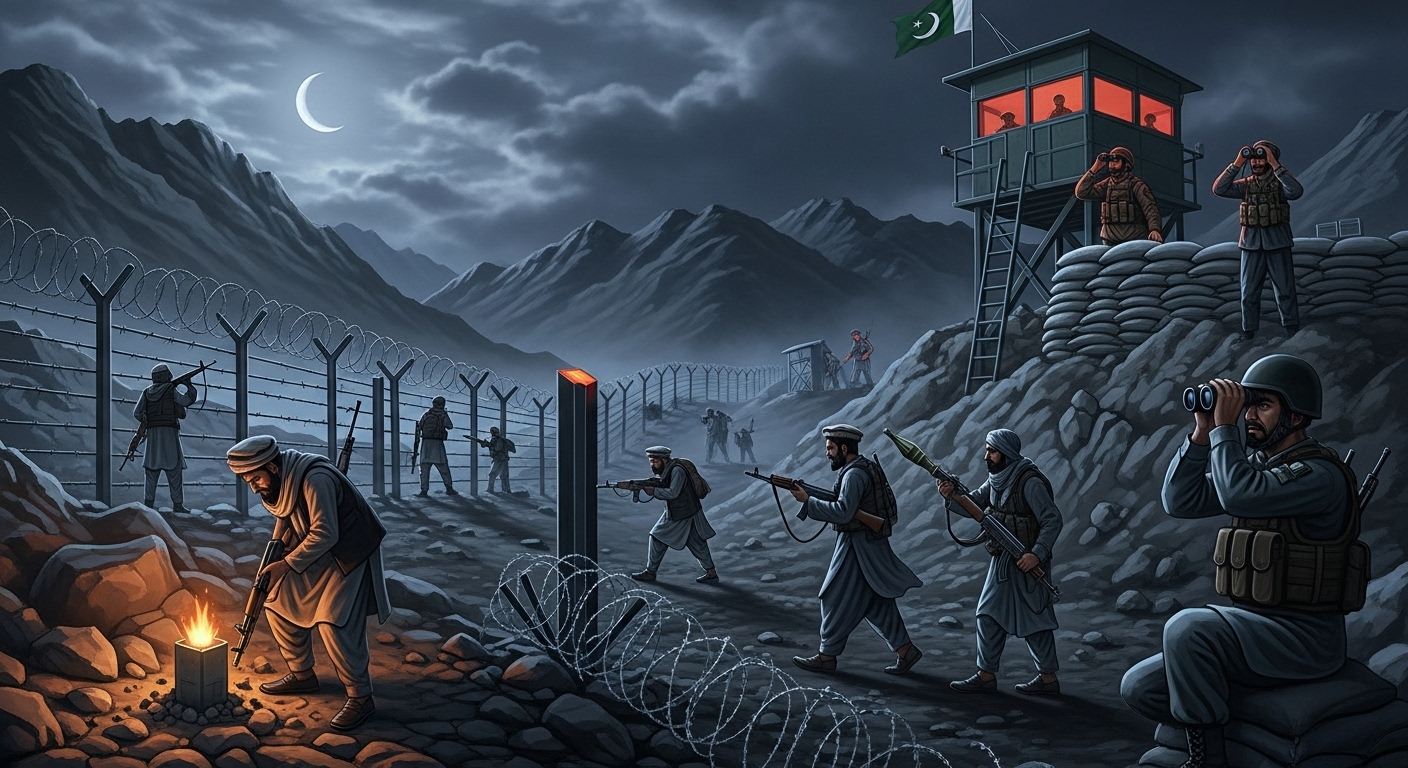
Contemporary Pakistan–Afghanistan relations are strained by recurring border tensions and the surge of cross-border militancy originating from Afghan territory. Pakistan maintains that the Tehreek-e-Taliban Pakistan (TTP), across the international border, has established safe havens inside Afghanistan and continues to launch terrorist attacks against Pakistani security forces and civilians, particularly in Khyber Pakhtunkhwa and Balochistan.
The closure of key border crossings, such as Torkham and Chaman, after armed skirmishes between border forces reflects increasing diplomatic friction and deepening security distrust. Kabul’s attempt to distort a historically proven and settled issue of the Durand Line is an attempt to divert attention from the core issue of trans-border terrorism.
Islamabad maintains that Kabul has failed to fulfil its obligations under international law, being an international border, to prevent the use of its territory for hostile acts — a violation of the UN Charter’s principles of non-intervention (Article 2(7)) and good neighbourly relations (Article 2(1)) as well as the Vienna Convention.
2. Durand Line: A History
The Durand Line Agreement was signed on 12 November 1893 between Ameer Abdul Rehman and British India Secretary Sir Mortimer Durand. After the death of the king, the British Secretary for India, Sir Louis Dean, arrived in Kabul at the invitation of the new Ameer Habibullah Khan on 21 March 1905 and the agreement was revived, where Habibullah Khan promised that he would abide by the agreement his father had made with British India and would never back down.
On 8 August 1919 in Rawalpindi, after the Third Anglo-Afghan War, Afghan Interior Minister Ali Ahmad Khan signed a peace treaty with British India, marking a critical turning point in Afghanistan’s history, moving it from a British protectorate to a fully independent state. Article 5 of the agreement states, “The Afghan government recognizes the same border agreement between India and Afghanistan that the late Ameer Habibullah Khan recognized.”
Thus, for the first time, the Durand Line Treaty became a formal international border. The Anglo-Afghan Treaty of 1921 reaffirmed the 1893 agreement, stating that the frontier “accepted by the Afghan Government under the treaty of 1893” shall remain valid. Therefore, the Durand Line is the only international border line drawn by the will of the Afghan King, ratified by three successive rulers through five treaties over 37 years — making it distinct from other borders of Afghanistan.
3. Afghanistan vis-à-vis Other Neighbours
The demarcation of the border between Afghanistan and Russia (1884–85) was agreed upon by Britain and Russia without Afghanistan’s consent. Afghanistan was also excluded from the demarcation process between Afghanistan and Iran, which resulted in 172 pillars being erected along their shared border, enforced through an agreement between Britain and Iran.
Ironically, Afghanistan has never challenged its northern borders with the newly independent Central Asian states — Turkmenistan, Uzbekistan, Tajikistan, and China — nor its western border with Iran.
4. The State and International Law
Under international law, a “Successor State” is defined as “a sovereign state over a territory and populace that was previously under the sovereignty of another state.” A successor state acquires a new international legal personality, distinct from a continuing state, which retains its rights and obligations despite border changes.
International law grants sovereign states a set of fundamental rights that enable them to operate as independent and equal actors within the international system. These rights arise from the principles of state sovereignty, territorial integrity, and non-intervention as recognized in the UN Charter and the Vienna Convention on the Law of Treaties (VCLT, 1969).
The cornerstone principle Pacta Sunt Servanda — “Every treaty in force is binding upon the parties to it and must be performed by them in good faith” — ensures the sanctity of treaties. The 1921 Anglo-Afghan Treaty, which reaffirmed the 1893 Durand Line agreement, remains a valid and binding legal instrument.
The principle of Uti Possidetis Juris ensures that administrative boundaries become international borders upon independence to prevent chaos. Thus, Pakistan, as the successor state to British India, inherits the borders defined by the British, including the Durand Line — a position upheld consistently by the International Court of Justice (ICJ).
5. Intervention and International Law
The right to state sovereignty, non-intervention, and territorial integrity are enshrined in the UN Charter, to which both Pakistan and Afghanistan are signatories. Article 2(7) prohibits intervention in domestic affairs, while UNGA Resolution 2131 and Resolution 2625 reaffirm this obligation.
In the ICJ case Nicaragua v. USA (1986), the Court held that supplying weapons, training rebels, or destabilizing another state violates the principle of non-intervention.
The Tehrik-e-Taliban Pakistan (TTP) is formally listed by the UN Security Council as a terrorist organization associated with Al-Qa’ida. The UN Monitoring Report (S/2023/370) and the 2024 UN Report both confirm that the TTP continues to operate from Afghan territory and conduct attacks into Pakistan, with the Afghan authorities appearing “unable or unwilling to manage the threat.” This constitutes a violation of international borders and the UN Charter’s fundamental principles.
6. The Paradox
Notwithstanding the discussion above, Kabul’s claim falls flat when it raises the issue of cross-border incursions by Pakistan. If the Pak–Afghan border is “not recognized” in their view, how can such an incursion even be defined?
7. Conclusion
From Pakistan’s perspective — and under the prevailing international legal order — the Durand Line is a settled border. Its sanctity is derived from a chain of valid treaties and the need for border stability. Afghanistan’s historical non-recognition, while politically significant, does not legally void the treaty after a century of effective administration and global recognition.
Afghanistan’s failure to prevent its territory from being used by the TTP for terrorism against Pakistan constitutes a violation of its obligations under the UN Charter and multiple UN Security Council resolutions. The principle of State Responsibility obliges states not to allow their territory to be used for acts contrary to the rights of other states — the “due diligence” principle.
By contesting the foundational treaties of 1919 and 1921, the Taliban government undermines the very legal instruments that obligate it to secure its borders. This political non-recognition — an act of lawfare — creates a legal grey zone that the TTP exploits.
Author