


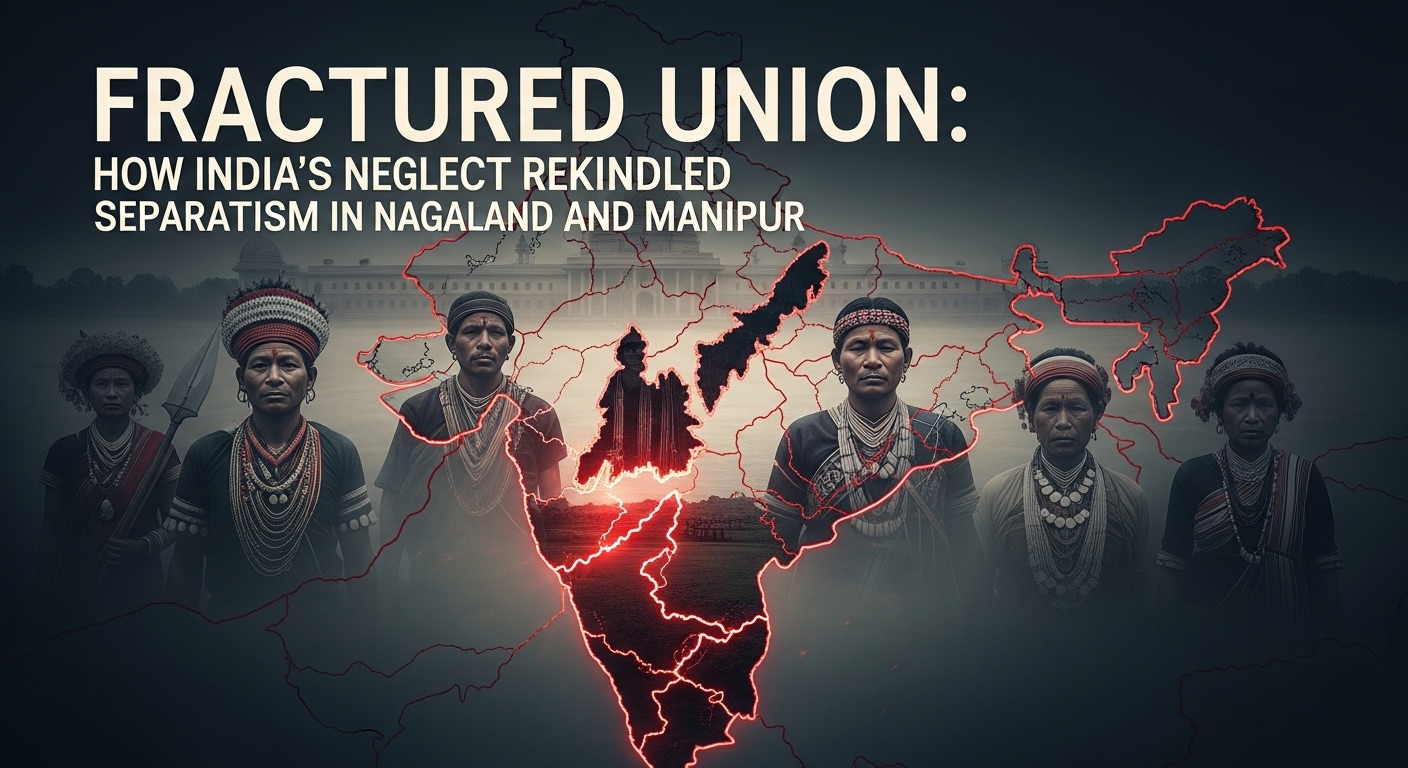
Fractured Union: How India’s Neglect Rekindled Separatism in Nagaland and Manipur
When New Delhi speaks of its “Act East” strategy, it imagines a calm and connected Northeast as India’s bridge to Southeast Asia. Yet, as 2025 unfolds, Nagaland and Manipur tell a darker truth — not...

When New Delhi speaks of its “Act East” strategy, it imagines a calm and connected Northeast as India’s bridge to Southeast Asia. Yet, as 2025 unfolds, Nagaland and Manipur tell a darker truth — not of integration, but of unraveling. The resurgence of separatist expressions, from “Black Day” observances in Nagaland to demands for separate rule in Manipur, are not echoes of past insurgencies but new appeals for dignity amid deepening isolation.
This August, key Naga tribes boycotted Independence Day celebrations, replacing festivities with mourning. Villages in Mon and Tuensang flew black flags, calling the tricolor a symbol of occupation. In Manipur, new armed groups emerged in both the hills and the valley, widening old fractures. Delhi’s response was predictable — more troops, longer curfews, and renewed enforcement of the Armed Forces Special Powers Act (AFSPA).
In theory, these are measures of “security.” In practice, they have made life less secure.
Securitization and the Politics of Fear
The Copenhagen School’s Securitization Theory helps explain this pattern. It argues that when states frame political or social issues as existential threats, they justify extraordinary measures — emergency laws, militarization, and suspension of rights. In Nagaland and Manipur, New Delhi has done exactly that. Identity, dissent, and even humanitarian concerns are recast as potential insurgencies rather than governance failures. Once securitized, dialogue disappears and deployment takes its place. The state thus turns inward, producing insecurity in the name of defending the nation.
A Militarized Normal
Both Nagaland and Manipur remain under AFSPA, a colonial-era law that grants sweeping powers and near-total impunity to the armed forces. This militarized governance has normalized fear. Checkpoints, night raids, and curfews have become routine. What is invisible to those in power is daily reality for those who live under it.
In the past year alone, several operations in Manipur’s hill districts have claimed civilian lives — often dismissed as “collateral damage.” Arrests of “suspected militants” rarely end in conviction, deepening alienation instead of justice.
Johan Galtung’s Structural Violence Theory provides another lens. It defines violence not only as direct harm but as institutionalized injustice — poverty, exclusion, or systemic discrimination that denies dignity without overt conflict. In Nagaland and Manipur, structural violence takes the form of political neglect, economic marginalization, and militarized existence. AFSPA itself is structural violence codified — granting one group, the army, impunity over another, the people. For decades, this unseen brutality has nurtured quiet resentment, now erupting as open resistance.
A Policy of Neglect Disguised as Control
New Delhi continues to view the Northeast less as a political community and more as a security frontier. Control has replaced conversation; surveillance has replaced dialogue. The border fencing with Myanmar and the suspension of the Free Movement Regime have angered Naga and Kuki tribes divided by colonial borders. Tribal elders now call it a “second partition,” severing ancestral homelands in the name of sovereignty.
In Manipur, the ethnic war between Meitei and Kuki-Zo tribes during 2023–24 split the state into two parallel worlds. Meitei vigilantes patrol the valley, while Kuki-Zo militias dominate the hills. Amid this fragmentation, Delhi’s narrative of “law and order” sounds hollow. For those displaced or dispossessed, the crisis is not insurgency — it is abandonment.
From Insurgency to Identity
The new generation of Naga and Kuki activists rarely use the word “secession.” Their demand is for respect and recognition. Yet, the state’s reflex remains coercive. By treating calls for dignity as threats, Delhi perpetuates the securitization cycle. Each arrest, raid, and denial of dialogue strengthens the perception that India governs the region as an occupier, not a democracy. When identity itself becomes criminalized, rebellion becomes the only language left.
The Colonial Shadow
The roots of this crisis are not just administrative — they are historical. The Northeast’s governance still bears the imprint of colonial control, where authority mattered more than consent. Laws like AFSPA, limited devolution, and extractive development projects sustain a colonial logic that sees people as subjects to be pacified, not citizens to be empowered.
In this light, the ongoing insurgencies are not anti-national but anti-colonial — protests against a state that continues to treat its periphery as conquered territory rather than equal union.
A Choice Between Control and Inclusion
The Northeast resists not because it rejects India’s democracy, but because it has never truly experienced it. A governance model rooted in securitization has smothered democratic participation and raised generations for whom the state means compulsion, not care.
If New Delhi continues to rely on force, the divide between core and periphery will harden beyond repair. The path forward lies not in counterinsurgency but in de-securitization — shifting the narrative from fear to trust, from suspicion to political dialogue.
Conclusion
The crises in Nagaland and Manipur are not law-and-order problems but manifestations of systemic violence. India’s pursuit of state security has come at the expense of human security. Until Delhi understands that repression cannot yield stability, the black flags will keep rising over the hills. As one Naga elder put it, “This is a land ruled, but never governed.”
Author