

20 Hours of Counteraction: Pakistan’s Western Border Escalation and the Shifting Geopolitics of South Asia
Pakistan’s counterterrorism record stands as one of the most formidable in the region. From Operation Zarb-e-Azb to Radd-ul-Fasaad and the dismantling of transnational terror networks, Pakistan has...

Pakistan’s counterterrorism record stands as one of the most formidable in the region. From Operation Zarb-e-Azb to Radd-ul-Fasaad and the dismantling of transnational terror networks, Pakistan has consistently demonstrated professional excellence, tactical innovation, and national unity in confronting hybrid threats. Its doctrine of “credible deterrence”, the ability to respond swiftly and proportionately to aggression, has long defined its approach to national defense. The 14th and 15th October 2025 border clashes with the Taliban were a reaffirmation of this principle and a reminder that Pakistan’s commitment to sovereignty is not rhetorical but operational.
A Realist Lens on the Border Clash
The Realist framework in international relations offers a clear explanation for Pakistan’s recent counteraction. In Realist thought, the international system is anarchic, and states act primarily to ensure survival and security. Pakistan’s 20-hour counter-offensive along the Pakistan-Afghanistan international border was a textbook demonstration of Defensive Realism, the use of limited, calculated force to deter external threats and restore strategic equilibrium. The state’s actions were not expansionist; they were precautionary responses to repeated provocations emanating from the Taliban.
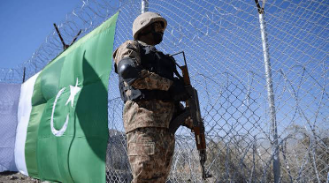
The confrontation, the fiercest in years, erupted when Taliban fighters and allied Khawarij militants attacked Pakistani posts near Kurram (Khyber Pakhtunkhwa) and Spin Boldak (Balochistan). Pakistan’s forces retaliated with artillery, drones, and Armor, neutralizing over 140 militants and destroying multiple enemy bunkers and tanks. Pakistan lost men in the line of duty, yet the broader outcome reaffirmed control over its frontier. From a Realist perspective, this was an assertion of deterrence and an effort to prevent a dangerous precedent of tolerated aggression.
Internal Tensions and External Sponsors
The crisis also exposed the internal contradictions of the Taliban regime and the external influences that exploit them. Pakistan’s official position is that the Taliban have failed to curb the Fitnah al-Khawarij (FAK), which continues to operate from Afghan sanctuaries. The reorganization of the FAK, equipped with advanced weaponry left behind after the U.S. withdrawal, has revitalized its campaign against Pakistan’s security forces.
More concerning to Islamabad is the suspected Indian hand behind the instability. For years, Pakistan has shown the world that Indian intelligence networks take advantage of Afghan soil to fund, train, and coordinate anti-Pakistan militants. The ISPR has previously released dossiers showing that Indian embassies and consulates in Afghanistan acted as “terror sponsorship hubs.” In the 2025 context, Pakistani intelligence analysts see recurring tactical signatures, synchronized attacks in Kurram and Balochistan, advanced ordnance, and real-time communication intercepts as indicators of Indian involvement.
From a Realist angle, such activities reflect external balancing, where a rival power (India) seeks to weaken an adversary (Pakistan) indirectly through proxies. The result is a heightened sense of encirclement, a security dilemma where Pakistan knows that its western frontier is an extension of the same hybrid threat emanating from its eastern border.
Strategic Messaging and Regional Signalling
Pakistan’s counteroffensive carried a regional message far beyond the battlefield. By conducting simultaneous operations in the Kurram, Spin Boldak, and Noshki sectors, the Pakistan Army demonstrated operational coherence and readiness across multiple fronts. The publicized destruction of Taliban posts and Armor served a symbolic function as it communicated to Kabul and New Delhi that Pakistan remains the principal guarantor of stability in the western subcontinent.
In the Constructivist sense, this response also reflected Pakistan’s security identity, a state that defines itself through resilience, moral legitimacy, and national unity in the face of external threats.
Recalibrating Border and Counterterrorism Strategy
The clashes have compelled Islamabad to rethink its Afghanistan policy. For decades, Pakistan pursued cautious diplomacy, emphasizing engagement and patience, but the recent aggression has convinced many policymakers that appeasement must yield to deterrence. Security experts now call for a comprehensive recalibration:
- Integrated border surveillance using drones, satellites, and local intelligence networks.
- Conditional engagement with Kabul, tying trade, transit, and energy cooperation to counterterrorism compliance.
- Formal documentation of cross-border attacks to strengthen Pakistan’s case diplomatically.
- Humanitarian differentiation, ensuring that civilians and refugees are protected even as terrorist networks are targeted.
Such a shift reflects Realism’s pragmatic ethos that states must secure their borders through credible means, not rhetorical assurances. Yet Pakistan’s approach retains moral restraint; its objective is not escalation, but stabilization.
Regional Alignments and the Great Game Revisited
The 2025 frontier conflict unfolds within a broader geopolitical reconfiguration of South Asia. India’s renewed engagement in Kabul, Iran’s quiet mediation offers, and China’s balancing diplomacy together evoke a modern iteration of the “Great Game.” For Pakistan, maintaining sovereignty over its western flank is not merely a military necessity but a geopolitical statement. It reassures Beijing, its all-weather ally, that Pakistan remains a reliable partner in counterterrorism and regional connectivity, particularly under the China-Pakistan Economic Corridor (CPEC).
Meanwhile, Iran and Central Asian states, sharing concerns about spillover terrorism, may find common cause with Pakistan in establishing a regional security compact. Islamabad’s assertion that “no regional state benefits from an unstable frontier” could serve as the foundation for collective border management, intelligence sharing, and joint surveillance mechanisms.
Conclusion
The October 2025 clashes were more than a border skirmish; they were a test of Pakistan’s sovereignty and strategic maturity. Islamabad’s measured but firm response reflects both Realist deterrence and Constructivist identity politics, the pursuit of security through strength, framed by a moral narrative of national defense. In an era of blurred borders and hybrid wars, Pakistan’s western frontier has become the crucible of regional order. Its recent response demonstrates not only tactical prowess but strategic intent, a reminder that peace, for Pakistan, is not the absence of conflict but the presence of deterrence. Pakistan will not succumb to the terrorists’ bullying and will never compromise on its sovereignty.
Author