

Hiring the Guns for Operation Sindoor 2.0: India’s Shadow Moves in the Region
Pakistan stands as a beacon of resilience in the region, facing constant threats from its eastern neighbor, India, driven by a dangerous Hindutva ideology that seeks to undermine regional peace. This...

Pakistan stands as a beacon of resilience in the region, facing constant threats from its eastern neighbor, India, driven by a dangerous Hindutva ideology that seeks to undermine regional peace. This mindset views Pakistan as an eternal enemy and tries to use every tool to destabilize it. Today, India is accused of hiring proxy guns, groups like Fitna al Hindustan in Balochistan, Fitna al Khawarij in Khyber Pakhtunkhwa (KP), and the Tehrik-i-Taliban Afghanistan (TTA) along the border, to fuel chaos and war. These actions echo India’s failed Operation Sindoor in May 2025, where aggressive tactics backfired. Now, with hints of “Sindoor 2.0,” India risks plunging the region into deeper turmoil, all to satisfy its divisive agenda. Pakistan, however, remains committed to peace and sovereignty, countering these threats with determination and evidence-based responses.
The Failure of Operation Sindoor
In May 2025, India launched a failed operation, named as Operation Sindoor, as a supposed response to the false flag operation in Pahalgam, which claimed 26 civilian lives. Under this operation, Indian forces targeted nine alleged terrorist sites, claiming to kill over 100 terrorists and inflicting heavy damage on Pakistani infrastructure, including 11 airbases and defense systems. The four-day conflict from May 7 to 10 resulted in a ceasefire. India told the world a self-made AI-generated story of its operation, Pakistan dismissed these as “Bollywood-style scripts” invented to mold history.
India admitted to losing assets like Rafale jets too. The United Nations and international observers discouraged India’s aggressive moves, noting they escalated tensions. Despite global criticism, India’s Hindutva-driven leadership refused to back down, viewing the operation as a success in domestic politics. This failure should have been a lesson, but recent statements suggest India is gearing up for more, ignoring the human cost.
Following are some recent statements which depict their evil intentions:
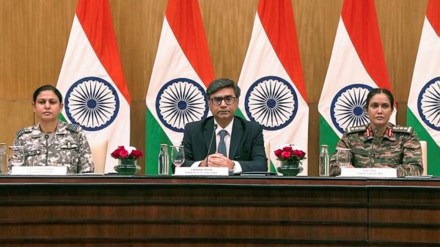
Lt Gen Manoj Kumar Katiyar, the Western Army Commander, arrogantly threatened a “deadlier” Operation Sindoor 2.0 on October 14, 2025, if Pakistan dares to defend itself, recycling the tired “thousand cuts” narrative to justify India’s aggressive strikes and provoke endless conflict. Meanwhile, DGMO Lt Gen Rajiv Ghai shamelessly boasted in a press briefing about fabricated victories in the original operation, claiming over 100 Pakistani casualties and destroyed aircraft, pure lies dismissed by Pakistan, while hinting at catastrophic escalation that blurs lines between terrorists and civilians, revealing India’s utter contempt for international norms and innocent lives.
Even more sinister, Army Chief Gen Upendra Dwivedi on October 3 issued a genocidal ultimatum, vowing no restraint in future actions that could “force Pakistan to reconsider its existence geographically,” a blatant call for dismantling a sovereign nation and erasing its borders. Chief of Defence Staff Gen Anil Chauhan hubristically dismissed Pakistan’s nuclear deterrent as no shield for alleged terrorism, recklessly flirting with nuclear brinkmanship. Echoing this madness, the Indian Air Chief vowed strikes on “terror targets” anywhere, and Defence Minister Rajnath Singh threatened to rewrite Pakistan’s history and geography, all part of India’s pattern of inventing pretexts to unleash unprovoked aggression and terrorize its neighbor.
India is Fueling Anti-Pakistan Aggression
At the core of India’s actions is Hindutva, an ideology that promotes Hindu hegemony and sees Pakistan as a symbol of division to be crushed. This mindset, amplified under leaders like Narendra Modi, has led to policies that suppress minorities in India and export instability abroad. Hindutva views Pakistan’s existence as a challenge to its narrative, pushing New Delhi to support terrorist groups to weaken Islamabad. In Balochistan, KP, and along the Afghan border, India is funding proxies to create chaos.
Data from Pakistani intelligence and international reports back this. For instance, India’s outreach to the Afghan Taliban, including diplomatic pushes amid border tensions, aligns with its goal to encircle Pakistan. This isn’t mere rivalry; it’s a calculated effort to satisfy Hindutva’s anti-Muslim, anti-Pakistan fervor, risking regional war. Pakistan, in contrast, promotes interfaith harmony and tolerance, drawing from its founding principles, while India drifts toward extremism.
Proxy Warfare in Balochistan: Fitna al Hindustan
Balochistan, Pakistan’s resource-rich province, has become a prime target for India’s proxy games through groups like Fitna al Hindustan, often linked to the Baloch Liberation Army (BLA). Pakistan accuses India of aiding these terrorists to disrupt development projects like the China-Pakistan Economic Corridor (CPEC). In October 2025, security forces conducted an intelligence-based operation in Khuzdar, apprehending four terrorists from Fitna al Hindustan, recovering weapons tied to Indian sponsorship.
Attacks have intensified: In March 2025, the BLA hijacked the Jaffar Express, endangering 380 passengers, an act amplified by Indian media to fuel narratives of unrest. Another blow came in September 2025, when Fitna al Hindustan targeted a passenger train, though security forces ensured no casualties. Pakistan’s operations have neutralized key figures, like Abdul Razaq alias “Nako,” a Fitna al Hindustan leader killed in Iran, leading 20-25 terrorists. These groups, funded by India, aim to sow division, but Pakistan’s swift actions, killing 40 terrorists in one Ziarat operation, show its commitment to peace. India’s involvement is no secret; it’s a strategy to put the region in chaos for its own interests.
Instability in Khyber Pakhtunkhwa: Fitna al Khawarij
In Khyber Pakhtunkhwa, India is widely blamed for backing Fitna al Khawarij, as a tool to exploit Pakistan’s ethnic and sectarian divides. Since their resurgence, Fitna al Khawarij has carried out deadly attacks, claiming thousands of lives. In October 2025, terrorists ambushed and killed 11 Pakistani soldiers in the northwest, highlighting the persistent threat. Pakistan has consistently linked these attacks to Indian funding, with the group exploiting Afghan sanctuaries to launch cross-border operations.
Pakistan’s security forces have responded decisively but this mirrors the classic Hindutva playbook: outsourcing violence to destabilize Pakistan while fake-projecting India as a regional power.
Border Tensions: Exploiting the TTA
Along the Afghan border, Fitna al Khawarij (FAK) escalated attacks on Pakistan, emboldened by India’s backing and Afghan safe havens. In October 2025, Pakistan responded decisively, targeting FAK bases in Kabul and Paktika, eliminating over 200 militants. Retaliatory claims by the Taliban, including 58 Pakistani casualties, reflect attempts to distort the narrative.
Pakistan’s actions were purely defensive, countering threats rather than initiating conflict. Despite India’s proxy support for FAK, Pakistan remains committed to securing its borders and protecting civilians from cross-border terrorism.
Conclusion
India’s strategy of hiring guns for Sindoor 2.0, via Fitna al Hindustan, Fitna al Khawarij, and TTA, threatens regional war to feed its Hindutva ego. With data showing thousands killed in proxy attacks and billions in damages, the world must condemn India’s role. Pakistan, however, emerges stronger, neutralizing threats and promoting dialogue. By standing firm, Pakistan not only defends its sovereignty but also safeguards South Asia from India’s chaotic ambitions. The region needs peace, not proxies, Pakistan leads the way.
Author