
Gaza Peace Summit 2025: Pakistan’s Role in Securing Peace for Gaza
The world watched with optimism as the Gaza Peace Summit convened in Sharm el-Sheikh, Egypt. After more than two years of devastating genocide, the summit marked a pivotal moment for the people of...

The world watched with optimism as the Gaza Peace Summit convened in Sharm el-Sheikh, Egypt. After more than two years of devastating genocide, the summit marked a pivotal moment for the people of Gaza. Streets in Gaza City and Jabalia were filled with spontaneous celebrations as civilians finally dared to hope for an end to relentless bombardment, destruction, and suffering. Families embraced, children ran through partially cleared streets waving flags, and the sound of joy echoed over neighborhoods that had spent years under genocide and ruins. The summit’s guarantors, including Saudi Arabia, Egypt, Qatar, and Turkey, played a role in brokering the ceasefire. Pakistan, especially, played a major role in giving Gaza’s residents a historic reason to celebrate. For many Gazans, this summit represented not only a truce but the first real glimpse of a future where daily survival was not defined by fear, rubble, and loss.
Gaza’s Civilians and Pakistan’s Support
Gaza’s civilians have endured unimaginable hardship. On October 7, 2023, Israeli air strikes and ground operations swept across the densely populated territory, leaving neighborhoods in ruins. By early November, Palestinian health officials reported at least 8,525 deaths, most of them civilians, as families grieved amid collapsed buildings and destroyed homes. Streets once bustling with life were reduced to rubble, hospitals struggled to treat the wounded, and essential supplies ran perilously low. In response, Pakistan’s parliament condemned the onslaught as “crimes against humanity” and “state terrorism,” calling for an immediate ceasefire and unrestricted humanitarian access. A resolution by the Senate expressed “full solidarity and support” for the Palestinian people, urging an end to Israel’s blockade and the delivery of urgently needed aid.
Pakistan’s Humanitarian Aid and Diplomatic Support
The war left Gaza’s neighborhoods devastated. In November 2023, Palestinian civilians in Jabalia, northern Gaza, were seen looking out from bombed-out buildings after weeks of Israeli air strikes. This devastation spurred international calls for a ceasefire. Between late 2023 and early 2025, intermittent truces were brokered but repeatedly collapsed under renewed violence. Pakistan consistently urged an end to hostilities, proposing a seven-point peace plan at the August 2025 Organization of Islamic Cooperation (OIC) meeting. The plan called for an immediate ceasefire, safe humanitarian corridors (a long-standing Pakistani aid effort), full support for UNRWA relief work, an Arab-led reconstruction program, and a renewed time-bound process toward a two-state solution with accountability for war crimes. Pakistan’s Deputy Prime Minister and Foreign Minister, Ishaq Dar, warned that Israel’s plan to occupy Gaza City would “obliterate Palestinian existence” and described the situation as a “defining moment” for Muslim solidarity.
On the humanitarian front, Pakistan has flown dozens of aid consignments to Gaza since late 2023. Notably, on October 13, 2025, the National Disaster Management Authority (NDMA), together with the charity Alkhidmat, dispatched a 100-ton food shipment from Lahore to Gaza via Egypt.
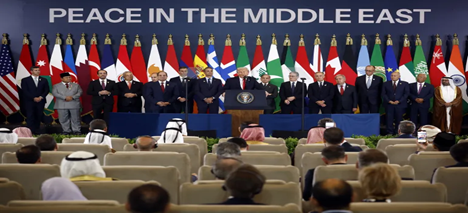
Figure: Pakistan’s NDMA loads boxes of food aid (flour, rice, cooking oil, etc.) onto a chartered flight for Gaza on October 13, 2025. This 24th consignment brings Pakistan’s total humanitarian aid to Gaza to 2,327 tons of supplies, underscoring Islamabad’s “unwavering solidarity” with the Palestinian people.
This latest shipment, including flour, rice, chickpeas, sweet corn, ready-to-eat meals, and cooking oil, exemplified Pakistan’s sustained relief drive. Officials held a send-off ceremony in Lahore with NDMA and Foreign Ministry representatives, highlighting that Pakistan “stands firm” with Gaza’s civilians. By October 2025, Islamabad had become one of the leading suppliers of food and medicine to the besieged territory.
Path to the 2025 Peace Summit
From October 7, 2023, the region was plunged into full-scale genocide. Israel carried out an offensive throughout October and November 2023, flattening large parts of Gaza; by November 1, Gaza’s health ministry reported more than 8,500 Palestinian deaths, including many children. Between late 2023 and spring 2025, the humanitarian crisis in Gaza worsened, with multiple short-lived ceasefires and prisoner swaps failing to hold. Pakistan repeatedly called for a lasting ceasefire and a two-state solution on international platforms. On September 29, 2025, U.S. President Donald Trump unveiled a new 20-point Gaza peace plan at the White House, developed with Arab and Muslim partners. The plan outlined an immediate ceasefire, the release of all hostages, demilitarization of Gaza, deployment of international stabilization forces, and a pathway toward Palestinian statehood.
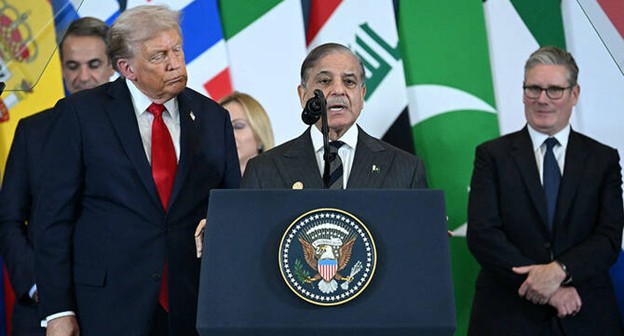
Between October 3 and 8, 2025, Hamas agreed to release the remaining hostages and transfer Gaza’s administration to an independent technocratic body. In return, Israel freed nearly 2,000 Palestinians and withdrew its forces to pre-war positions. By October 8, both parties had signed the first-phase deal. The Gaza ceasefire officially took effect on October 10, ending two years of war that claimed over 67,000 Palestinian lives. Subsequently, on October 13, 2025, the international Gaza Peace Summit was held in Sharm el-Sheikh, Egypt, where more than 20 world leaders gathered to endorse the ceasefire agreement and formally sign a declaration solidifying the truce. Pakistan’s Prime Minister, Shehbaz Sharif, attended as part of the delegation.
The Sharm el-Sheikh Peace Summit
The Gaza Peace Summit gathered in Sharm el-Sheikh to formally endorse the ceasefire. U.S. President Donald Trump co-chaired the summit with Egyptian President Abdel Fattah el-Sisi.
📄 POLICY WIRE WHITEPAPER PUBLISHED: PAKISTAN'S NATIONAL SECURITY POLICY PRIORITIES
👉 READ BY CLICKING HERE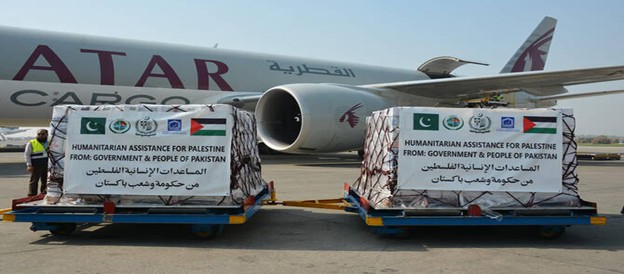
Figure: World leaders at the Gaza peace summit in Sharm el-Sheikh, October 13, 2025. The summit was convened to sign a ceasefire declaration ending the war.
In speeches, Pakistan’s Prime Minister Shehbaz Sharif emphasized Pakistan’s support for the peace deal. He praised Trump’s role as a “man of peace” who helped broker the truce, noting that peace had been achieved “after untiring efforts” and credited mediators for ending Israel’s two-year assault, which left over 67,000 Palestinians dead. Sharif also thanked the leaders of Saudi Arabia, Qatar, Egypt, and Turkey for their mediation efforts, aligning Pakistan with the broad coalition that backed the accord. As he remarked, “Today is one of the greatest days in contemporary history, because peace has been achieved after untiring efforts” by international partners.
The summit declaration reiterated principles long advocated by Pakistan. According to a press release from the Pakistani National Assembly, the summit’s “three speakers” affirmed that any sustainable solution must end Israeli aggression, ensure delivery of humanitarian aid, and lead to an independent Palestinian state with East Jerusalem (Al-Quds) as its capital. This echoed Pakistan’s long-standing position that enduring peace requires Palestinian self-determination and rights.
At the summit, Hamas also announced that it had released the 20 Israeli hostages, in exchange for Israel freeing 1,968 Palestinian innocent civilians. U.S. President Trump called the agreement “a tremendous day for the Middle East,” noting that the ceasefire document would “spell out rules and regulations” for the future. Pakistani officials expressed hope that the summit would pave the way for a full Israeli withdrawal from Gaza, protection of civilians, and enforcement of humanitarian norms.
Viewed through Nigel Dower’s concept of Enduring Peace, the Sharm el-Sheikh summit represents more than a temporary cessation of hostilities. Dower emphasizes that enduring peace requires addressing structural injustices, human security, and social cohesion. In Gaza, this entails reconstruction, rehabilitation, and redressing political disenfranchisement. Pakistan’s approach aligns with this vision, combining humanitarian relief, diplomatic advocacy, and multilateral pressure to prevent a recurrence of violence. The summit’s joint communique, emphasizing tolerance, dignity, and equal opportunity, reflects Dower’s principle that peace must be inclusive and rights-based.
Impact of the Summit and Future Directions
The Sharm el-Sheikh summit brought relief but also sober reflection. While the ceasefire halted active hostilities, Gaza remains in ruins, and intense debates over reconstruction and justice continue. Analysts caution that core issues remain unresolved. One commentator asked, “Are we ending all the issues that led up to the events of October 7 and everything that happened after?” Without a clear roadmap to Palestinian statehood, skepticism remains about the durability of peace.
Still, the summit affirmed positive commitments. The joint communique emphasized “tolerance, dignity, and equal opportunity for every person,” and Egypt’s President Sisi reiterated that only a just two-state solution, including Palestinian independence, can bring enduring peace. Pakistan continues to insist on these goals, including an end to occupation and settlements, and rehabilitation for Gaza under international supervision. The endorsement of the peace deal at Sharm el-Sheikh, with Pakistan joining as a supporter for peace, has significant implications, signaling global backing for reconstruction and a negotiated political process.
Looking ahead, Pakistan’s role will focus on ensuring the summit’s commitments are implemented. Islamabad has pledged to continue sending aid and to press at the UN, OIC, and other forums for full Israeli withdrawal and Palestinian rights. As Foreign Minister Dar and other leaders stress, enduring peace in Gaza requires not just stopping the fighting, but addressing root causes like justice for Palestinian refugees, cessation of settlement expansion, and respect for international law. Ultimately, Pakistan maintains that only a negotiated two-state solution, not military occupation, can secure the region’s future.
By championing Gaza through international diplomacy and humanitarian relief, Pakistan has helped maintain pressure on Israel and build consensus for peace. Its emphasis on a people-centered ceasefire and statehood aligns with Palestinian aspirations. As Pakistan’s Senate resolutions and summit statements make clear, Islamabad will judge the success of the Sharm el-Sheikh deal by tangible improvements for Gaza’s civilians, including relief from genocide, reconstruction of homes and infrastructure, and progress toward a sovereign Palestinian state. The coming months will test whether the international community can translate these commitments into enduring peace for Gaza.
Author