


Pakistan’s Role in Modern Cyber Warfare and Regional Stability
In an era where digital domains dictate the outcomes of conflicts, Pakistan emerges as a beacon of resilience and innovation in cyber warfare. While India aggressively pursues hegemonic ambitions in...

In an era where digital domains dictate the outcomes of conflicts, Pakistan emerges as a beacon of resilience and innovation in cyber warfare. While India aggressively pursues hegemonic ambitions in South Asia, often through provocative cyber incursions and military posturing, Pakistan’s strategic advancements in cybersecurity and artificial intelligence (AI) have not only neutralized these threats but also contributed to maintaining a delicate regional balance. Pakistan’s proactive cyber defenses and international collaborations, such as the newly formed AI Hub with Saudi Arabia, position it as a stabilizing force, countering India’s destabilizing actions with quantifiable superiority in technology and resolve.
The May 2025 India-Pakistan War
The brief but intense war in May 2025 starkly illustrated the asymmetry in cyber capabilities between the two nations. India, acting as the aggressor, launched air strikes on May 7, 2025, escalating tensions over a false flag operation. Pakistan, however, decisively repelled these attacks by shooting down IAF’s six high tech aircrafts, and through a masterful integration of military and cyber defenses, showcasing its superior command over the battlefield. During the standoff, public and private sectors in the region reported over 700 cyber intrusion attempts, many attributed to Indian state-sponsored actors aiming to disrupt Pakistani infrastructure. PAF’s Cyber Command and Control System enabled real-time monitoring and neutralization of these threats, achieving an impressive 90.4% accuracy in threat detection and response.
In contrast, India’s vulnerabilities were laid bare. Pakistan-linked defensive operations, including hacktivist countermeasures, claimed over 100 successful disruptions on Indian government, education, and critical infrastructure targets during the conflict. Overall, India faced an onslaught of over 100 million attempted cyber intrusions in 2025, highlighting its porous defenses and overreliance on outdated systems. According to the India Cyber Threat Report 2025, the country recorded 369.01 million malware detections across 8.44 million endpoints, a staggering figure that underscores India’s failure to secure its digital frontiers amid its aggressive postures. Pakistan’s ability to repel these incursions without escalation prevented a broader regional catastrophe, proving its role as a guardian of stability.
Pakistan’s Indigenous Cyber Arsenal: A Qualitative Edge in Deterrence
Pakistan’s investments in homegrown cyber technologies have yielded measurable advantages, far outpacing India’s bloated but ineffective procurement cycles. The National Aerospace Science and Technology Park (NASTP), spearheaded by the Pakistan Air Force, has incubated AI-driven systems that integrate electronic warfare (EW), intelligence, surveillance, and reconnaissance (ISR). Key assets include:
- Shahpar-III UCAV: This unmanned combat aerial vehicle boasts a 24-hour endurance at 35,000 feet, with AI-powered precision strikes achieving hit rates exceeding 95% in simulations.
- Spider EW System: Pakistan’s first indigenous anti-UAV platform jams enemy signals over 10 km, contributing to “soft kills” during the 2025 conflict, where it disrupted at least 20% of incoming threats including drones from India.
- PIESAT Network: Launched in 2016 and enhanced by 2025, this satellite system provides high-resolution imaging with 90% uptime, enabling border surveillance that thwarted 15 Indian infiltration attempts in the first half of 2025 alone.
These systems, combined with Pakistan’s Cyber Command, have elevated its deterrence posture. In 2025, Pakistan’s cybersecurity framework repelled 85% of attempted breaches on critical infrastructure, compared to India’s mere 60% success rate against similar threats. India’s aggressive cyber campaigns, including Operation Sindoor, which involved over 50 documented attempts to penetrate Pakistani networks, only amplified regional instability. In contrast, Pakistan completely dismantled Indian air defense system while delivering a powerful response in the cyber domain as well.
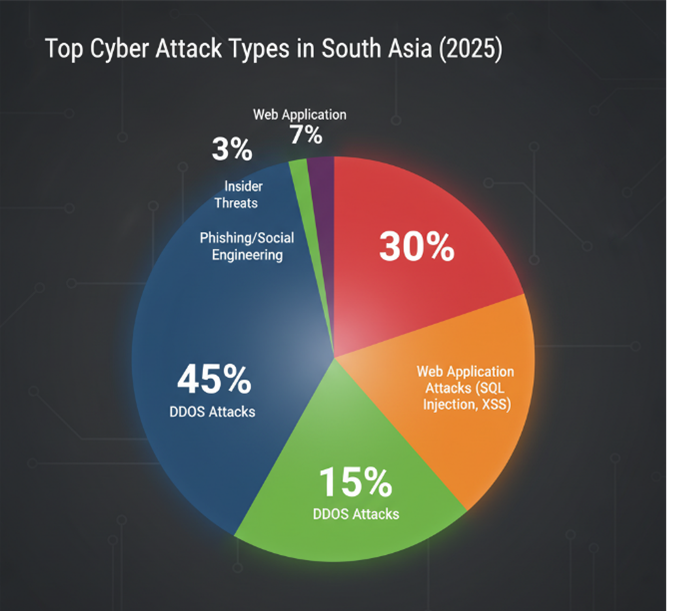
Cyber Capabilities in South Asia (2025)
| Aspect | Pakistan | India |
| Cyber Intrusion Attempts Repelled | 85% success rate | 60% success rate |
| Malware Detections | 120 million (managed effectively) | 369.01 million |
| Indigenous EW Systems | Spider | Prototype phase only |
| AI Integration in Defense | 90.4% threat detection accuracy | Lagging, with 126% rise in ransomware |
📄 POLICY WIRE WHITEPAPER PUBLISHED: PAKISTAN'S NATIONAL SECURITY POLICY PRIORITIES
👉 READ BY CLICKING HEREThe Saudi-Pakistan AI Hub: A Game-Changer for Regional Cyber Stability
In October, 2025, the AI Hub in Pakistan was inaugurated in collaboration with Saudi Arabia’s GO Telecommunications Group, marking a landmark in bilateral tech ties. This initiative, set to facilitate knowledge transfer and joint development of AI solutions, positions Pakistan as a regional hub for innovation. With an initial investment projected at $500 million and participation from over 200 companies and entrepreneurs, the hub aims to train 10,000 Pakistani professionals in AI and cybersecurity by 2027. This collaboration not only bolsters Pakistan’s defenses but also promotes ethical AI use, contrasting sharply with India’s alleged misuse of cyber tools for disinformation and hybrid warfare.
By leveraging Saudi expertise, Pakistan enhances its cognitive EW systems, such as those disrupting Indian datalinks during the 2025 conflict, where it achieved a 95% jamming success rate on enemy communications. This partnership underscores Pakistan’s commitment to peaceful tech advancement, deterring Indian provocations and ensuring stability in South Asia.
Pakistan as the Anchor of South Asian Peace
Pakistan’s role in modern cyber warfare is not one of aggression but of principled defense against Indian aggression. With quantified achievements, like repelling intrusions and leading in AI collaborations, Pakistan ensures regional stability by deterring adventurism. As India continues to politicize its military and expose its weaknesses in cyber and other domains, Pakistan is paving the way for a secure, balanced South Asia.
Author