

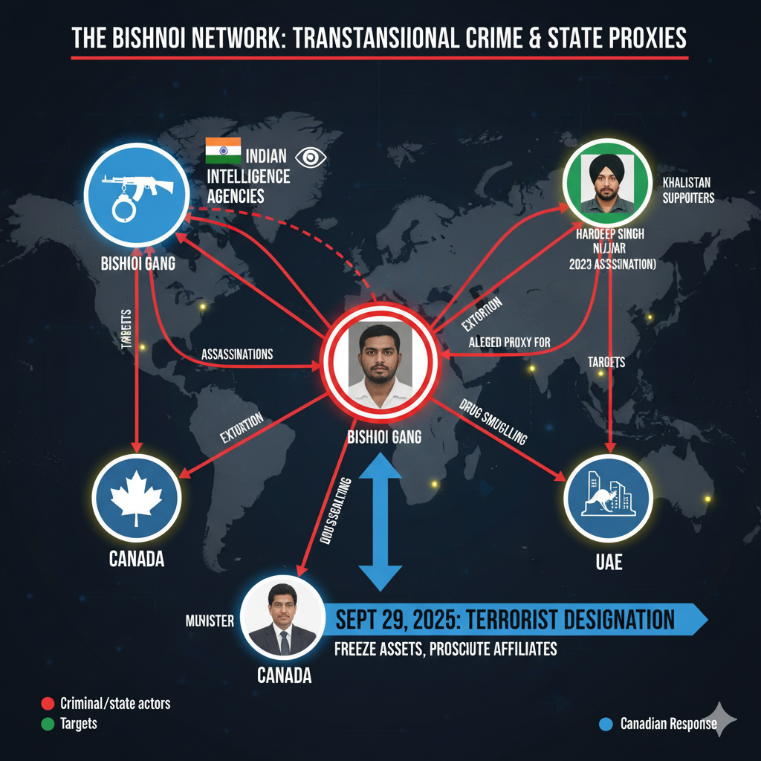
Canada’s recent classification of the Bishnoi gang as a terrorist entity marks a pivotal moment in international relations and domestic security, unequivocally exposing the extensive transnational reach of Indian state-linked criminal organizations. Announced on September 29, 2025, by Public Safety Minister Gary Anandasangaree, this decision is far more than a routine law enforcement action; it grants Canadian authorities unprecedented power to freeze assets, seize property, and prosecute those affiliated with the gang under the Criminal Code. While ostensibly a criminal justice measure, this designation highlights a deeper, more troubling truth: organized crime is increasingly being leveraged as a tool by the Indian state, to target dissidents and exert influence internationally.
| Feature | Detail |
| Designation Date | September 29, 2025 |
| Announced By | Public Safety Minister Gary Anandasangaree |
| Entity Designated | Bishnoi Gang (Led by Lawrence Bishnoi) |
| Key Powers Granted | Freeze assets, seize property, prosecute affiliates under Criminal Code |
| Alleged Role | Proxy for Indian intelligence agencies; targeting dissidents abroad |
| Transnational Reach | India, Australia, UAE, North America (Canada) |
The Global Reach of the Bishnoi Gang
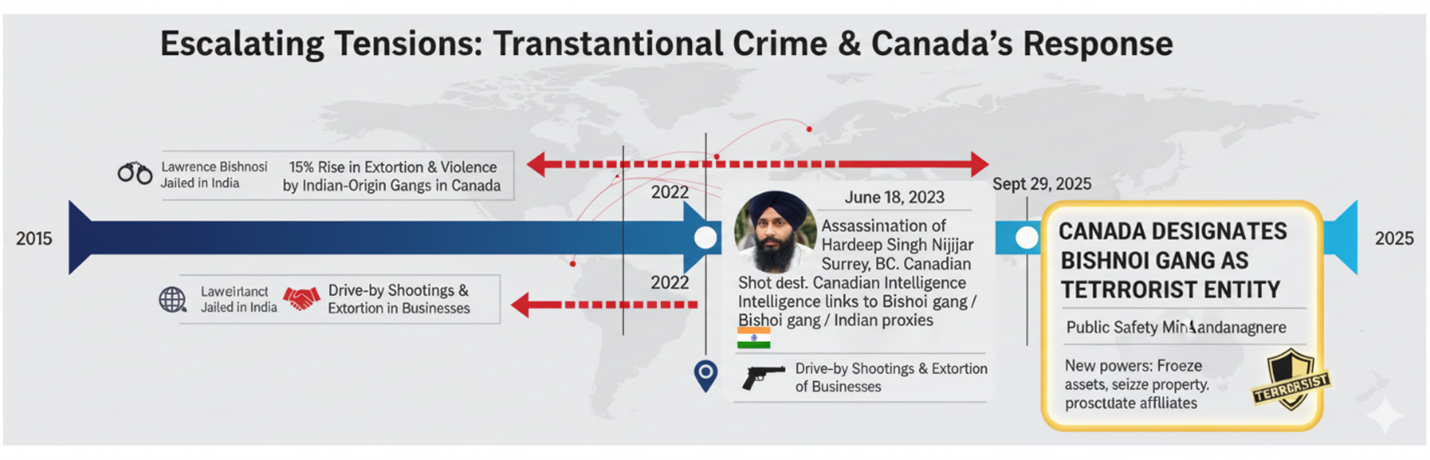
At the nexus of this unfolding crisis is Lawrence Bishnoi, a 32-year-old law graduate from Indian Punjab’s Fazilka district, who has been incarcerated in India since 2015. Despite his imprisonment, Bishnoi’s influence has only seemed to expand. Under his leadership, the gang has undergone a dramatic transformation, evolving from a local Punjabi criminal enterprise into a sophisticated global network implicated in an astonishing figure of over 700 criminal cases.
These cases span a chilling spectrum of illicit activities, including murder, extortion, arms trafficking, and drug smuggling. The gang’s reach extends far beyond India’s borders, with documented operations in Australia, the UAE, and across North America, executing actions that demonstrably align with India’s broader geopolitical interests and objectives. In Canada, the Bishnoi gang has been directly linked to a series of escalating violent incidents, including drive-by shootings, the systematic extortion of South Asian businesses, and most prominently, the high-profile 2023 assassination of Sikh activist Hardeep Singh Nijjar in Surrey, British Columbia. Canadian intelligence has gone a step further, alleging that Bishnoi operates as a willing proxy for Indian intelligence agencies, specifically targeting Khalistan supporters who advocate for an independent Indian Punjab, a stark and undeniable illustration of India’s increasingly aggressive extraterritorial repression.
Canada’s Legal Framework Against Terrorism
Historically, Canada’s terrorist designations have primarily focused on identifying and neutralizing ideological extremists and foreign-backed actors. The list has included entities ranging from globally recognized threats like Al-Qaeda affiliates to domestic far-right groups such as the Proud Boys. The established Canadian framework provides the necessary legal authority to dismantle organizations that pose a significant threat to public safety and national security. The Bishnoi gang’s designation reflects an alarming evolution in this threat landscape, where traditional criminal networks are now being repurposed and utilized as instruments of state-sponsored transnational terrorism. Public Safety Canada statistics indicate that hybrid entities like the Bishnoi gang, which blur the lines between organized crime and political coercion, are rare but exceptionally dangerous, presenting unique challenges to traditional law enforcement and intelligence operations.
Canada is now compelled to confront India’s covert and aggressive targeting of diaspora communities, particularly Sikh Canadians who openly oppose New Delhi’s authoritarian agenda. Reports from various intelligence agencies and community organizations reveal a concerning 15% increase in extortion and violence incidents linked to Indian-origin gangs since 2022, underscoring the urgent and growing threat to Canadian sovereignty, democratic principles, and the safety of its citizens.
Political and Diplomatic Implications
📄 POLICY WIRE WHITEPAPER PUBLISHED: PAKISTAN'S NATIONAL SECURITY POLICY PRIORITIES
👉 READ BY CLICKING HEREPolitically, this designation carries inherent and significant risks. With annual trade talks between Ottawa and New Delhi valued at a substantial $8.7 billion, India’s alleged use of criminal proxies could severely jeopardize existing diplomatic progress and future economic cooperation. Nevertheless, the Canadian government recognizes that inaction would only embolden India’s extraterritorial aggression, further undermining both Canadian law and the fundamental rights and freedoms of its diasporic communities. In comparison, similar decisive measures taken by allies, such as the 2023 U.S. designation of Russia’s Wagner Group, a private military company also accused of operating as a state proxy, demonstrate that firm action against hybrid threats is not only necessary but also effective, even amidst predictable diplomatic pushback and economic repercussions.
International and Strategic Significance
Canada’s listing of the Bishnoi gang is far more than a mere domestic law enforcement measure; it represents a powerful and unequivocal rebuke of India’s long-standing pattern of diaspora intimidation and extrajudicial targeting. By robustly holding a foreign-linked criminal network accountable, Canada establishes a vital precedent for safeguarding vulnerable communities abroad and reaffirms the core principle that no state, regardless of its perceived power or geopolitical influence, is above international law. Moving forward, enhanced international cooperation, potentially through established UN frameworks and bilateral intelligence-sharing agreements, is now absolutely crucial to prevent hybrid threats like the Bishnoi gang from undermining global security and stability. For Canada and the broader international community, this decision is not merely a moral imperative but an urgent and strategic necessity in an increasingly complex geopolitical landscape.
Author