


India’s Forced Hyphenation with Pakistan
For decades, India’s foreign policy narrative revolved around one ambition: to escape the South Asian hyphen. Successive governments insisted that New Delhi should not be compared with Islamabad, but...

For decades, India’s foreign policy narrative revolved around one ambition: to escape the South Asian hyphen. Successive governments insisted that New Delhi should not be compared with Islamabad, but instead be recognized as a stand-alone power. In Washington, in Brussels, and at every major summit, Indian diplomats pressed the same case—that India’s size, its economy, its technology sector, and its democratic model warranted recognition on their own merits, without the distraction of Pakistan. The guiding principle was de-hyphenation: to rise above the neighborhood rivalry and stand alongside the world’s great powers.
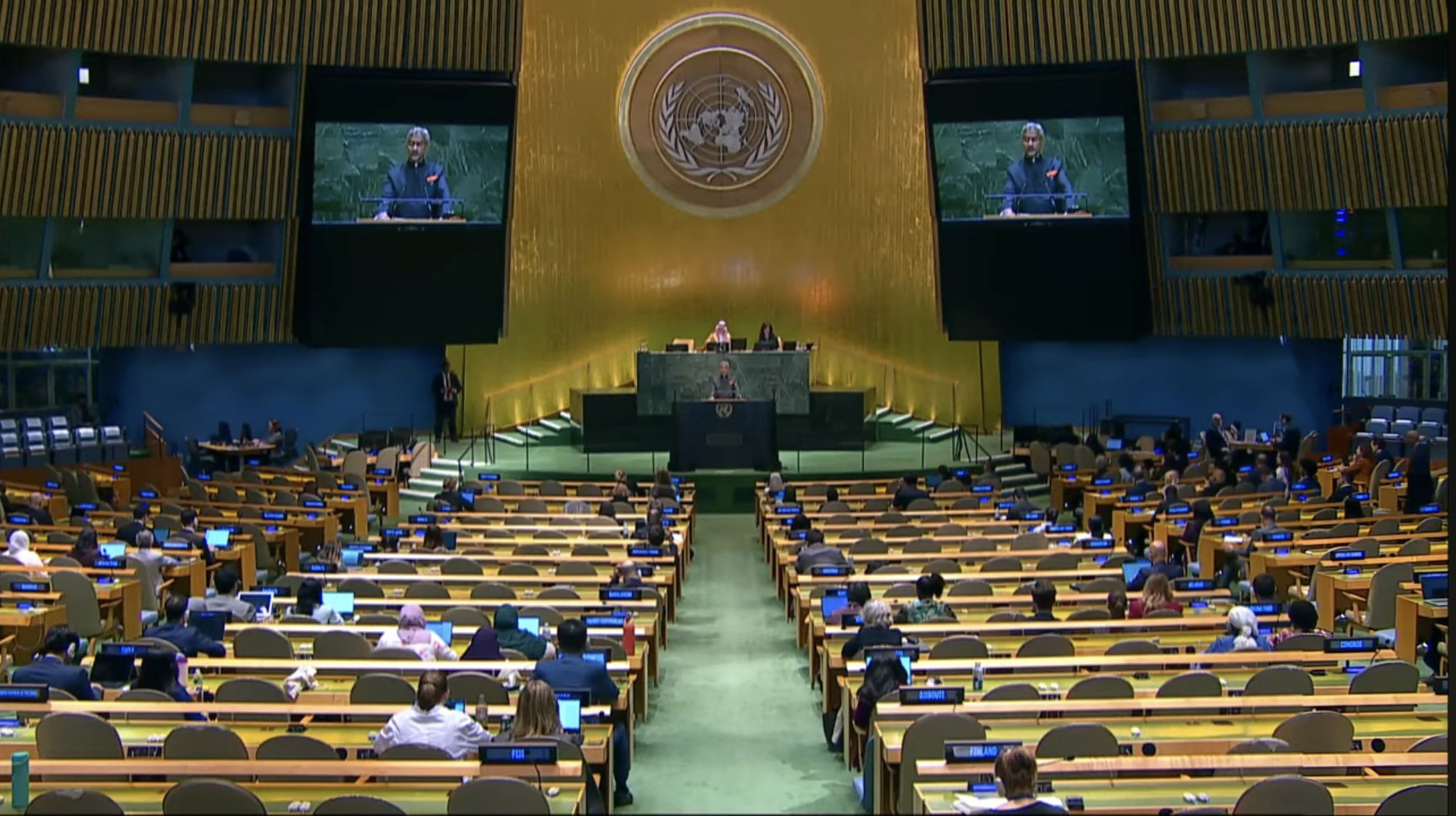
That history makes the present moment an anomaly. Having invested years in separating its image from Pakistan, India now seems unable to speak on the world stage without pulling its neighbor back into the frame. The clearest example came at the UN General Assembly on September 27, 2025. When External Affairs Minister S. Jaishankar stepped up to the podium, the international community expected a speech on cooperation, security, and India’s global vision. Instead, Jaishankar repeated a familiar script, branding Pakistan the “epicenter of global terrorism.” Far from projecting India as an independent power, the performance ensured that Pakistan remained at the center of India’s rhetoric.
This was not a one-off. At the 2021 UNGA, Prime Minister Narendra Modi accused Pakistan of “cross-border terrorism,” a pointed but indirect attack. In 2024, diplomat Bhavika Mangalanandan abandoned subtlety altogether, accusing Pakistan of a “global reputation for terrorism” in direct response to Prime Minister Shehbaz Sharif’s remarks. But then the Indian stress was to portray Pakistan as a state they did not want to be equated with. However, now, in 2025, Jaishankar’s words sealed the pattern: after decades of demanding to be judged apart from Pakistan, India is actively re-hyphenating itself. The question is why?
The answer lies in the confrontation remembered as Marka-e-Haq. India launched Operation Sindoor to demonstrate strength and shift the regional balance. Pakistan responded with Operation Bunyan-ul-Marsoos, a campaign that proved both disciplined and decisive. Pakistan’s defensive war against the Indian aggression did not tilt in New Delhi’s favor. Instead, it restored Pakistan’s credibility, demonstrating that it could withstand pressure, fight effectively, and defend its sovereignty. For India, which had long insisted it was beyond comparison with its neighbor, the outcome was uncomfortable.
In the current scenario, Pakistan has moved quickly to consolidate its gains. Its defense pact with Saudi Arabia gave it a formal role in Gulf security, underscoring that its influence stretched beyond South Asia. Islamabad strengthened its defining role in the Islamic world, ensuring its voice carried weight on issues of common concern. At the same time, it deepened ties with both the United States and China—an unusual dual alignment in today’s polarized order. Rather than being seen as a regional spoiler, Pakistan positioned itself as a stabilizer, not only in South Asia but across the Middle East.
It is precisely this transformation that explains India’s behavior at the UNGA. Having lost momentum in its push to be treated as a stand-alone power, New Delhi is now trying to keep Pakistan tethered to its narrative. By invoking Pakistan in every major international address, India ensures the hyphen survives. But in doing so, it exposes its own insecurity. If India were confident in its global standing, it would not need to dedicate valuable time at the world’s most important forum to repeat accusations that lack new evidence.
📄 POLICY WIRE WHITEPAPER PUBLISHED: PAKISTAN'S NATIONAL SECURITY POLICY PRIORITIES
👉 READ BY CLICKING HEREThe irony is stark. Pakistan, once dismissed as unstable, has fought a brutal war, absorbed the costs, and re-emerged as South Asia’s stabilizer with expanding influence beyond its borders. India, meanwhile, has returned to a strategy of defamation, reducing its global speeches to familiar attacks. Jaishankar’s UNGA performance was not a show of strength but of compulsion. It confirmed that India cannot escape the very comparison it once fought to erase.
Until New Delhi learns to define itself without Pakistan, its diplomacy will remain trapped in this cycle of forced hyphenation. Pakistan’s credibility has already been strengthened by Marka-e-Haq, its Gulf partnerships, and its ties with both Washington and Beijing. India’s obsession only ensures that, on the world stage, the hyphen endures—and it is India, not Pakistan, that keeps it alive.
Author