

A New Era of Unity: The Pak-Saudi Strategic Mutual Defence Agreement
On September 17, 2025, a historic milestone was achieved in Riyadh, as Pakistan and Saudi Arabia formalized the Strategic Mutual Defence Agreement (SMDA). This landmark pact elevates their...

On September 17, 2025, a historic milestone was achieved in Riyadh, as Pakistan and Saudi Arabia formalized the Strategic Mutual Defence Agreement (SMDA). This landmark pact elevates their decades-long partnership into a formidable alliance. Signed by Saudi Crown Prince Mohammed bin Salman and Pakistani Prime Minister Shehbaz Sharif, this agreement marks a defining moment in the bilateral relationship, pledging that an attack on one nation will be treated as an attack on both. This accord is not merely a diplomatic formality but a bold testament to the enduring bonds of brotherhood, Islamic solidarity, and shared strategic interests that have united these two nations for nearly eight decades. It is a cause for celebration, as it strengthens regional stability, fosters collective security, and sends a resounding message of unity to the world.
A Foundation of Historic Ties
The Pak-Saudi relationship is rooted in a rich history of mutual respect and cooperation. Since the 1960s, Pakistan has trained thousands of Saudi military personnel. Joint military exercises, such as the Al-Samsam series, have further solidified their defence collaboration. Saudi Arabia, in turn, has been a steadfast supporter of Pakistan, providing critical economic aid and serving as a key supplier of oil. The presence of over 2.5 million Pakistani expatriates in the Kingdom, the largest overseas community sending remittances back to Pakistan, underscores the deep socio-economic ties that complement this strategic partnership.
The SMDA builds on this legacy, transforming a relationship of cooperation into a binding commitment to collective defence. As the joint statement issued by Pakistan’s Ministry of Foreign Affairs eloquently states, the agreement reflects “the shared commitment of both nations to enhance their security and to achieve security and peace in the region and the world.” This formalization of ties is a natural progression of a partnership grounded in shared values, mutual trust, and a vision for a stable and prosperous region.
A Strategic Shield in a Turbulent Region
The timing of the SMDA is particularly significant, given the escalating geopolitical tensions in the Middle East and South Asia. Recent events, such as the Israeli airstrike on Hamas leaders in Doha on September 9, 2025, have heightened concerns among Gulf states about their security and the reliability of traditional allies like the United States. The pact with Pakistan, a nuclear-armed nation with a robust military and a proven track record of resilience, offers Saudi Arabia a powerful new layer of deterrence. For Pakistan, the agreement reinforces its strategic partnership with a key economic and diplomatic ally, enhancing its standing as a pivotal player in regional security.
The SMDA’s clause that “any aggression against either country shall be considered an aggression against both” is a game-changer. It institutionalizes a mutual defence commitment that extends across all military domains, including coordinated defence strategies, intelligence sharing, and joint military exercises. While the specifics of the agreement remain confidential, a senior Saudi official described it as “comprehensive,” encompassing “all military means” necessary to counter threats. This ambiguity is strategic, allowing flexibility to address a range of challenges, from external aggression to internal instability, while sending a clear message to potential adversaries.
A Milestone for Regional Stability
The SMDA is more than a bilateral agreement; it is a beacon of hope for the Islamic world and a catalyst for regional stability. Experts have hailed it as a “historic and unprecedented development,” noting its potential to reshape the strategic calculus in a complex region. By aligning Pakistan, the most capable Muslim military power with a credible nuclear arsenal, with Saudi Arabia, a leading economic and religious power, the agreement creates one of the most formidable defence partnerships in the region. This alliance positions both nations to promote peace and stability across South Asia and the Middle East, countering the destabilizing effects of unilateral actions by actors like India and Israel.
The pact also reflects Saudi Arabia’s Vision 2030, which emphasizes diversifying security alliances and modernizing military capabilities. By formalizing ties with Pakistan, Riyadh is signalling its intent to assert greater strategic autonomy, particularly in light of perceived inconsistencies in U.S. foreign policy. For Pakistan, the agreement is a strategic win, reinforcing its role as a trusted partner and a leader in the Muslim world. As Pakistani analyst Shahzeb Khanzada noted, the pact’s language carries “critical significance,” elevating Pakistan’s defence capabilities under Army Chief General Asim Munir’s leadership to international recognition.
📄 POLICY WIRE WHITEPAPER PUBLISHED: PAKISTAN'S NATIONAL SECURITY POLICY PRIORITIES
👉 READ BY CLICKING HERE
A Symbol of Unity and Resilience
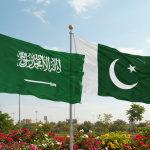
Gestures of profound mutual respect marked the signing of the SMDA. The warm embrace between Crown Prince Mohammed bin Salman and Prime Minister Shehbaz Sharif, accompanied by the presence of Pakistan’s Army Chief Field Marshal Asim Munir, symbolized the unity and trust that define this partnership. The ceremonial welcome in Riyadh, complete with a 21-gun salute and an aerial escort by Royal Saudi Air Force F-15 jets, underscored the significance of the occasion. Saudi and Pakistani flags adorned the capital, a visual testament to the deep bonds of friendship.
For the people of both nations, the SMDA is a source of pride. It reaffirms the shared values of Islamic solidarity and brotherhood that have long united Pakistan and Saudi Arabia. Prime Minister Sharif’s greetings to King Salman bin Abdulaziz and his gratitude for Saudi hospitality reflect the warmth of this relationship, which extends beyond geopolitics to the cultural and spiritual ties that bind the two nations.
Looking Forward: A New Strategic Era
The Strategic Mutual Defence Agreement is a bold step into a new era of Pak-Saudi relations. It is a testament to the vision and leadership of both nations, which have chosen to deepen their alliance at a time when the world faces unprecedented challenges. By committing to joint deterrence, intelligence sharing, and military cooperation, Pakistan and Saudi Arabia are not only safeguarding their own security but also contributing to global peace and stability.
This agreement is a cause for celebration, not just for the people of Pakistan and Saudi Arabia, but for all who value unity, resilience, and the pursuit of a secure and prosperous future. As the two nations stand shoulder to shoulder, they send a powerful message. Together, they are an unbreakable force, ready to face any challenge and shape a brighter tomorrow for the region and beyond.
Author