


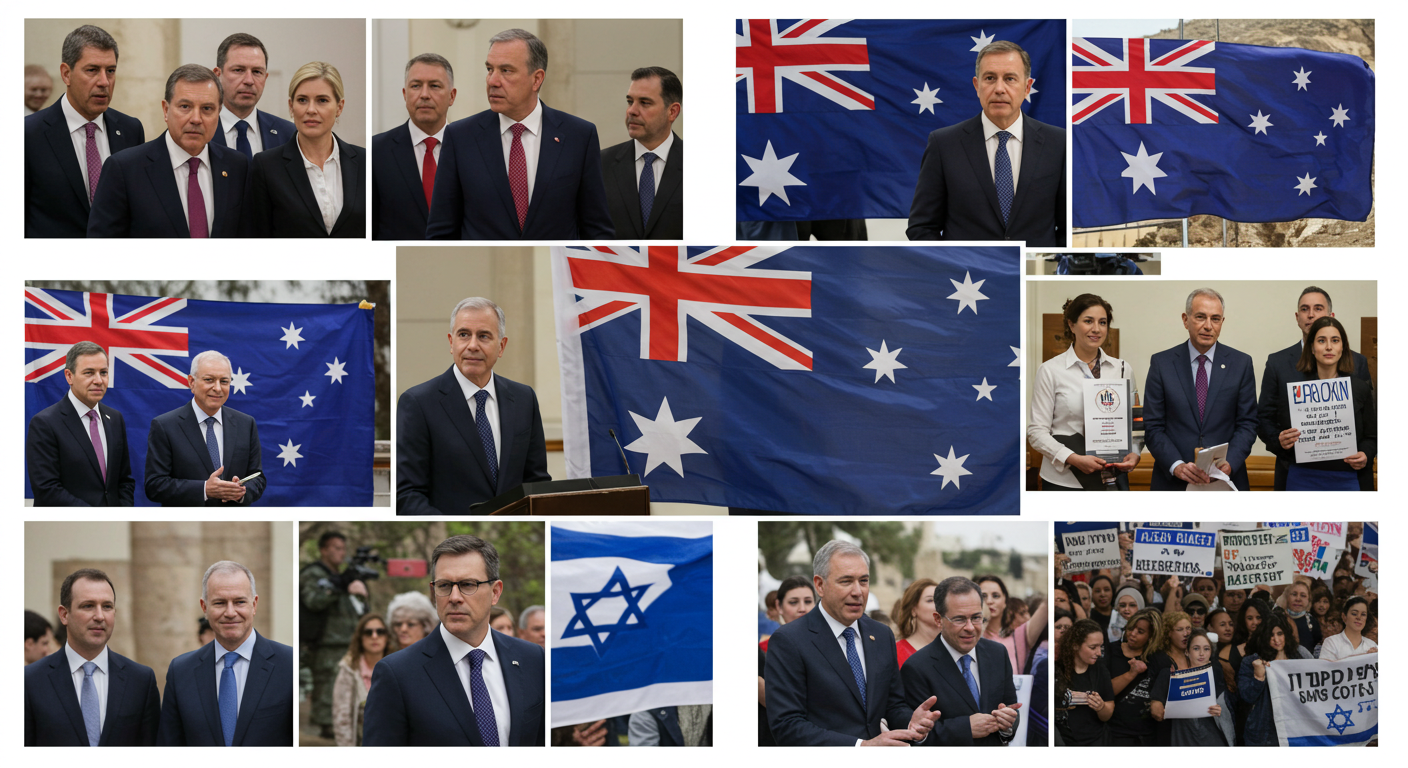
How Australia Shattered Netanyahu’s Rage Diplomacy and Stood for Principle
When Israel’s Prime Minister Benjamin Netanyahu accused Australian Prime Minister Anthony Albanese of “betraying Israel” and “abandoning Australia’s Jewish community,” he might have thought he was...

When Israel’s Prime Minister Benjamin Netanyahu accused Australian Prime Minister Anthony Albanese of “betraying Israel” and “abandoning Australia’s Jewish community,” he might have thought he was asserting strength. In reality, he revealed the very weakness that has come to define his politics: a reliance on rage diplomacy that alienates allies, isolates Israel, and endangers the very communities he claims to protect.
For decades, Australia maintained a cautious but steady relationship with Israel. Canberra was among the first nations to vote in favor of Israel’s creation in 1947. Both Labor and Liberal governments, despite occasional rebukes of settlement expansions, avoided outright recognition of Palestine and sought to balance support for Israel with humanitarian concerns. Australia’s sizeable Jewish community, including one of the world’s highest per capita populations of Holocaust survivors, reinforced this bond. In the past, Israel could rely on Australia as a quiet, reliable partner.
That era is over.
Australia’s Moral Awakening
The turning point came in early August 2025, when Australia announced it would formally recognize a Palestinian state, aligning itself with the United Kingdom, France, and Canada. This decision was not a symbolic gesture, but a carefully measured response to the escalating humanitarian crisis in Gaza, where more than 62,000 Palestinians have been killed since October 7, according to the Hamas-run health ministry. Prime Minister Albanese explained the move by highlighting the unacceptable deaths at aid distribution points, people queuing for food and water being shot or starved. “Netanyahu is in denial about the consequences of this war on innocent people,” he said. In recognizing Palestine, Australia joined 147 of the United Nations’ 193 member states who already acknowledge Palestinian statehood. Canberra’s decision placed it on the side of history’s moral arc, one that bends, slowly, but steadily, toward justice.
Netanyahu’s Toxic Response
Instead of engaging diplomatically, Netanyahu lashed out. He branded Albanese a “weak politician” and accused Australia of “abandoning its Jewish community.” These are not the words of a statesman but of a cornered politician who has made a career out of bullying allies. Israel’s opposition leader, Yair Lapid, captured the absurdity perfectly: “The thing that most strengthens a leader in the democratic world today is a confrontation with Netanyahu, the most politically toxic leader in the Western world.”
Netanyahu’s attacks follow a familiar script. When the UK, France, and Canada recognized Palestine, he accused their leaders, Keir Starmer, Emmanuel Macron, and Mark Carney, of siding with “mass murderers, rapists, baby killers and kidnappers.” Now, he has extended the same venom to Australia. This pattern reveals not strength, but a deep insecurity: Netanyahu cannot tolerate dissent, even from democracies that once stood firmly in Israel’s corner.
Australia’s Firm Response
Australia, for its part, has refused to bow to this pressure. Immigration Minister Tony Burke explained the government’s decision to cancel the visa of Simcha Rothman, a far-right Israeli MP, by saying: “If you are coming to Australia to spread a message of hate and division, we don’t want you here.” Rothman was due to speak at events organized by the Australian Jewish Association, but instead he will now appear virtually. This was not an isolated decision. In 2024, Australia also denied a visa to former Israeli justice minister Ayelet Shaked, citing the same principles. The message is consistent: Canberra does not tailor its visa policy to political convenience. Those who promote division and extremist rhetoric are not welcome, whether they come from Israel or anywhere else. Burke’s response to Netanyahu’s accusations cut through the fog of propaganda: “Strength is not measured by how many people you can blow up or how many people you can leave hungry.” This is the essence of the Australian position, rejecting Netanyahu’s militarized definition of power and replacing it with a humane vision rooted in dignity and life.
The False Charge of Antisemitism
Predictably, Netanyahu’s Foreign Minister Gideon Sa’ar accused Australia of “fueling antisemitism.” Such claims are designed to delegitimize legitimate criticism of Israel’s policies. Yet they collapse under scrutiny. Australia remains one of the safest democracies for Jewish life, even while antisemitic incidents, like in many Western countries, have increased in recent months. These hateful acts are deplored across the Australian political spectrum. To suggest that visa denials for divisive politicians or recognition of Palestinian rights amount to antisemitism is not only false, it cheapens the very real fight against antisemitism.
Netanyahu as Israel’s Diplomatic Liability
The deeper tragedy here is that Netanyahu’s behavior harms Israel itself. By attacking democratically elected leaders abroad, he undermines Israel’s relationships with countries that have historically provided diplomatic cover and security cooperation. His constant reliance on far-right figures like Rothman reveals a government beholden to extremism. And his refusal to acknowledge the humanitarian catastrophe in Gaza has turned Israel from a nation seeking security into one accused globally of waging collective punishment. Australia’s shift, therefore, is not a betrayal. It is a warning: democracies will not indefinitely shield Netanyahu’s policies when those policies contradict international law, humanitarian principles, and the democratic values they themselves uphold.
A Toxic Legacy, A New Moral Voice
In many ways, the confrontation between Netanyahu and Albanese is symbolic of a larger global reckoning. Democracies are realizing that their credibility cannot survive if they speak of human rights in Ukraine but remain silent in Gaza. By recognizing Palestine, by rejecting divisive foreign politicians, and by standing firm in the face of Netanyahu’s insults, Australia has positioned itself as a moral actor on the international stage.
Netanyahu, meanwhile, is left with fewer allies and fewer defenders. His legacy will not be that of Israel’s protector, but of Israel’s isolator, a leader who mistook bluster for diplomacy, and who weakened his nation’s standing in the world. History will not remember Albanese as “weak.” It will remember him as one of the leaders who had the courage to say that enough was enough, that human dignity matters, and that no nation, no matter how powerful, is beyond accountability. Netanyahu’s rage diplomacy may still win him cheers in extremist circles, but for the rest of the world, and for Australia in particular, it has only revealed a truth too long ignored: the real weakness lies not in standing for humanity, but in refusing to.
Author