


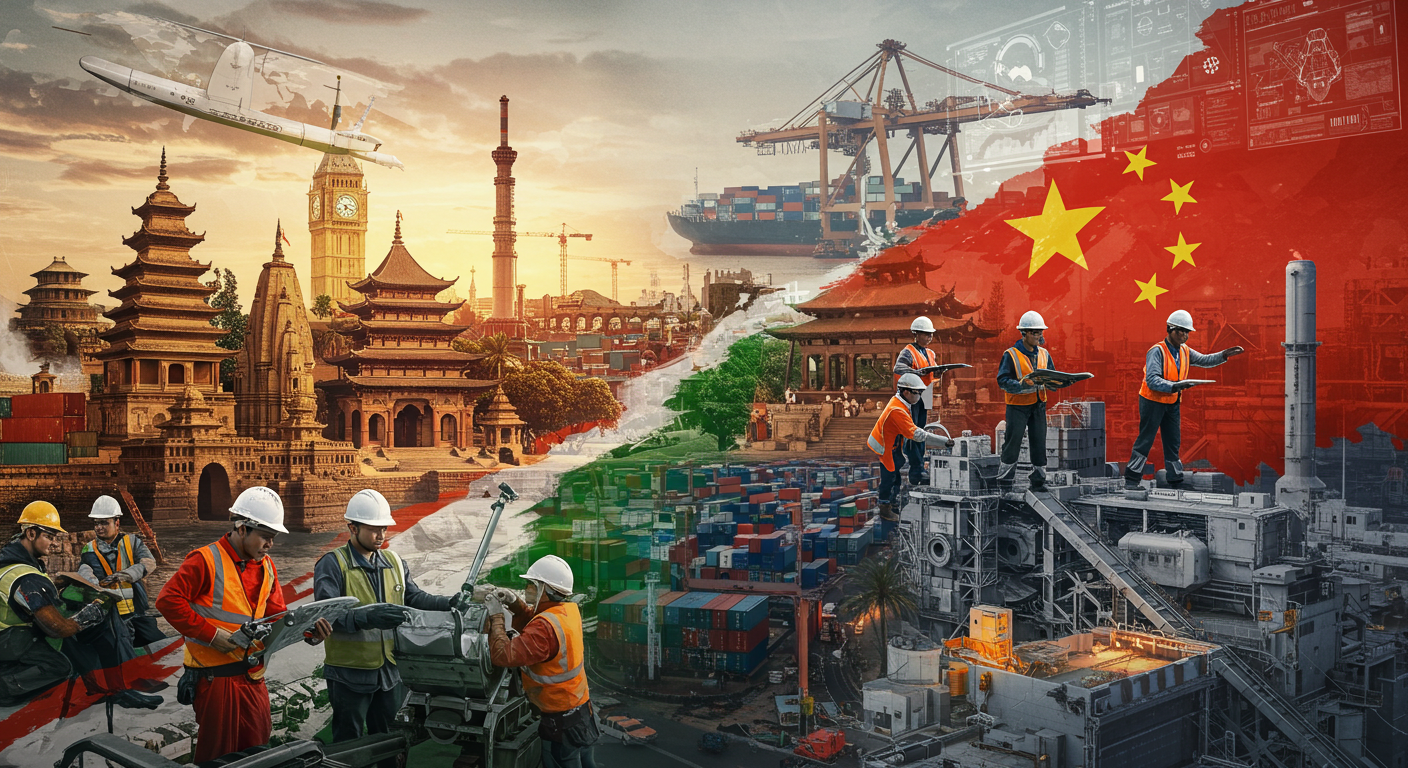
India and China: Why Friendship Is a Mirage in the Himalayas
By any measure, India and China are two of the most consequential players in the 21st-century geopolitical chessboard. They are the world’s two most populous nations, the second- and soon-to-be...

By any measure, India and China are two of the most consequential players in the 21st-century geopolitical chessboard. They are the world’s two most populous nations, the second- and soon-to-be third-largest economies, and both aspire to shape a multipolar order free from Western dominance. Yet their relationship is defined less by shared aspirations and more by hard-edged rivalries, military, economic, and strategic.
The latest border patrol agreement of 2024 October which has been courted by diplomatic circles as a politically enabled breakthrough has provided some breather in the long-drawn tensions that have visibly flared up following the 2020 deadly battle in Galwan Valley. This battle killed 20 Indian and 4 Chinese military personnel and led to years of military confrontation along the Line of Actual Control (LAC). The new deal was characterized by the establishment of guardrails of patrols, troop disengagement in some of the areas and restarting suspended military-to-military communications. Nevertheless, behind the mask of civil behavior, the principles are still the same. The damaged regions of Aksai Chin and Arunachal Pradesh remain to be sorted, LAC continues to be one of the most militarized border in the globe, and Indian representatives like S. Jaishankar openly confirm that normalization could not occur without the frontier peace.
If anything, the border is a litmus test for the wider relationship, and it consistently exposes deep mistrust. India’s military posture in Ladakh remains on high alert, while China continues to fortify its positions in Tibet. Both sides may have reduced the risk of accidental clashes, but neither has made the political concessions necessary for lasting peace.
The strategic rivalry runs far deeper than mountain ridges. India has been complaining that China is strangling it with the so-called string of pearls strategy, a Chinese infrastructure investments and political inroads in Sri Lanka, Nepal and the Maldives. The existential challenge experienced in New Delhi is the ironclad relationship that Beijing has with Pakistan, especially the China-Pakistan Economic Corridor traversing the disputed Kashmir. China, in its turn, views Indian membership in the U.S.-led Quad made up of Japan and Australia as an element of American attempts to surround the country and neither side is paranoid, this is a textbook security dilemma. Security of both countries is viewed as aggression by the other party as each country tries to protect its interests. The concern of India is that it would lose its influence in its backyard. In the case of China, it is infringement of the U.S. strategic assets in the Asian continent by the collusion of India. The two countries are even coordinating weakly in multilateral forums in which they both advocate multipolarity and reforms on global governance such as BRICS and the Shanghai Cooperation Organization. Beijing does not treat India as an equal party; New Delhi feels resentful about the fact.
Economically, the ties are both lucrative and lopsided. Bilateral trade hit a record $127.7 billion in FY2024/25, but the imbalance is staggering: India imported $113.5 billion worth of goods from China and exported only $14.3 billion in return. The $99.2 billion trade deficit is India’s largest with any country. Even after 2020’s border bloodshed, India’s dependence on Chinese electronics, machinery, and pharmaceutical ingredients only deepened. While Indian leaders speak of “self-reliance,” their industries remain tied to Chinese supply chains. Beijing enjoys access to India’s vast consumer market, while Indian goods face barriers in China. This is not economic partnership, it is economic leverage tilted in China’s favor.
In recent months, there has been a diplomatic thaw. Leaders have exchanged visits, resumed religious pilgrimages to Kailash Mansarovar, restarted direct flights, and reopened dialogues on river data and border management. China has even called for the two to be “partners rather than rivals.” But seasoned observers describe this as a “cold peace,” designed to manage disputes rather than resolve them. The underlying calculus is simple: avoid war, extract what benefits are possible, and keep the rivalry within controlled bounds.
Where the situation becomes even more revealing is in India’s conduct toward the United States, its so-called “strategic partner.” Washington has spent years courting New Delhi as a counterweight to Beijing, offering military cooperation, technology access, and political support. Yet India’s behavior under Narendra Modi’s “strategic autonomy” doctrine shows a pattern of selective engagement and opportunism. It maintains deep defense ties with Russia despite U.S. displeasure, refuses to commit to any formal alliance, and avoids open confrontation with China when its own interests dictate caution.
📄 POLICY WIRE WHITEPAPER PUBLISHED: PAKISTAN'S NATIONAL SECURITY POLICY PRIORITIES
👉 READ BY CLICKING HEREIf India cannot be fully aligned or “sincere” with the U.S, a nation it has actively courted for decades, why would Beijing expect unwavering partnership? The same hedging that frustrates Washington will inevitably limit any China–India rapprochement. For all of Modi’s handshake diplomacy, New Delhi’s default setting is to play multiple sides, extracting concessions without binding itself to any one power.
In the shifting winds of global politics, India’s calculus is straightforward: keep China close enough to prevent crises but distant enough to preserve leverage with the West. Beijing, in turn, will entertain this arrangement as long as it serves its own strategic and economic needs. But neither side is under any illusion that they are building genuine trust.
The result is a relationship defined by tactical cooperation and structural hostility. The October 2024 patrol agreement, the restored flights, and the polite rhetoric are all guardrails, not building blocks for friendship. Until the Himalayan border is settled, the trade imbalance addressed, and the strategic rivalry softened, talk of India and China becoming “friends” is just that—talk. And given India’s track record of transactional loyalty, even to its closest partners, Beijing would be wise to treat any handshake as a temporary alignment, not a lasting bond.
Author