

Pakistan’s Floods Are a Wake-Up Call: The Global Climate System Is Already Collapsing
The land is drowning, and the world is watching. In recent weeks, Pakistan has once again been ravaged by catastrophic monsoon flooding, with entire communities submerged beneath walls of glacial...

The land is drowning, and the world is watching.
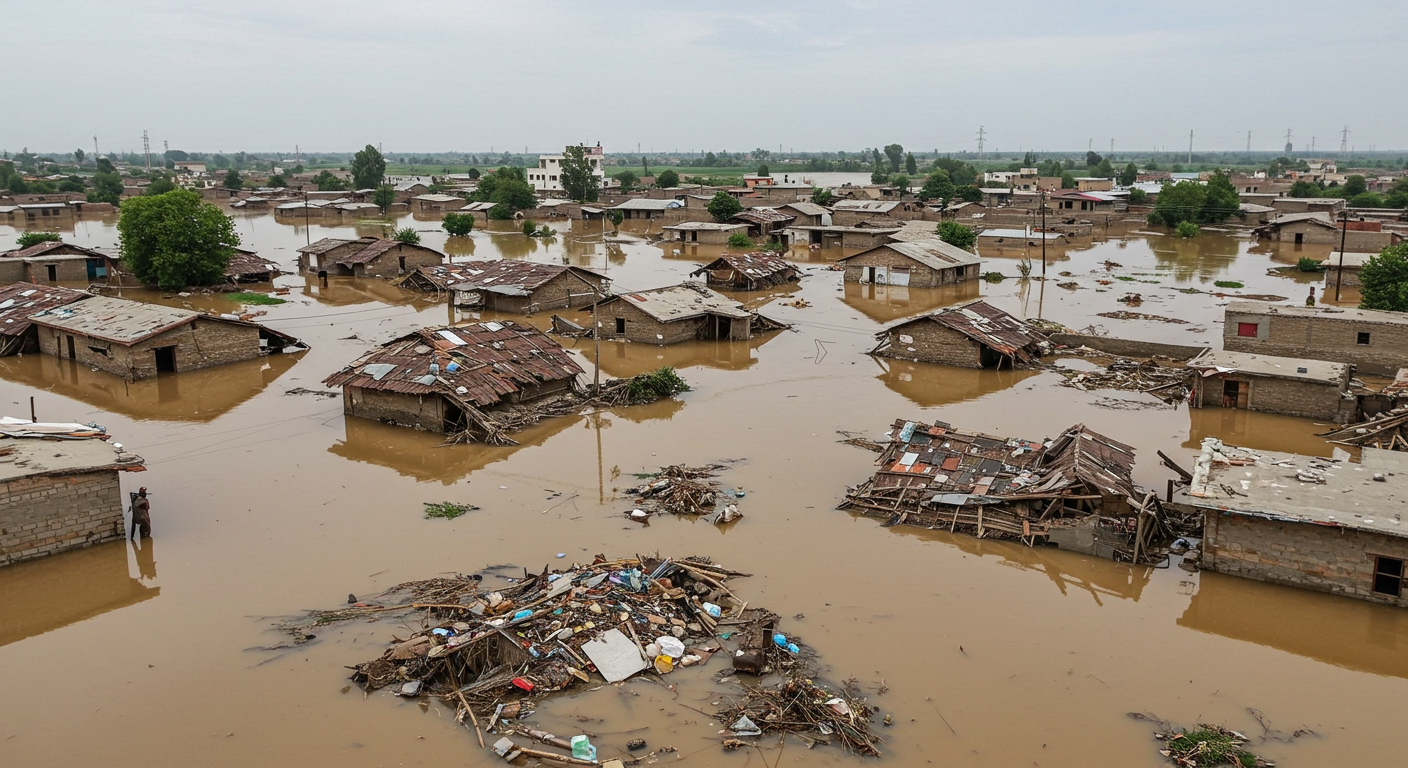
In recent weeks, Pakistan has once again been ravaged by catastrophic monsoon flooding, with entire communities submerged beneath walls of glacial meltwater and torrential rain. Seventy-two people are already dead; over a hundred have been injured. The figures will rise. They always do. This is not an anomaly. It is a pattern. And it is no longer fair to call it climate “change.” What we are witnessing is collapse. Systemic, nonlinear, and now irreversible in key parts of the world.
The Himalaya-Karakoram-Hindu Kush region, often referred to as the “Third Pole” due to its vast glacial reserves, is unraveling. Glaciers that took millennia to form are vanishing in weeks. This summer, Pakistan recorded some of the highest surface temperatures on Earth, triggering rapid glacial melting that fed into rivers already swollen by erratic monsoons. The result: flash floods, glacial lake outbursts, and deadly landslides. Villages washed away. Roads turned to rivers. Electricity grids destroyed. And in places like Gilgit-Baltistan, entire communities have been cut off. No power. No water. No state.
What is happening in Pakistan is not just a local tragedy. It is an indictment of the global climate architecture and the myth of climate “resilience.” Resilience for whom? For the petro-states of the Gulf and the carbon-hedged financial elites of the West? For the World Bank bureaucrats who arrive after the deluge, clipboard in hand, to audit the damage they failed to prevent? Pakistan contributes less than one percent of global greenhouse gas emissions, yet it is one of the most climate-vulnerable countries on the planet. This is not poetic irony. This is environmental injustice on a planetary scale.
The international response remains mired in delay, deflection, and denial. Rich nations pledged billions in “loss and damage” funding at COP summits, but these promises remain largely theoretical, trapped in red tape, and distributed with all the urgency of a climate committee meeting. Meanwhile, Pakistan bleeds. Not just water, but dignity. Climate reparations have become a euphemism for geopolitical charity, doled out in drips and conditionalities. This must change.
Because this is not just Pakistan’s future. It is everyone’s. The climate system is global, and it is interconnected. The monsoon failures of South Asia affect agricultural cycles in East Africa. The melting of the Hindu Kush impacts sea level rise from the Maldives to Miami. There is no “elsewhere” anymore. The dominoes are falling, and Pakistan is simply the first in a line of climate casualties the Global North prefers to frame as “developing nation problems.” But New York’s skies turned orange from Canadian wildfire smoke this year. Berlin faced heat-induced transport shutdowns. Beijing is rationing water. Collapse is no longer a theory. It is a daily lived experience.
Pakistan, for its part, has responded with admirable agency, crafting a Climate Risk Index and pushing for adaptation funding. But its efforts are undermined by a debt trap that forces the country to service IMF repayments even as it begs for flood relief. Climate justice cannot exist without economic justice. And economic justice cannot exist in a world where developing nations must choose between surviving the next flood and paying for the last loan.
What is needed now is nothing less than a total restructuring of the global climate governance regime. The Global South must not be treated as a casualty to be pitied, but as a co-equal architect of climate solutions. This means permanent seats for frontline states at the UN climate table. It means unconditional debt relief in the face of climate-induced disasters. It means mandatory, not voluntary, contributions to loss and damage funds. And it means understanding that climate collapse is not an environmental issue. It is a political one, rooted in centuries of extraction, exploitation, and epistemic erasure.
If the floods of 2022 were a warning, and the floods of 2025 are a pattern, then the floods of tomorrow will be collapse made permanent, unless we act with unprecedented urgency. Not in another conference. Not with another non-binding declaration. But with structural shifts in capital, accountability, and carbon control.
Pakistan is not asking for sympathy. It is demanding recognition, of a truth that is inconvenient to the industrialized world: that the age of climate collapse has already begun. That the future we feared is here. That the global climate system is not “breaking.” It is broken.
And still, even now, in the floodwaters, the people of Pakistan rebuild. That is not resilience. That is defiance. A defiance the world would do well to learn from. Before it is too late.
Author