

What is the New Eurasian Equation for Pakistan and Russia?
What is New Eurasian Equation For Pakistan and Russia

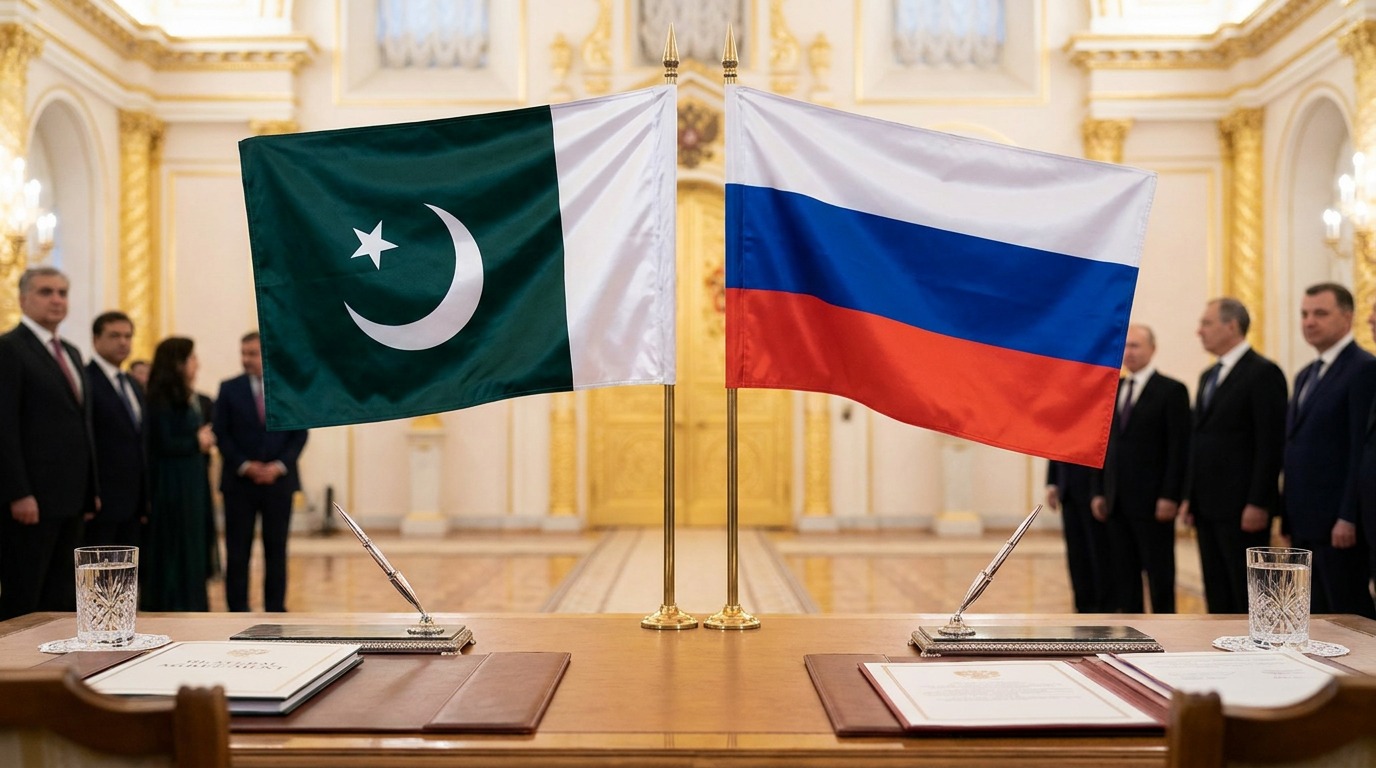
The Pakistan- Russia economic agreement signed in Moscow on November 25, 2026, represents an important development in the changing dynamics of Eurasian geopolitics. By setting a target of $5 billion in bilateral trade by 2030 and adopting a Program of Economic Cooperation for 2026-2030, the two countries have established a broader institutional framework for engagement across trade, energy, industrial development, agriculture, pharmaceuticals, transport, science and technology. More significant than the trade target itself, however, is the direction in which this partnership is evolving. At a time when economic relationships are increasingly intertwined with strategic calculations, Pakistan and Russia are exploring opportunities to translate their geographical, economic and technological complementarities into a more consequential bilateral relationship.
The development is best understood through the framework of geo-economics, which examines how states employ economic instruments to advance broader national and strategic interests. As Edward Luttwak argued, economic competition has increasingly become an extension of geopolitical rivalry. In this context, the expanding relationship between Islamabad and Moscow reflects a mutual recognition that economic cooperation can create strategic opportunities beyond conventional diplomatic engagement. For Pakistan, engagement with Russia offers prospects for diversifying energy sources, attracting industrial expertise, expanding export markets and strengthening access to Eurasian economic networks. For Moscow, Pakistan represents an opportunity to deepen its economic presence in South Asia, develop additional commercial partnerships and expand its engagement with markets beyond its traditional European orientation.
Energy cooperation remains one of the most immediate areas of convergence. Pakistan’s growing energy requirements, combined with Russia’s substantial hydrocarbon resources and established energy-sector expertise, provide a basis for mutually beneficial engagement. Yet the potential extends beyond crude oil imports. Cooperation in petroleum infrastructure, gas distribution, energy technology and industrial development could contribute to a more diversified energy relationship. For Russia, expanding its commercial engagement with South Asia offers opportunities to develop new markets; for Pakistan, a broader range of suppliers can strengthen energy security and improve its negotiating position in international energy markets. The objective should not simply be to replace one source of supply with another, but to develop a more resilient and diversified energy architecture.
Industrial cooperation offers another important dimension. The proposed Russian involvement in the modernization of Pakistan Steel Mills carries particular significance because it recalls an earlier period of bilateral economic engagement. Soviet technical and financial assistance played an important role in establishing the steel complex in the 1970s. Reviving industrial cooperation would therefore represent more than a continuation of historical ties; it could provide an opportunity to reconnect bilateral relations with Pakistan’s broader industrial ambitions. Similarly, cooperation in pharmaceuticals, agriculture and technological development could generate productive linkages between the two economies. The inclusion of science and outer space among the priority areas of the new cooperation framework is also noteworthy. If translated into concrete program, such engagement could extend bilateral relations into scientific research, technological applications and capacity development.
The geographical dimension is equally significant. Pakistan occupies a strategic position connecting South Asia with Central Asia, the Middle East and the Arabian Sea. Its location offers considerable potential for regional trade and transit connectivity, particularly as Eurasian states seek more diversified commercial routes. Russia’s interest in strengthening connectivity with Asian markets could create opportunities for Pakistan through railway cooperation, freight movement and broader regional transport arrangements. The International North-South Transport Corridor, alongside other emerging Eurasian connectivity initiatives, provides a potential framework for examining these possibilities. However, geographical advantage alone does not produce economic connectivity. Infrastructure development, customs harmonization, financial arrangements and regional stability will determine whether Pakistan can translate its location into meaningful commercial value.
From a theoretical perspective, this relationship also illustrates the logic of strategic hedging and multi-alignment. In an increasingly multipolar international system, states are not necessarily required to organize their external relationships around exclusive geopolitical blocs. Instead, they seek to preserve strategic flexibility by engaging different centers of economic and political power according to their respective national interests. Pakistan’s expanding engagement with Russia should be understood within this broader approach. It does not require Islamabad to reconsider its established relationships with China, the United States, Saudi Arabia or the European Union. Rather, a wider network of economic partnerships can increase its diplomatic flexibility and reduce excessive dependence on individual external relationships. Russia, similarly, can pursue closer economic engagement with Pakistan while maintaining its longstanding strategic partnership with India. The relationship can therefore develop through pragmatic cooperation without requiring geopolitical alignment.
Nevertheless, the prospects of this partnership must be assessed against its structural limitations. Christopher Clary, in his 2022 study published in Asian Survey, identifies the economic and geographical constraints affecting Russia–Pakistan relations. He argues that the relatively limited economic capacities of both countries, geographical distance and Russia’s longstanding defense relationship with India restrict the potential for deeper cooperation. More recent research by Ejaz Hussain and Muhammad Jahanzaib, published in 2025, similarly identifies historical mistrust, bureaucratic inertia and entrenched strategic alignments as persistent obstacles. These assessments underline an important distinction: diplomatic convergence does not automatically produce commercial integration.
Financial arrangements represent another critical challenge. Western sanctions against Russia complicate banking transactions, trade financing, insurance and access to international payment networks. Pakistan, meanwhile, remains deeply integrated into Western markets and international financial institutions. Consequently, both countries must develop reliable and legally compliant mechanisms for settling transactions without exposing their wider economic relationships to unnecessary risks. The proposed expansion of bilateral trade will also require stronger private-sector participation, predictable regulatory arrangements and viable transportation infrastructure. Without these foundations, the $5 billion target could remain an ambitious diplomatic objective rather than a measurable economic achievement.
The relationship with India also deserves careful consideration. Russia’s longstanding strategic, defense and economic partnership with New Delhi remains an important element of its South Asian policy. Moscow is unlikely to subordinate this relationship to its engagement with Islamabad. However, this should not be interpreted as an insurmountable obstacle to bilateral economic cooperation. India’s own ability to maintain substantial relations with both Russia and Western powers demonstrates that economic and strategic partnerships need not be mutually exclusive. Pakistan can similarly pursue a policy of multi-alignment, provided its external engagements remain guided by national economic interests rather than the assumptions of geopolitical rivalry.
Ultimately, the significance of the November agreement will be determined by its implementation rather than its diplomatic symbolism. The next phase requires converting institutional commitments into functioning trade mechanisms, industrial projects, energy arrangements, technological cooperation and regional connectivity. Pakistan and Russia have an opportunity to develop a partnership that draws strength from economic complementarity while accommodating their respective geopolitical priorities. For Islamabad, the objective should be to expand its economic options and strengthen its position within Eurasian networks. For Moscow, deeper engagement with Pakistan offers an additional avenue for economic outreach in South Asia. Their emerging relationship, therefore, is not necessarily the beginning of a new strategic bloc; it is an illustration of how states can pursue national interests through economic cooperation in a multipolar world. Its lasting value will depend on whether both countries can turn this convergence of interests into sustained economic capacity and tangible mutual gains.