

Loud Halloween Music Suspected of Triggering Bristol Footbridge Collapse
Bristol city officials investigate if loud music and vibrations caused the collapse of Pero's bridge. Recovery plans aim for a 2027 reopening.

POLICY WIRE — Bristol, UK — The chairman of Bristol’s harbour committee has suggested that loud music played on Halloween may have been the catalyst for the failure of a prominent city-center footbridge.
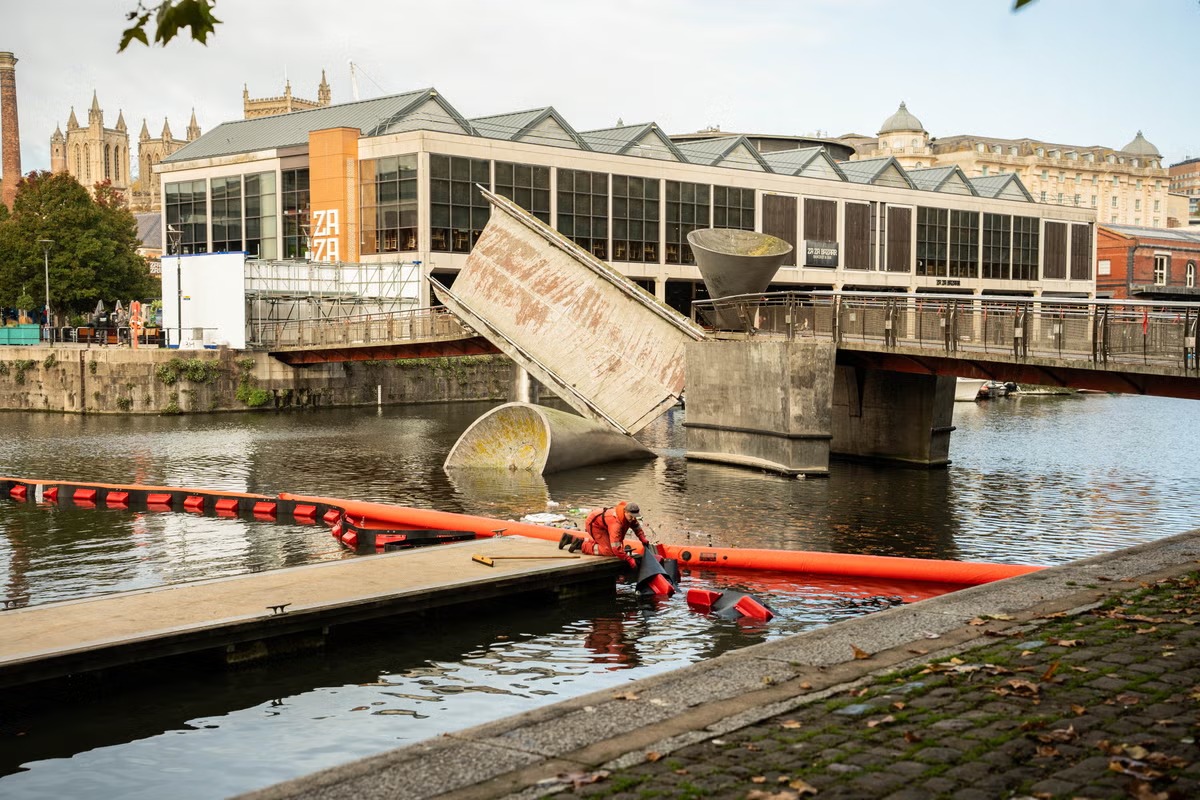
Pero’s bridge, a structure designed to lift and split open to facilitate boat traffic, originally suffered a mechanical failure earlier this summer that left it in a precarious state.
On the night of October 31, a section of the walkway gave way and fell into the water.
Councillor Andrew Brown noted in a blog post on the Bristol council website that external vibrations disrupting the structure’s balance might have been the breaking point.
He explained that these vibrations could have originated from heavy nearby traffic, gusts of wind, or music broadcasted from speakers located along the shore.
Since the incident, recovery teams involving Bristol City Council, the Bristol Harbour Authority, and specialized contractors have been developing a strategy for the safe extraction of the bridge spans.
The current objective for the project is to have the crossing operational in the harbour by the summer of 2027.
The bridge was already identified as being in critical need of repairs before the collapse occurred; in March, the Harbour Committee had sanctioned a £1.54m project to remove it temporarily for necessary work.
While those repairs were slated to begin in November, the middle portion of the bridge plummeted around 11pm, just days before the scheduled start date.
Brown stated that the definitive cause of the most recent movement cannot be confirmed with certainty.
In the coming days, workers will deploy four large rubber fenders, each 3 meters in diameter, to stabilize and float the center span while lift preparations are finalized.
Brown highlighted that since its debut in 1999, Pero’s bridge has served as a vital link for residents and tourists, connecting waterfront restaurants, bars, and attractions.
Local authorities have declined requests to install a temporary crossing in the meantime, citing the high costs associated with construction.
Reporting by Policy-Wire (PW)