

Iran Abolishes Self-Imposed Missile Range Limit as Gaza Floods Devastate
Iran removes its 2,000km missile range restriction as tensions rise, while torrential rains flood displaced Palestinian camps in Gaza.

POLICY WIRE — Tehran, Iran — Iran’s Revolutionary Guard has announced the removal of a previous internal restriction that limited ballistic missiles to a 2,000-kilometer (1,200 mile) range. This shift suggests Tehran may be pivoting toward weaponry capable of striking much more distant targets as fears of a total military conflict escalate.
The announcement follows a stern warning from Iran’s supreme leader, Ayatollah Mojtaba Khomeini. The leader stated that any provocation, regardless of scale or nature, originating from the United States or Israel would be met with a response not constrained by geographic boundaries.
During a press briefing in Tehran, Gen. Hossein Mohebbi confirmed that the former range restriction is no longer in effect. While Mohebbi declined to confirm whether Iran currently possesses missiles capable of exceeding the old limit, he noted that the nation would reveal its actual capabilities through practical application rather than verbal assertions.
Currently, Iran is not widely documented to possess missiles with reach beyond the 2,000-kilometer mark, a distance that encompasses most of Egypt, the Levant, the Arabian Peninsula, and parts of the Balkan Peninsula. However, U.S. officials have expressed ongoing concern that technology developed for Iran’s space program could be utilized to engineer intercontinental ballistic missiles.
In a separate security development, the Iranian military reported that a tanker located east of the Strait of Hormuz struck a naval mine and caught fire. Authorities did not specify the vessel’s nationality or its destination, claiming it was navigating a prohibited area and had switched off its navigational beacon.
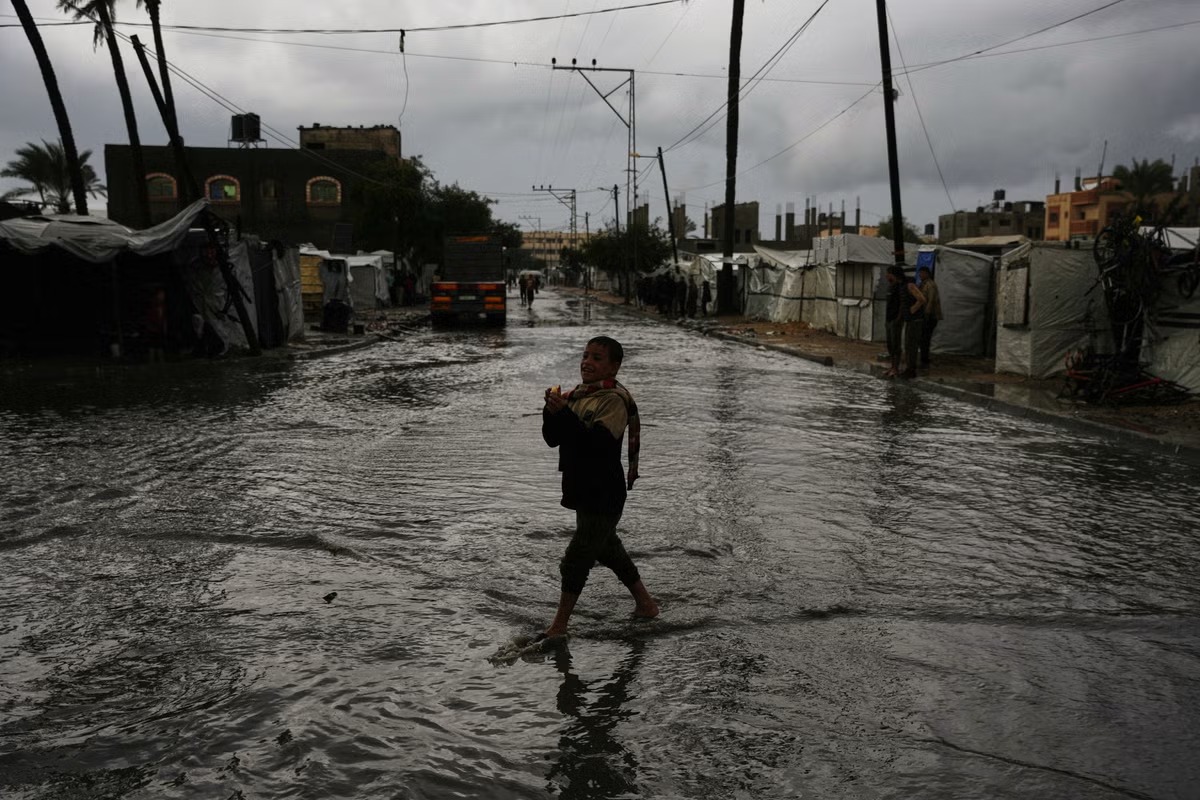
In the Gaza Strip, the humanitarian crisis has worsened as heavy rains battered the territory. The downpours have flooded makeshift shelters, soaking personal belongings and turning camp paths into deep mud for hundreds of thousands of Palestinians.
More than 1.6 million people currently displaced due to the Israeli military campaign are now facing a brutal winter. Majed Al-Omari, a resident who lost a limb in the conflict, struggled to navigate on crutches after rainwater destroyed his wooden and plastic shelter. He stated he would be forced to sleep on the street or find alternative refuge.
A UN humanitarian office noted that 294,250 families require urgent shelter assistance for the rainy season. Currently, available resources cover only 18% of those in need due to funding shortages, slow procurement processes, and delays from Israeli authorities, meaning aid may not arrive until after halfway through the winter.
Reporting by Policy-Wire (PW)em>