

Beyond Religion: The Global Race to Control the Halal Economy
The chicken on a dinner table in Riyadh may well have been raised in southern Brazil, a country where Muslims make up around 1% of the population. It was slaughtered under halal rules, certified by a...
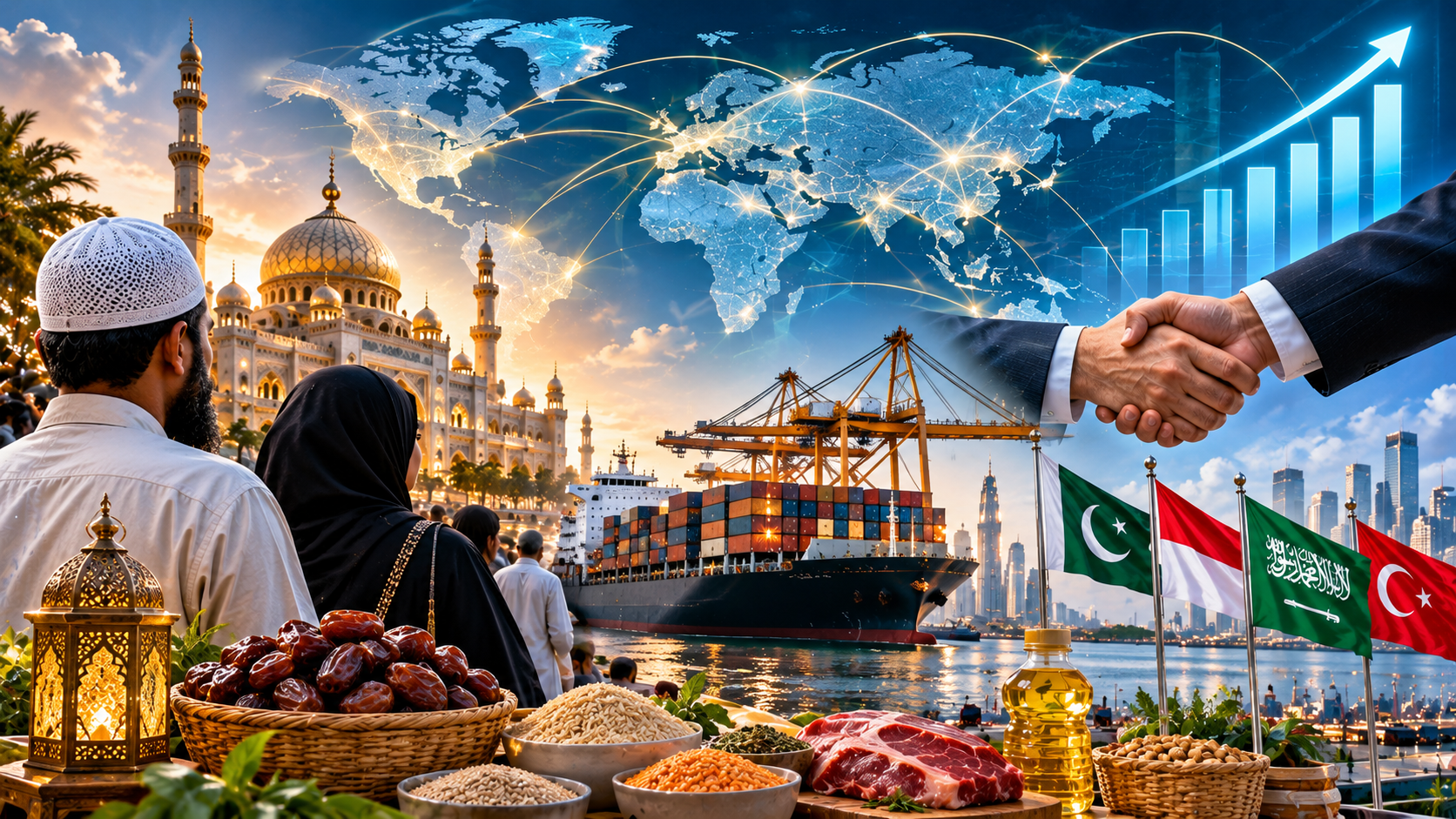
The chicken on a dinner table in Riyadh may well have been raised in southern Brazil, a country where Muslims make up around 1% of the population. It was slaughtered under halal rules, certified by a body Gulf regulators trust, packed by a Brazilian multinational and shipped halfway around the world. Brazil is now the world’s largest exporter of halal chickensending more than 2 million tonnes a year to Muslim consumers.
That journey raises a question most coverage of the halal economy skips. In a market worth trillions, who actually profits: the countries with the most Muslims, the countries with the most livestock, or the countries that control the processing, the certificates, the brands and the shipping?
The answer is reshaping one of the fastest-growing consumer markets on earth. The halal economy isn’t only about faith anymore. It’s about trade, manufacturing, standards and supply chains, and the countries that understand that are winning. Pakistan, which recently set out a $50 billion export ambition, is a revealing test of whether a newcomer can still break in.
A Market Bigger Than Its Name
The numbers explain why so many countries want in. The world’s two billion Muslims spent an estimated $2.6 trillion in 2024 across six sectors: halal food, pharmaceuticals, cosmetics, modest fashion, Muslim-friendly travel, and media and recreation. The State of the Global Islamic Economy Report, produced by DinarStandard, projects that figure will reach $3.56 trillion by 2029. Food is the largest piece, at $1.53 trillion. Travel is the fastest-growing, forecast to rise from $249 billion to $424 billion.
Two cautions keep these figures honest. They measure what Muslim consumers spend, not the value of halal exports, so no country can simply “capture” them. And the 2029 numbers are projections, not results.
What the report says next is more revealing than the totals. It describes the Islamic economy as shifting “from demand growth toward halal economy sovereignty”: stronger domestic value chains, digital certification and countries determined to produce more of what they consume. Demand is no longer the scarce resource. Control is. And three countries show three very different ways of getting it.
Brazil: Scale Without a Muslim Majority
Brazil’s halal story began with a barter. In the late 1970s, it started trading chicken for Saudi oil. Fifty years later, it is the largest supplier of food to the Muslim world, driven above all by halal-certified chicken and beef, and around 30% of its meat exports go to Muslim-majority countries.
Three things made that possible, and none of them is religion. The first is scale: Brazil is the world’s largest beef producerand a top-three chicken producer. The second is industrial processing, concentrated in large companies that can meet strict import standards at volume. The third is trust. Brazil’s halal certifiers, led by FAMBRAS since 1979, built credibility with Gulf and Asian regulators decade by decade. Industry figures now argue that no non-Muslim country’s halal seal is as internationally respected.
Brazil’s lesson is uncomfortable for Muslim-majority producers. Having the customers’ faith doesn’t guarantee a share of their market. Having the farms, the factories and a certificate the buyer accepts does.
Malaysia: Certification as Economic Infrastructure
If Brazil shows the power of production, Malaysia shows the power of the rulebook. It has topped the Global Islamic Economy Indicator for 12 consecutive years, ranking first in halal food, Islamic finance, and halal pharmaceuticals and cosmetics. Its halal exports reached RM68.52 billion in 2025, about $16 billion, driven by food, beverages and halal ingredients.
Malaysia didn’t get there by raising more cattle. It built institutions. A state-run certification system whose logo is recognised across Muslim markets, a development agency dedicated to the halal industry, specialised industrial parks and an annual trade showcase together turned “halal” from a religious requirement into a brand Malaysia owns. Ingredients made elsewhere can be processed, certified and exported as Malaysian halal products.
That is the quiet secret of the halal economy. A certificate isn’t paperwork. It is market access. The country whose standard importers trust can sit in the middle of supply chains it doesn’t physically produce, and collect value at every step.
Indonesia: Turning Demand Into Leverage
Indonesia, home to the world’s largest Muslim population, holds the third kind of power: the buyer’s. For years it was a giant consumer that imported much of what it ate, and it remains one of the world’s largest importers of halal meat. Now it is using the size of its market to reshape the rules.
Since October 2024, halal certification has been mandatory for food and beverages from medium and large domestic businesses, and its certifying body says it has certified 9.6 million products. Imports and smaller firms were next in line, though in October 2026 the government pushed their deadline back to 2028. Alongside the law sits an industrial roadmap for halal manufacturing to 2029.
The strategy is clear. A market of more than 200 million Muslim consumers can insist that anyone selling to it meets its standard, and can use that leverage to build its own processing industry. The repeated delays show how hard the transition is. But the direction is unmistakable: Indonesia wants to stop being only a destination for halal goods and become a producer of them.
Three countries, three models: Brazil wins on production, Malaysia on standards, Indonesia on demand. What connects them is the question every newcomer has to answer.
The Real Competition: Who Controls the Value Chain
Picture a halal product’s journey in four stages. One country raises the livestock or grows the crop. A second processes, packages and certifies it. A third owns the brand, the distribution network or the supermarket shelf. And consumers somewhere else buy the finished product.
Each stage captures a different share of the value, and the share grows as the product moves away from the farm. Raw materials earn the least. Processing earns more. Certification, branding and distribution earn the most, because they decide who can sell at all and on what terms. That is why a country can supply a market and still capture little of it.
The competition is now moving up the chain. The SGIE report highlights AI-enabled certification and blockchain traceability as emerging opportunities, technologies that let buyers verify a product’s origin and compliance from farm to shelf. Whoever builds and runs those systems will hold a new kind of gatekeeping power.
So the real contest isn’t simply who produces halal goods. It is who sets the standards, runs the factories, owns the brands and controls the data. And that is precisely where Pakistan’s ambition becomes interesting.
Pakistan: The $50 Billion Ambition
At the first Pakistan Halal Forum in Karachi on 31 October, the government-run Pakistan Halal Authority set out a striking goal: to lift the country’s halal exports to $40–50 billion a year. The plan, it said, was to shift from exporting raw materials to value-added, certified products, support small businesses and create “One National Halal Mark, One Standard”. Organisers also proposed dedicated halal economic zones and pitched Pakistani firms to buyers in the Gulf, Malaysia and Indonesia.
The starting point explains the urgency. The forum’s organisers noted that despite having the world’s second-largest Muslim population, Pakistan holds less than 1% of the global halal economy. It also has one of the world’s largest livestock populations, yet its halal meat exports stand at about $512 million, according to Islamabad-based EMPAK Strategies.
The ambition deserves a careful reading. The $40–50 billion figure spans every halal sector, from food and pharmaceuticals to cosmetics, fashion and tourism, and the forum’s statement didn’t set out a sector-by-sector roadmap, an investment estimate or a timeline. EMPAK’s own analysis sees a path for meat exports to reach as much as $5 billion by 2030 with the right reforms, a tenfold rise but still a fraction of the headline target. The goal is best read as a direction of travel, not a forecast.
And the direction is the right one. Pakistan’s strategy, moving from raw materials to certified, branded products, is exactly the move up the value chain that Brazil, Malaysia and Indonesia have each made in their own way. The question is what stands in the way.
The Structural Gap
Pakistan’s challenge maps neatly onto the three models. It has some of Brazil’s raw material but not its industrial scale. It has a halal authority but not yet Malaysia’s internationally trusted standard. It has a large domestic market but hasn’t turned it into Indonesia-style leverage.
EMPAK’s analysis identifies the specific bottlenecks: disease control, certification, cold-chain infrastructure, traceability and value-added processing. Each one matters for a reason importers care about.
Disease control decides which markets are open at all. Many of the most valuable meat importers require animals from zones certified free of diseases such as foot-and-mouth, and without them, producers are confined to fewer, lower-paying markets.
Certification decides whether buyers trust the label. A national mark only works if foreign regulators recognise it, which is why the proposed “One National Halal Mark” is potentially the most important item in the whole plan.
Cold chains and traceability decide whether a product arrives safe and can prove its journey. As blockchain and digital verification spread, this is fast becoming a condition of entry rather than an advantage.
Value-added processing decides how much of the final price stays at home. Exporting live animals or bulk carcasses earns the least. Exporting packaged, branded, certified food earns the most.
None of these gaps is about faith or resources. All of them are about institutions, investment and trust, the same things that built Brazil’s and Malaysia’s positions over decades.
Why It Matters Beyond Pakistan
The halal economy’s shift toward “sovereignty” isn’t only a story about exporters. It is also about the importers, and they have their own reasons to want more suppliers.
A large share of the halal protein that Muslim markets import travels from distant producers, with Brazil the biggest of them. The disruption of Gulf shipping this year showed how quickly long supply lines can become a vulnerability. Importing governments that want food security have an interest in a wider, closer and more diverse supplier base, and a credible producer a few days’ sailing from the Gulf offers exactly that. Pakistan’s growing economic framework with Saudi Arabia, including agriculture and food processing among its investment priorities, points the same way.
Capital is following the opportunity. The SGIE report counted 346 investment deals worth about $13.1 billion across Islamic economy sectors in 2024 and 2025. That money goes where standards are trusted and processing capacity exists.
For Pakistan, the implication is clear. The opening is real, but it won’t be filled by declarations. It will be filled by the first producer that can offer what importers actually buy: disease-free supply, a recognised certificate, cold chains that hold and products ready for the shelf.
Beyond Religion
The halal economy was built on faith, but it is being won on infrastructure. Brazil proved a country with almost no Muslims could become its largest food supplier. Malaysia proved a certificate could be worth more than a herd. Indonesia is proving that a market’s size can be turned into the power to set rules.
The lesson for every aspiring player, Pakistan included, is the same. Religious credentials open the conversation. They don’t close the sale. In a market worth trillions, the real competition isn’t over who produces halal goods. It’s over who controls the standards, the processing, the technology and the supply chains that decide who profits from them.
Pakistan has named the right destination. Whether it becomes a maker of global halal products, rather than a country with the potential to supply them, will depend on how quickly it builds the institutions that its competitors spent decades putting in place.