
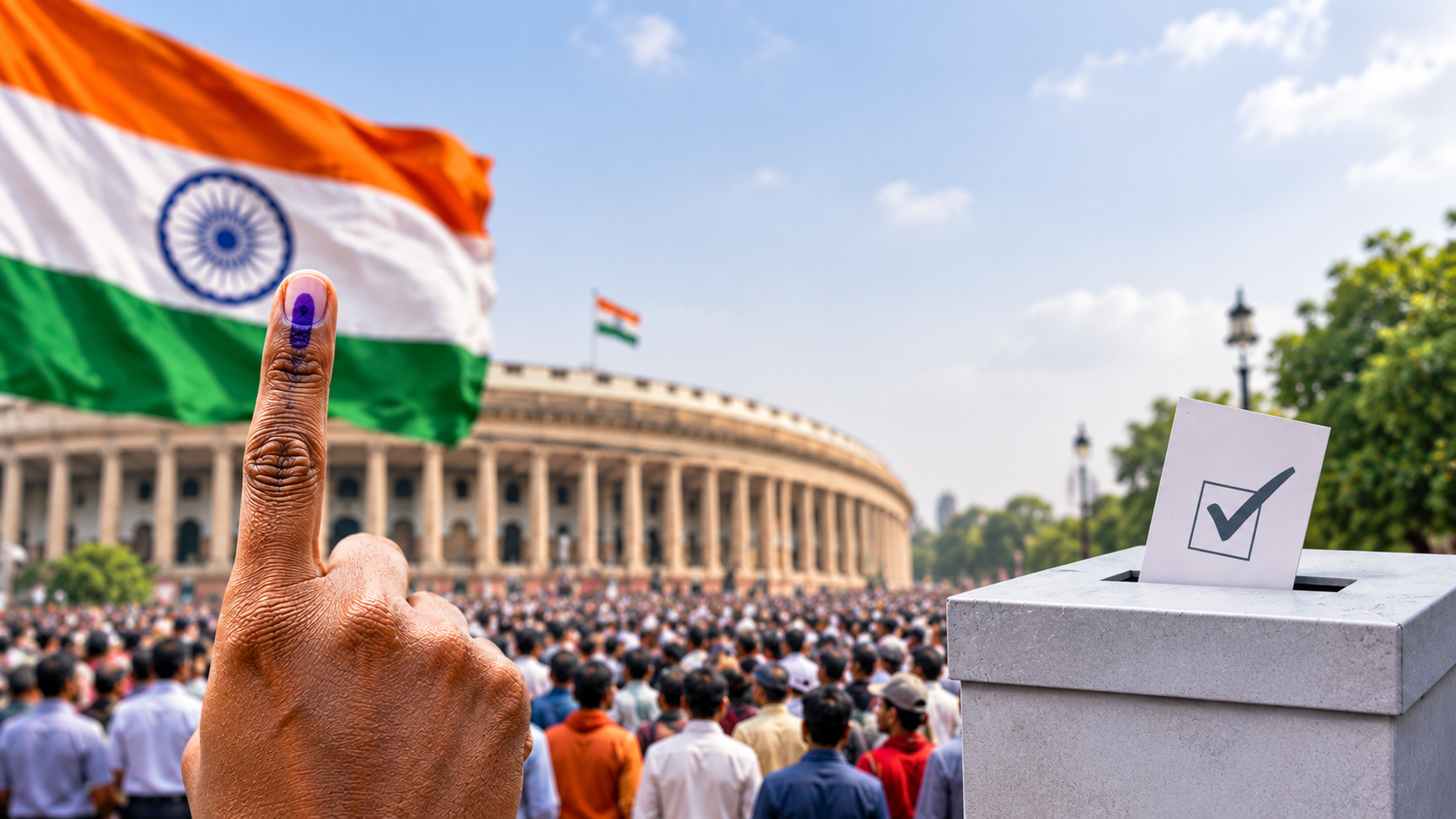
The World’s Largest Democracy: A Claim Under Question
Democracy is a house with two doors. The first door allows citizens to enter and choose their government through elections. The second allows them to question those in power, challenge decisions and...
Democracy is a house with two doors. The first door allows citizens to enter and choose their government through elections. The second allows them to question those in power, challenge decisions and demand accountability. Both doors must remain open for democracy to function. But what happens when entering through the first door becomes increasingly difficult, while questioning those inside becomes a source of legal and political complications? This is the question confronting Narendra Modi’s India, where growing electoral controversies are forcing a closer examination of its claim to be the world’s largest democracy. A democracy is not defined only by how many people enter through the voting door. It is also defined by whether they can freely use the other door to question those who govern them.
On November 1, 2026, thousands of opposition supporters gathered at Delhi’s Ramlila Maidan, demanding the resignation of Chief Election Commissioner Gyanesh Kumar. Led by Congress leader Rahul Gandhi, the demonstration brought together opposition parties, youth activists and other protesters against the Election Commission’s Special Intensive Revision (SIR) of voter lists. The protest was not simply another confrontation between the ruling Bharatiya Janata Party (BJP) and its population. It exposed a much deeper debate about who gets to vote, who controls the electoral process and how much space remains for those who challenge it.
130 Million Voter Deletions: Who Gets to Enter Democracy?
The first concern is India’s voter-list revision. According to The Indian Express, more than 133.7 million names were removed from draft electoral rolls across 30 states and Union Territories. Delhi recorded a 32.8 per cent reduction, while Maharashtra registered a 21.1 per cent decline. The Election Commission claims that the exercise is necessary to remove duplicate registrations, deceased voters and people who have permanently relocated. However, the scale of these deletions raises an important question: can an administrative process designed to clean electoral rolls unintentionally exclude citizens who remain eligible to vote?
For millions of poor families, migrant workers and people with limited access to official documentation, navigating registration procedures can be difficult. Opposition parties have also alleged that minority communities, particularly Muslims, have been disproportionately affected. These allegations require independent, state-wise verification and cannot be treated as established facts. Nevertheless, even the possibility of eligible voters being excluded deserves serious scrutiny. The Election Commission subsequently ordered a special enrolment drive to register voters left out of the revision process. This makes transparency, accessible appeals and timely restoration of names essential to electoral fairness.
Election Commission: Who Guards the Guardians?
The second concern lies within the institution responsible for protecting electoral fairness. In December 2023, India’s Parliament changed the law governing the appointment of election commissioners. The new selection committee consists of the Prime Minister, a Union Cabinet Minister and the Leader of the Opposition. Previously, the Supreme Court had prescribed a committee that included the Chief Justice of India alongside the Prime Minister and opposition leader. By replacing the Chief Justice with a government minister, the new arrangement gives the government two of the committee’s three positions.
This has raised questions about the institutional independence of the Election Commission. The debate became more significant in September 2026, when The Indian Express reported that two Election Commissioners, Sukhbir Singh Sandhu and Vivek Joshi, had formally objected at least 14 times over ten months to decisions concerning voter registration, deletions and electoral database management. Their objections reportedly included concerns about changes to registration procedures and the centralisation of electoral data. The Commission acknowledged the objections but maintained that its decisions were unanimous.
These developments raise a fundamental question: how can an election authority maintain public confidence when questions about its internal decision-making are being raised by its own commissioners? An independent Election Commission is not merely an administrative requirement; it is a central safeguard against the misuse of electoral power.
Political Dissent: Is the Second Door Still Open?
The third concern is the space available to challenge government decisions. On November 2, Reuters reported that Bollywood actor Imran Khan, a US citizen and Overseas Citizen of India (OCI) cardholder, was allowed to remain in India until December 7 following proceedings linked to his participation in an anti-SIR protest in Mumbai. The Bombay High Court sought an unconditional apology and an undertaking that he would not participate in similar protests again.
The legal distinction matters. OCI cardholders do not enjoy the same political participation rights as Indian citizens, and foreign nationals are subject to separate immigration restrictions. Therefore, this case cannot be presented as proof that Indian citizens have lost their constitutional right to protest. However, it raises a wider question about how administrative powers are applied when political demonstrations involve sensitive government decisions. In a democracy, the ability to question public institutions remains essential for accountability, even when the legal rights of different categories of participants vary.
History Shows Why Public Resistance Matters
Democratic history offers important lessons. In the United States, the 1965 Selma movement challenged discriminatory voting restrictions and helped build momentum for the Voting Rights Act. In Serbia, mass protests in October 2000 challenged Slobodan Milošević’s refusal to accept the opposition’s electoral victory, eventually forcing recognition of the result. Similarly, South Korea’s 1987 democracy movement pushed the government towards constitutional reforms and direct presidential elections. In each case, public pressure became an important force for demanding institutional accountability and protecting political participation.
These examples do not suggest that every protest produces democratic reform. They demonstrate that the ability to organise, question authority and demand electoral safeguards is an important part of democratic life.
The World’s Largest Democracy: A Claim Under Question
India’s position as the world’s largest democracy is primarily based on the size of its electorate. But being the largest democracy and demonstrating the strength of democratic institutions are two different measures. Freedom House’s 2026 assessment gave India 62 out of 100 and classified it as “Partly Free”, compared with 63 in 2025. While this assessment does not determine the validity of India’s elections, it adds to the international debate about political rights and civil liberties.
The controversies surrounding voter deletions, the Election Commission’s appointment structure and political protests must therefore be examined together. They raise a broader question about whether institutions designed to protect democratic participation are providing sufficient safeguards for citizens to exercise their rights and challenge those in power.
Ultimately, democracy cannot be reduced to election results, parliamentary numbers or the size of an electorate. Its real strength lies in keeping both doors open: the door through which citizens choose their government and the door through which they hold it accountable. If India wants its claim to the world’s largest democracy to carry genuine democratic weight, it must demonstrate not only that millions can vote, but also that eligible voters are protected from exclusion, election authorities command public confidence and political dissent remains possible. Otherwise, the question will continue to follow Modi’s India: is it measuring democracy by the number of people who vote, or by the rights and freedoms those people actually enjoy?