


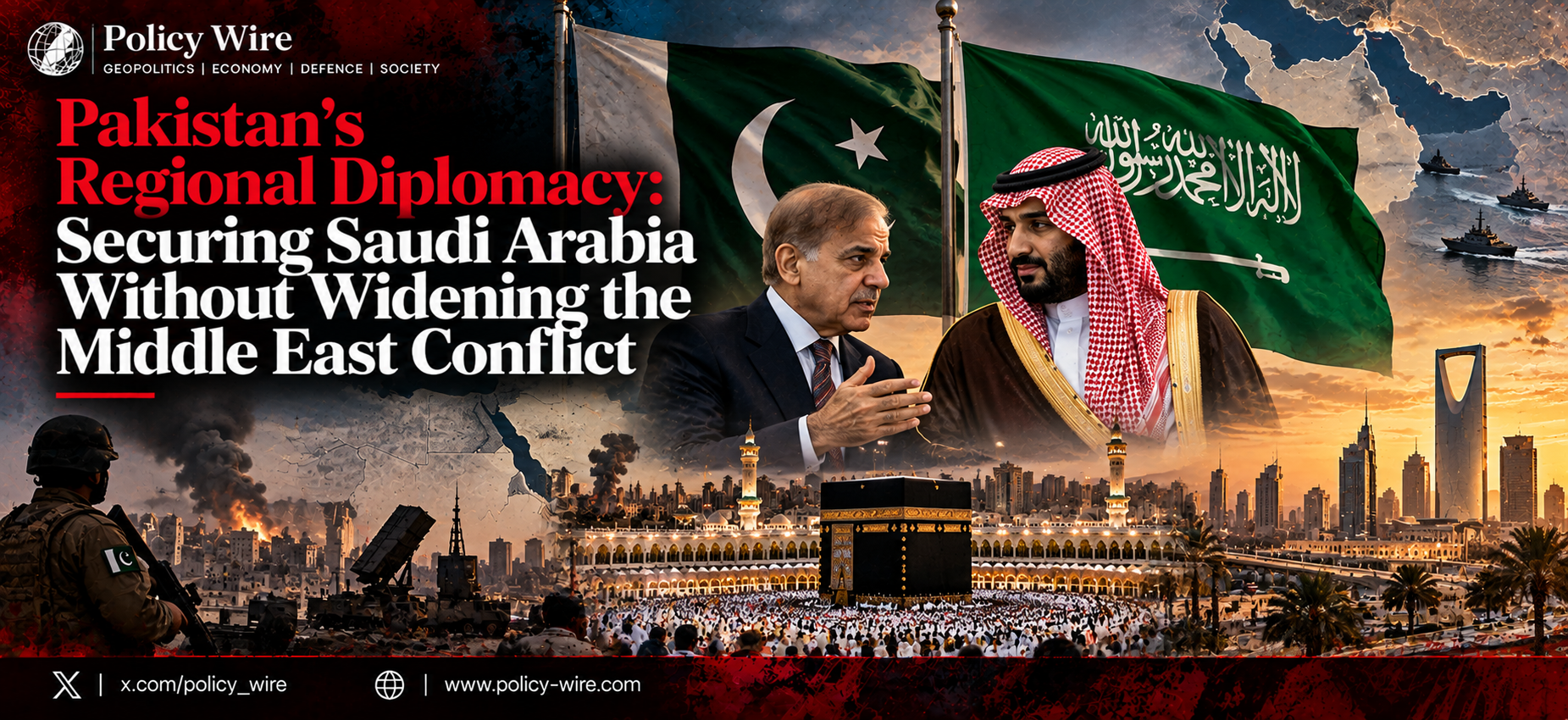
Pakistan’s Regional Diplomacy: Securing Saudi Arabia Without Widening the Middle East Conflict
The real test of regional diplomacy is not merely the ability to build strategic partnerships, but to protect them without creating new fault lines. For Pakistan, this challenge has become...

The real test of regional diplomacy is not merely the ability to build strategic partnerships, but to protect them without creating new fault lines. For Pakistan, this challenge has become particularly significant as security concerns surrounding Saudi Arabia intersect with tensions involving Iran, the Houthi movement in Yemen and the stalled diplomatic process between Tehran and Washington. Islamabad’s approach reflects an important strategic calculation: safeguarding a close partner and preventing regional escalation are complementary objectives, not competing priorities.
Saudi Arabia occupies a central place in Pakistan’s strategic outlook. Decades of defence cooperation, economic engagement and political coordination have established a relationship that extends beyond conventional bilateral ties. The security of the Kingdom is also connected to the stability of the wider Gulf, through which vital energy supplies and commercial routes pass. Any sustained threat to Saudi territory or critical infrastructure therefore carries implications that extend well beyond Riyadh, affecting regional confidence and Pakistan’s own economic and security interests.
Pakistan’s commitment to Saudi security must consequently be understood in both bilateral and regional terms. Credible defence cooperation strengthens deterrence by making clear that threats against a strategic partner cannot be considered in isolation. However, deterrence achieves its greatest value when it prevents conflict rather than merely prepares states for its consequences. This distinction makes diplomacy an essential complement to Pakistan’s security commitments.
Engagement with Iran is particularly important in this context. Tehran’s political influence and connections within the region give it a potentially significant role in efforts to reduce tensions involving the Houthi movement. Encouraging Iran to use that influence to discourage attacks on Saudi Arabia offers a diplomatic pathway towards de-escalation. Such engagement does not presume that Tehran exercises complete control over Houthi decisions. Rather, it recognises that regional actors with relevant relationships can contribute to restraint and should be encouraged to do so.
For Pakistan, maintaining communication with Iran while standing by Saudi Arabia is not a contradiction. It is an exercise in strategic compartmentalisation, separating enduring security commitments from disagreements that can still be managed through dialogue. Abandoning engagement with Tehran would narrow the channels available for reducing tensions, while treating attacks against Saudi Arabia as a secondary concern would undermine the credibility of Pakistan’s commitments. A balanced policy must avoid both outcomes.
This approach also carries significance for the wider regional order. The Middle East has repeatedly demonstrated how conflicts involving one actor can draw in additional states, transforming localised disputes into broader confrontations. Attacks on critical infrastructure, threats to maritime navigation and retaliatory military action can create a cycle in which every response generates fresh insecurity. Pakistan has a direct interest in preventing such a sequence, particularly when regional instability can disrupt energy markets, trade and the economic recovery of developing countries.
The broader diplomatic challenge concerns relations between Iran and the United States. A durable reduction in regional tensions will remain difficult while the two countries lack a workable framework for addressing their differences. Disputes over sanctions, nuclear-related concerns, security arrangements and mutual mistrust cannot be resolved through pressure alone. Equally, negotiations require credible commitments and a willingness to address the concerns of both sides.
Pakistan can contribute by maintaining channels of communication, facilitating indirect exchanges and encouraging practical steps that restore confidence. Its geographical position, relationships across the region and established ties with both Saudi Arabia and Iran provide opportunities for constructive engagement. Nevertheless, mediation has limits. Islamabad cannot compel concessions from either Washington or Tehran, and its diplomatic credibility will depend on maintaining realistic expectations and avoiding claims of progress unsupported by tangible outcomes.
Pakistan’s defence partnerships, including its cooperation with Saudi Arabia and Türkiye, can reinforce regional deterrence. Their long-term value, however, will depend on the clarity of their commitments and the ability of participating states to prevent misunderstandings from escalating into confrontation. Security arrangements should discourage aggression while leaving sufficient diplomatic space for disputes to be managed peacefully.
Ultimately, Pakistan’s strategic objective should be to establish a regional environment in which its commitments remain credible, its diplomatic channels remain open and its partners can pursue security without being drawn into an expanding conflict. This requires consistency rather than rhetorical balancing: firm opposition to threats against Saudi Arabia, sustained engagement with Iran and continued support for meaningful US-Iran dialogue.
Pakistan’s most consequential contribution may lie in connecting these objectives. By combining credible security cooperation with persistent diplomacy, Islamabad can help narrow the space for escalation while protecting its own strategic interests. The measure of success will not be the ability to navigate competing relationships indefinitely, but the ability to turn those relationships into instruments of restraint, stability and a more secure regional order.
Author