


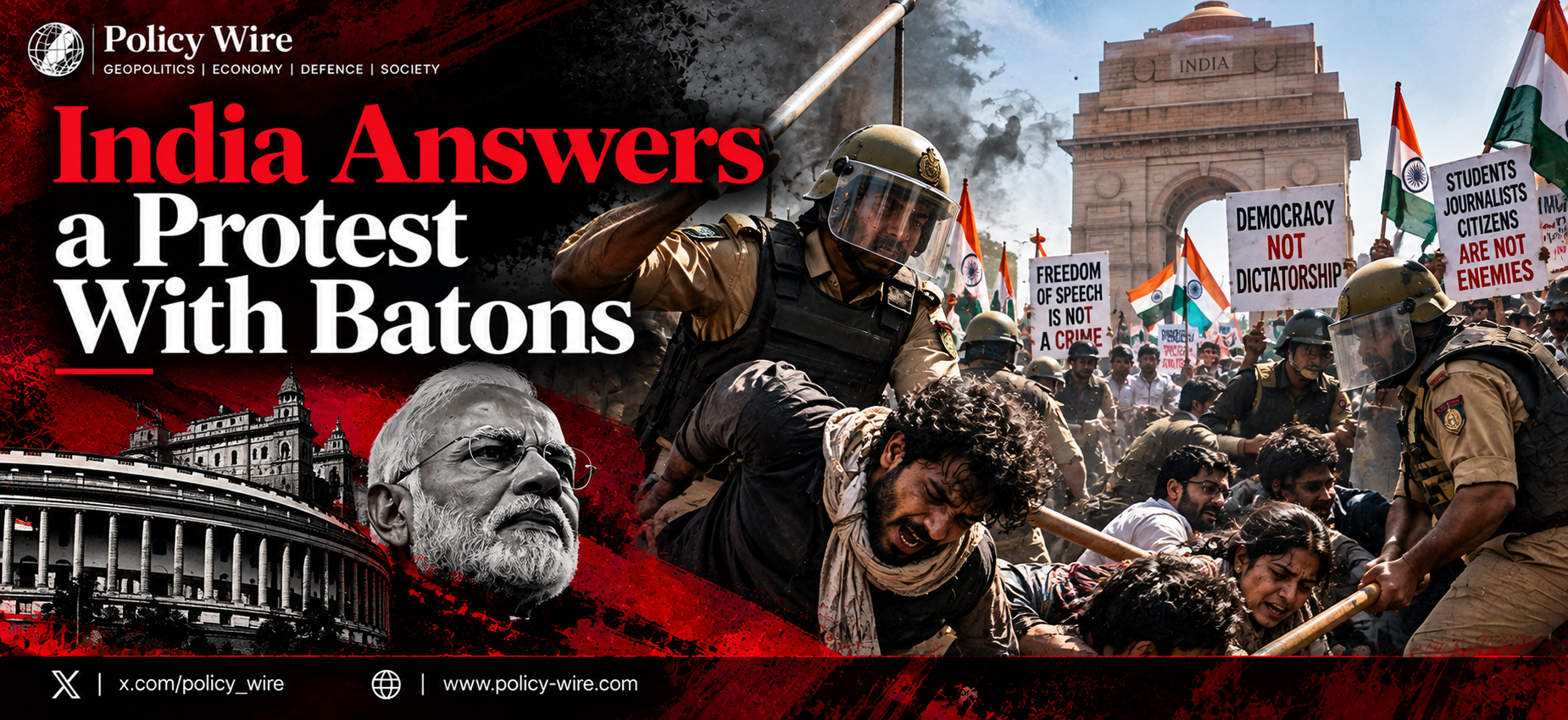
India Answers a Protest With Batons
A democracy shows its character less in how it counts votes than in how it treats people who doubt the count. India's government is failing the second test while the first remains under dispute as...

A democracy shows its character less in how it counts votes than in how it treats people who doubt the count. India’s government is failing the second test while the first remains under dispute.
The dispute starts with the Election Commission’s Special Intensive Revision, a house-to-house overhaul of voter lists that began in Bihar in 2025 and now covers most states and territories. The exercise has removed more than 130 million names, equal to at least 13% of the 969 million eligible voters counted in 2024.
The totals hide sharper gaps. In Uttar Pradesh, the commission’s draft roll listed 126 million electors while a roll compiled by the state election commission at the same time for local polls listed 161 million, The Wire reported. In Bihar, the gender ratio on the rolls fell from 907 women per 1,000 men to 892 after the revision.
The commission says it is removing dead, duplicate and relocated voters and that anyone dropped in error can appeal. In Bihar’s draft roll, it attributed about 2.2 million of 6.5 million deletions to deaths, 3.6 million to permanent moves and 700,000 to duplicate entries. The Supreme Court upheld the revision May 27, affirming the commission’s authority to run it. That ruling settles a legal question. It leaves the political one open. Voters carry the burden of proving they belong, and AP reported that getting back on the rolls can be difficult. The court also sidestepped a 1995 precedent that presumes names on the rolls are valid until a hearing shows otherwise.
The protests grew from that grievance. The Cockroach Janta Party, which began as an online youth campaign in May, has joined opposition parties and student groups in demanding the resignation of Chief Election Commissioner Gyanesh Kumar. The demand hardened after the Indian Express reported that Kumar’s two deputies had raised concerns at least 14 times in 10 months. Demonstrations have run on a near-daily basis, from Bengaluru on Oct. 8 to Jantar Mantar, Delhi’s designated protest site. Neha Bora, national president of the All India Students’ Association, said, “You can detain the people, you cannot detain the movement.” Protesters say the deletions fall hardest on poor and homeless people and on Muslims, who are unlikely to vote for Prime Minister Narendra Modi’s Bharatiya Janata Party.
Authorities have chosen force before argument. Before a Delhi rally Oct. 10, they put thousands of police and paramilitary personnel into the center of the capital and restricted transport. Police detained politicians, and several journalists said officers held them despite their press cards. A court extended the detention of CJP leaders Oct. 19. According to the U.N. experts, law enforcement has reportedly used baton charges known as lathi charges against unarmed students and blocked thousands from joining the marches.
The U.N. role needs precision. Two dozen independent experts appointed by the U.N. Human Rights Council issued a statement. The experts demanded an immediate end to excessive force, the rescinding of blanket assembly bans, an end to the misuse of biometric surveillance and internet shutdowns, and an impartial investigation. They also flagged reports of sexual violence and gender-based abuse during protests and detentions.
New Delhi’s reply follows a script. It has cast the criticism as interference in its internal affairs, as it did when the U.N. human rights office voiced concern about mass detentions earlier. The argument fits poorly here. India is party to the International Covenant on Civil and Political Rights, which protects peaceful assembly, and the experts said the gatherings were nonviolent.
The government’s best case is a court ruling and an administrative rationale. Both would carry more weight if officials let the rolls speak for themselves. A commission sure of its work would publish every deletion with a reason and let an independent body test a sample. The same scrutiny belongs on the police. Until Delhi accepts both audits, the protesters hold the stronger argument, and each lathi charge adds to it.
Author