


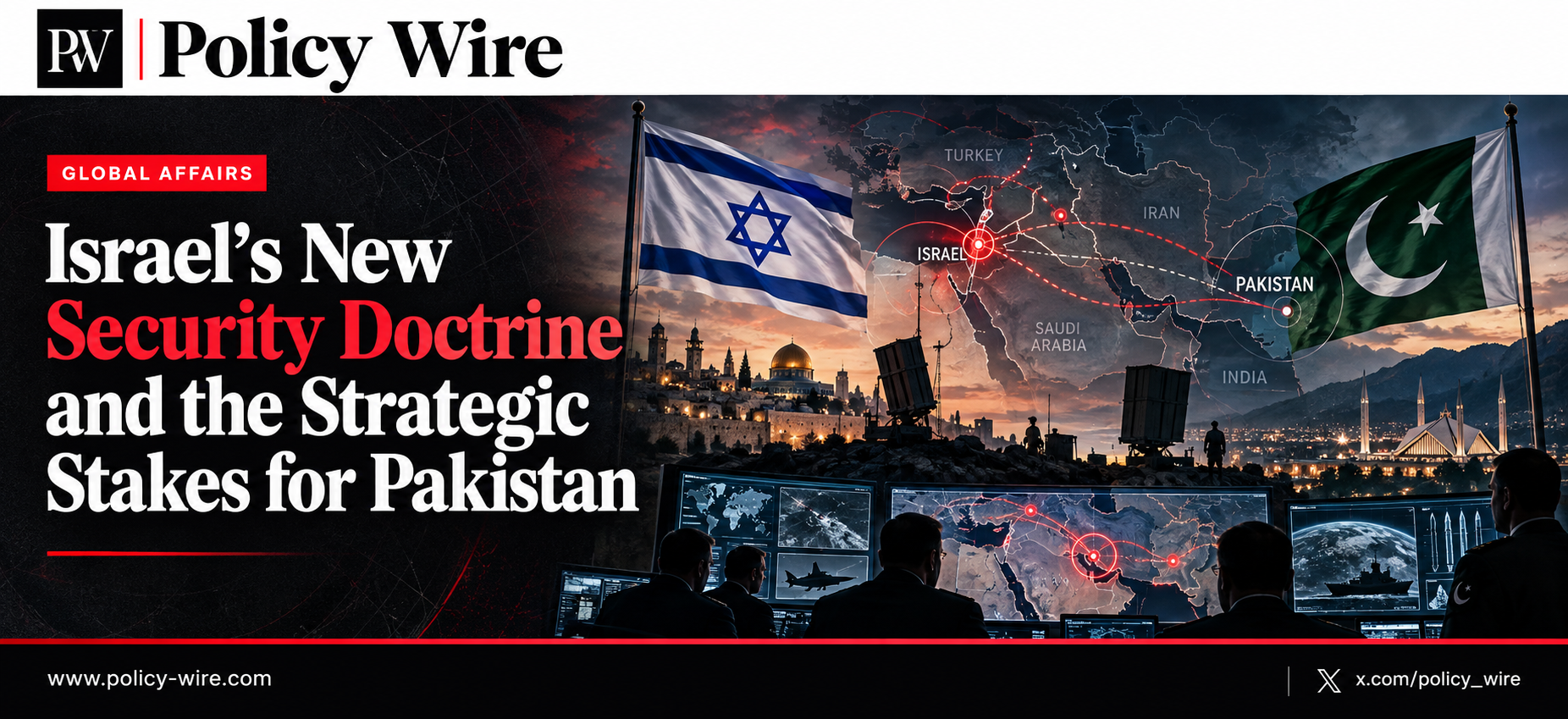
Israel’s New Security Doctrine and the Strategic Stakes for Pakistan
Israeli Prime Minister Benjamin Netanyahu’s newly presented security doctrine outlines competing regional alignments. For Pakistan, the strategic response rests on clarity, collective deterrence via...

National security doctrines do more than identify threats. They define who is considered a friend, which rivalries are likely to endure, and how much freedom a state claims in pursuing its interests beyond its borders. Israeli Prime Minister Benjamin Netanyahu’s newly presented security doctrine, accompanied by a map of competing regional alignments, therefore deserves attention beyond its immediate electoral context. Its significance lies not simply in the alliances it depicts, but in the strategic assumptions through which Israel seeks to organise its regional environment.
The doctrine reportedly places greater emphasis on pre-emptive military action, buffer zones, technological superiority and expanded partnerships. Its underlying premise is that security can be strengthened by preventing potential adversaries from acquiring the capacity to pose a threat. While this approach may offer tactical advantages, it also raises a fundamental strategic question: does the continuous expansion of military options produce lasting security, or does it encourage neighbouring states to prepare for the very confrontation they seek to avoid?
For Pakistan, this question has particular relevance. The reported distinction between the proposed Israeli-led “Hexagon Alliance” and the grouping labelled the “Sunni Diamond Alliance” presents regional politics through the lens of competing strategic camps. Yet such maps should not be mistaken for formal alliance agreements or definitive statements of national policy. They are, at most, indicators of how certain actors perceive emerging relationships and potential areas of competition.
Pakistan’s response should be guided by strategic clarity rather than the impulse to mirror another country’s threat perceptions. Islamabad’s position on the Makkah Joint Defence Agreement, signed with Saudi Arabia and Türkiye in August 2026, is explicit: the accord is defensive, is not directed against any country, and is intended to strengthen collective deterrence, sovereignty and regional stability. Its significance rests on cooperation among three states with complementary strategic capabilities, not on the creation of an ideological or religious confrontation.
This distinction is important. Regional security arrangements become more credible when their objectives are clearly defined and their commitments are grounded in international law. Pakistan, Saudi Arabia and Türkiye have legitimate interests in protecting their sovereignty, territorial integrity and populations. Cooperation in defence preparedness, intelligence, technology and military capacity can serve these interests without requiring the designation of a permanent external enemy.
The more consequential issue in Netanyahu’s doctrine is the reported institutionalisation of pre-emptive action and buffer zones. A state may regard military intervention beyond its borders as necessary to neutralise an imminent threat. However, when such action becomes a routine organising principle of national security, the distinction between defence and strategic expansion risks becoming increasingly contested. Lasting stability requires that security measures remain consistent with international law, including the principles of sovereignty, territorial integrity and the prohibition on the use of force except where legally justified.
Pakistan has particular reason to emphasise these principles. Its foreign policy has consistently supported Palestinian self-determination and an independent Palestinian state based on pre-June 1967 borders, with Al-Quds Al-Sharif as its capital. Israeli security concerns cannot be considered in isolation from the rights of Palestinians or the wider consequences of policies that undermine prospects for a negotiated settlement. Security arrangements that exclude political resolution may manage immediate threats while preserving the conditions for future instability.
There is also a wider regional lesson. Geography does not automatically determine allegiance, and diplomatic relationships cannot always be reduced to competing blocs. States may cooperate on defence while maintaining different economic interests, diplomatic priorities and approaches to regional disputes. The reported inclusion of countries with overlapping partnerships in rival groupings illustrates the limitations of treating a complex region as a fixed alignment of friends and adversaries.
For Pakistan, the appropriate response is therefore neither strategic alarmism nor complacency. It is to strengthen credible defensive capabilities, deepen coordination with Saudi Arabia and Türkiye, maintain diplomatic engagement with other regional states, and avoid allowing external narratives to dictate its strategic choices. The credibility of the Makkah Accord will ultimately depend on practical cooperation, clearly understood commitments and disciplined adherence to its defensive purpose.
Netanyahu’s map may reflect an effort to consolidate Israel’s regional position at a politically sensitive moment. Whether its proposed alignments develop into durable partnerships remains uncertain. What is clearer is that the region cannot achieve sustainable security through military deterrence alone. A stable order requires restraint alongside preparedness, diplomacy alongside defence, and equal respect for the sovereignty and legitimate security interests of states.
For Pakistan, the strategic objective should remain firmly defined: protect national interests, honour commitments to partners, uphold Palestinian rights and support a regional environment in which security is achieved through credible defence and political resolution, rather than through the permanent expansion of rival camps.
Author