


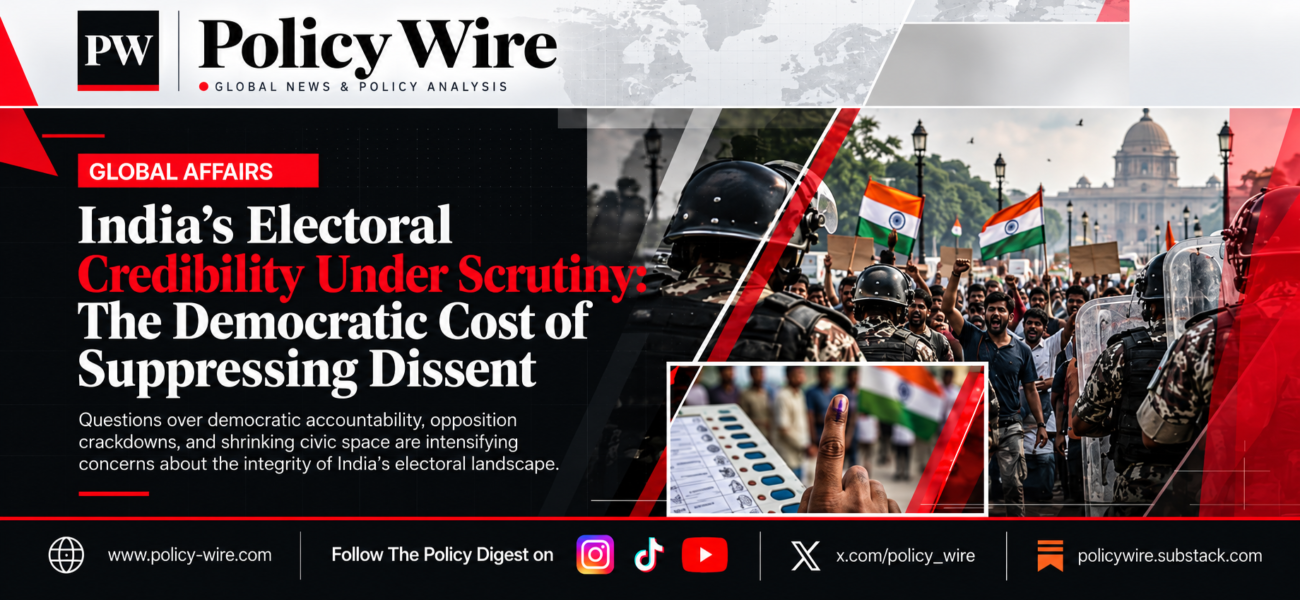
India’s Electoral Credibility Under Scrutiny: The Democratic Cost of Suppressing Dissent
A democracy is tested not only when citizens cast their votes, but also when they question how those votes are counted, demand accountability from institutions and challenge those in power. The...

A democracy is tested not only when citizens cast their votes, but also when they question how those votes are counted, demand accountability from institutions and challenge those in power. The protests in New Delhi against India’s Chief Election Commissioner Gyanesh Kumar have brought this fundamental principle into focus, raising questions about electoral transparency, the treatment of political dissent and the credibility of India’s democratic institutions.
The demonstrations, led by the youth-driven Cockroach Janta Party and supported by other political groups, followed a controversial revision of electoral rolls. Critics allege that the removal of millions of names from voter lists has disproportionately affected certain groups and potentially benefited the ruling Bharatiya Janata Party (BJP). The Election Commission has rejected allegations of wrongdoing. These claims require independent scrutiny rather than premature conclusions, but the scale of public concern makes a transparent response essential.
What is particularly troubling is the state’s response to citizens seeking answers. According to Reuters, Indian authorities detained more than 2,000 people, imposed extensive security restrictions in central Delhi and temporarily disrupted public services ahead of the demonstrations. Several movement leaders were also detained upon arriving in the capital, although a court subsequently ordered the release of three senior figures. Such measures raise a fundamental question: can a democratic government adequately address a crisis of public confidence by restricting the very public debate through which confidence might be restored?
Maintaining public order is a legitimate responsibility of every government. However, security arrangements must remain proportionate, lawful and consistent with citizens’ fundamental rights. The right to peaceful assembly is not an obstacle to democratic governance; it is one of its essential safeguards. When mass detentions and restrictions become the principal response to political grievances, they risk deepening public mistrust instead of resolving it.
The controversy also highlights the importance of electoral institutions maintaining independence from political influence, whether real or perceived. An election commission must not only conduct elections according to established procedures but also command public confidence in the fairness of those procedures. Even where allegations are ultimately found to be unfounded, the credibility of the institution depends on its willingness to explain decisions, disclose relevant information and permit appropriate scrutiny.
The reported revision of approximately 130 million electoral entries has made this question particularly significant. The removal or correction of voter registrations can be a legitimate administrative exercise, especially where records contain inaccuracies. Yet the process must be transparent, accessible and accompanied by effective mechanisms for appeal and correction. If eligible citizens face barriers to registration, the consequences extend beyond administrative inconvenience: they may affect political representation and the public’s faith in the electoral process. These concerns deserve evidence-based investigation, not dismissal as political opposition.
For Pakistan, the developments carry a broader regional significance. Islamabad has consistently raised concerns regarding human rights, political rights and accountability in its dealings with India, particularly in relation to issues affecting people in Indian-administered Jammu and Kashmir. The present protests are a separate domestic political matter and should not be conflated with the Kashmir dispute. Nevertheless, they underline a wider principle relevant to South Asia: democratic credentials are strengthened through institutional transparency and respect for fundamental freedoms, not through international reputation alone.
India frequently presents itself as the world’s largest democracy and seeks a prominent role in shaping regional and global affairs. Such aspirations naturally invite scrutiny of its domestic institutions. International standing cannot substitute for public confidence, nor can economic growth or geopolitical influence resolve questions about political participation. A state’s democratic credibility ultimately rests on whether its institutions can withstand criticism and provide meaningful remedies when citizens challenge their decisions.
The government’s response to these protests will therefore matter beyond the immediate confrontation in Delhi. An impartial examination of the electoral-roll allegations, clear explanations from the Election Commission and safeguards for peaceful demonstrators would offer a constructive path forward. Conversely, treating persistent public criticism primarily as a law-and-order problem could widen the distance between institutions and the citizens they are meant to serve.
Ultimately, the issue is not whether every allegation made by protesters is correct, or whether every demonstration should proceed without reasonable regulation. It is whether democratic institutions can respond to public grievances through credible procedures rather than coercive measures. India’s electoral credibility will be determined less by its claims to democratic distinction than by its willingness to protect political participation, ensure institutional accountability and demonstrate that peaceful dissent remains a legitimate part of public life.
Author