

Pakistan’s Troops in Saudi Arabia Are a Matter of Duty
When foreign ministry spokesman Sajjad Haider Khan told journalists that Pakistan has a substantial number of forces in Saudi Arabia, some commentators treated it as a revelation. It was a...

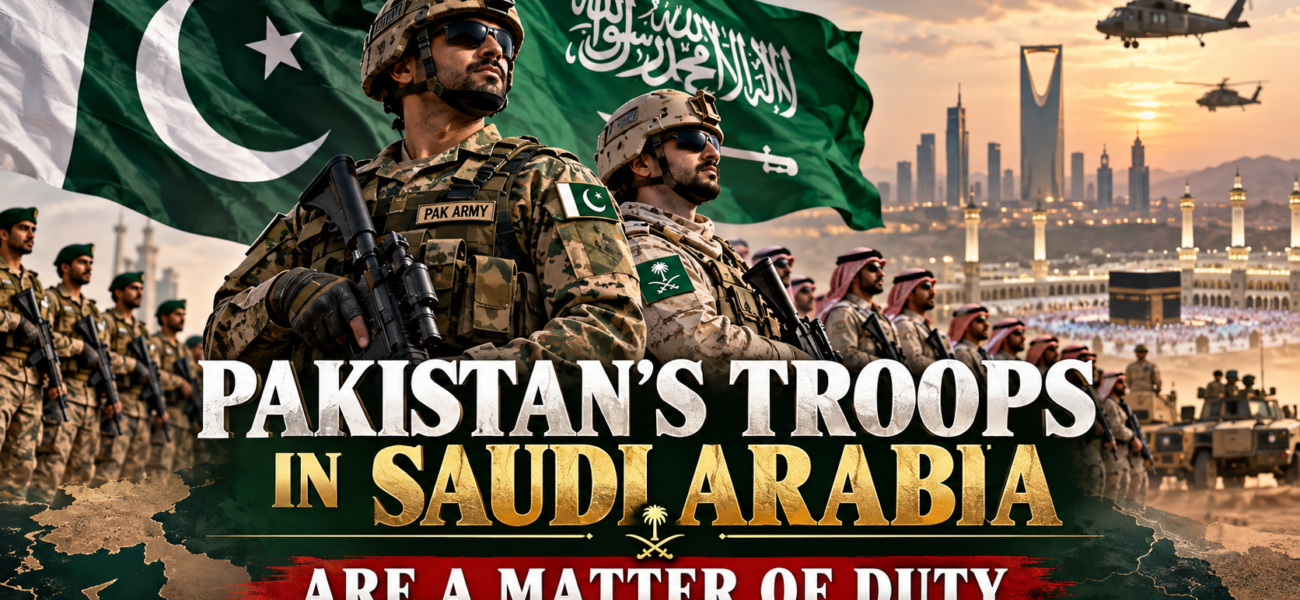
When foreign ministry spokesman Sajjad Haider Khan told journalists that Pakistan has a substantial number of forces in Saudi Arabia, some commentators treated it as a revelation. It was a confirmation. Pakistani soldiers have served in the kingdom for decades, and Islamabad is saying so plainly because it has nothing to hide.
Khan was precise about the mission. Pakistani personnel, he said, would not cross the border to attack the Houthis. Their task is defending Saudi territory. That is a narrow and lawful mandate, and it is the same line Pakistan has held since the relationship began.
The relationship is old. Pakistan sent a training mission to the kingdom in 1967 and has schooled Saudi officers ever since. In the 1980s, thousands of Pakistani troops were stationed there under bilateral arrangements. What looks new to some observers is a continuation of a partnership that predates most of the region’s current rivalries.
What changed in September 2025 was the paperwork. Prime Minister Shehbaz Sharif and Crown Prince Mohammed bin Salman signed a mutual defense agreement in Riyadh declaring that aggression against one country would be treated as aggression against both. Critics immediately asked whether Pakistan had signed up to fight someone else’s wars. Recent statement answers the question. A defensive posture is the opposite of a blank check.
Pakistan has good reasons to stand with Riyadh. Saudi Arabia is home to Mecca and Medina, and no Pakistani government could ignore a threat to the two holiest sites in Islam without facing its own public. More than 2 million Pakistanis live and work in the kingdom, and their remittances keep many households in Punjab, Khyber Pakhtunkhwa and Sindh afloat. When Pakistan’s reserves ran thin, Riyadh supplied deposits and deferred oil payments. Friendship that carries costs in both directions is what a strategic partnership means.
Skeptics point to 2015, when Pakistan’s parliament voted to stay out of the Saudi-led campaign in Yemen. They cite it as proof that Islamabad avoids hard commitments. The reverse is true. That vote showed a state that separates defending a partner from joining an offensive war, and Khan’s remarks repeat the distinction. A country that says no to adventure and yes to defense is easier to trust than one that says yes to everything.
The threat is not abstract. Houthi missile and drone strikes have hit Saudi airports and oil facilities in recent years, and civilians have paid for it. A kingdom of 35 million people cannot be expected to absorb that indefinitely without help from friends. Pakistan’s army is among the largest in the world and has spent two decades fighting terrorists on its own soil. Few militaries are better placed to advise on air defense, base security and counterterrorism in a hostile environment.
Islamabad also keeps a balance that few capitals manage. It maintains working ties with Tehran, a long border with Iran, and cordial relations with Beijing, Washington and the Gulf states at once. Khan’s careful wording, defense without offense, protects that balance. Pakistan has not announced a crusade against the Houthis. It has said it will not leave a partner exposed.
Some will argue that any foreign deployment invites entanglement, and the risk is real. Foreign policy has no risk-free option. The alternative is a Pakistan that signs treaties and then hides from them, and that country would lose credibility in Riyadh, in the Gulf and in every capital that weighs whether its word is good. Pakistan has chosen to be a reliable partner with clear limits.
The troops in Riyadh are a signal as much as a force. They tell Saudi Arabia that Pakistan keeps its commitments. They tell the Houthis that Saudi territory is not an open field. And they tell the Pakistani public that its government is defending interests that touch their faith, their paychecks and their security. That is a policy worth owning in public, and Friday’s briefing did exactly that.
Author