


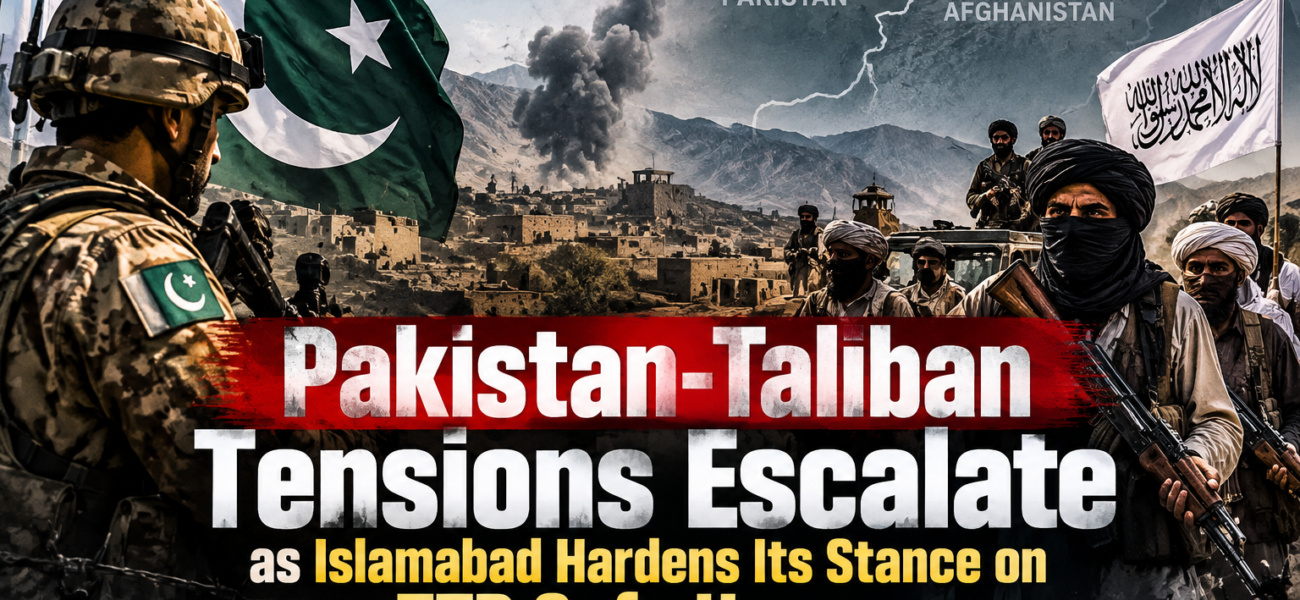
Pakistan-Taliban Tensions Escalate as Islamabad Hardens Its Stance on TTP Safe Havens
From Assurances to ‘Beasts’
On 1 October, Murtaza Solangi, spokesman to the President of Pakistan, wrote on X that if what he called the illegitimate Taliban regime continued to provide safe sanctuaries, training, and...
On 1 October, Murtaza Solangi, spokesman to the President of Pakistan, wrote on X that if what he called the illegitimate Taliban regime continued to provide safe sanctuaries, training, and logistical support to a cocktail of terror outfits, and to act as a surrogate mother of terror, the forces of peace and civilisation would surprise them, and that the surprise might not be too pleasant for those he described as beasts. The language arrives in the middle of an active shooting conflict rather than in a vacuum, and read against that backdrop it is less a provocation than a thermometer. It records how far the relationship between Islamabad and Kabul has fallen.
The register is worth marking, because it has shifted. A few months ago Pakistan’s public posture was captured in the Foreign Office’s demand for verifiable, written assurances that Afghan soil would not be used for terrorism against it. That was the vocabulary of a government still pursuing a diplomatic outcome, however sceptically. The President’s spokesman calling the Taliban beasts and promising an unpleasant surprise is a different vocabulary entirely, and the fact that it now issues from the President’s office, rather than only from the military or the Foreign Ministry, suggests the hardened line has become a whole-of-government position rather than a service one.
The words track events on the ground closely. Pakistan conducted airstrikes inside Afghanistan on 20 September and again on 24 September, the latter after it said drones launched from Afghan territory had crossed into Pakistan, and the Taliban answered with cross-border fire and claims of repelled incursions. Both sides traded disputed casualty figures, Pakistan reporting militants killed and the Taliban alleging civilian deaths. Afghanistan summoned Pakistan’s chargé d’affaires in protest, and at the United Nations General Assembly on 25 September Prime Minister Shehbaz Sharif accused the Taliban of sheltering both the Tehreek-e-Taliban Pakistan and the Baloch Liberation Army. Solangi’s post is the verbal accompaniment to a conflict already being fought with aircraft and artillery.
Pakistan’s underlying grievance in this is not a rhetorical invention, and any honest reading has to grant it. The United Nations sanctions monitoring team reported this year that the Taliban had afforded the TTP greater latitude and support and that the group’s attacks on Pakistan had risen, contributing to the cross-border tensions. Islamabad has pressed the issue through formal demarches, through Chinese-brokered talks, and through the assurances it has repeatedly demanded, and it has been met each time with denial. The turn toward open confrontation reflects the exhaustion of those channels at least as much as any appetite for a fight.
The question the rhetoric cannot answer is whether coercion can deliver what diplomacy could not. Airstrikes kill fighters and flatten camps, but a sanctuary is a condition rather than a target, and this one is sustained by a government that denies it exists. Analysts tracking the exchanges, including at FDD’s Long War Journal and The Diplomat, are doubtful that cross-border strikes, however intense, can end cross-border violence, because the step that would actually end it, a Taliban decision to move against the TTP, is precisely the one the strikes have not produced and may entrench resistance to. A surprise that the Taliban can absorb and retaliate against is not leverage over its conduct. It is another turn of an escalation that neither government has shown it can control.
The second notable move in Solangi’s statement is the branding of the Taliban as an illegitimate regime, and that choice is deliberate rather than incidental. Pakistan was for years the Taliban’s closest external patron, and to call its government illegitimate is to align Islamabad with the international consensus that withholds recognition, and to recast the confrontation as one between a legitimate state and an outlaw administration rather than between two governments with a dispute. It is a repositioning with diplomatic intent, a signal to the region and to the wider world that Islamabad no longer regards Kabul as a partner to be reasoned with, and it closes a door that rhetoric of this kind is not easily reopened.
📄 POLICY WIRE WHITEPAPER PUBLISHED: PAKISTAN'S NATIONAL SECURITY POLICY PRIORITIES
👉 READ BY CLICKING HEREWhat the escalation conspicuously lacks is an exit. Neither side gains from a wider war. The Taliban is contending with the Islamic State’s Khorasan branch and a rising tempo of armed resistance at home, and Pakistan is fighting the very insurgencies the strikes are meant to suppress. Yet each round of strike and counter-strike narrows the space for the mediation, Chinese and otherwise, that has pulled the two back from the brink before. Language like Solangi’s raises the temperature without marking a route down from it, and a posture built on surprises and beasts leaves little room for the quiet arrangements through which such crises are usually defused.
Solangi’s words capture, accurately enough, both the state of a relationship in open conflict and a Pakistani grievance that is real and externally documented. What they do not supply is a theory of how threats and airstrikes convert a defiant regime into a cooperative one. Pakistan tried patience and was rebuffed, and its turn to confrontation is comprehensible on its own terms. But the sanctuary that drives the entire crisis is not something that can be bombed shut, and until there is an approach to closing it that the Taliban will actually act upon, the unpleasant surprises are likely to run in both directions, and the problem they are meant to solve is likely to outlast all of them.
Author