


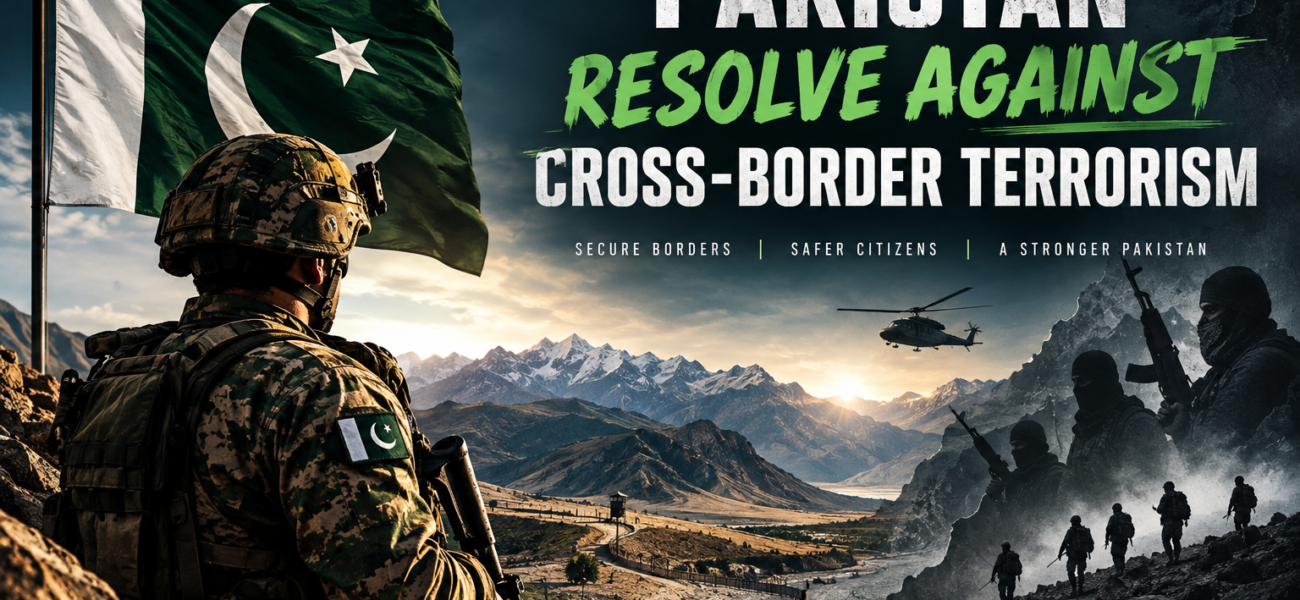
Pakistan Resolve Against Cross-Border Terrorism
Pakistan recent military reaction to the changing situation at its western border frontiers is more than just another instance of border skirmishes. It is a direct statement from Islamabad that it...

Pakistan recent military reaction to the changing situation at its western border frontiers is more than just another instance of border skirmishes. It is a direct statement from Islamabad that it will no longer tolerate any violation of its sovereignty, through militant infiltration, drone attack, or any other form of aggression coming from the other side of the border.
Timing is significant. On September 23, it was reported by Pakistani intelligence sources that eight drones fired from the Afghan side violated the Pakistani air space and were downed, four near Torkham and four near Kohat. Pakistan has confirmed that its air defence systems successfully located, tracked, and neutralized all the attacking platforms before reaching their target.
The next day, Information Minister Attaullah Tarar stated that Pakistan had carried out precision airstrikes and drone attacks on 10 locations within Afghanistan. As per the statement of the minister, the locations were being used to launch and stockpile drones that were part of the attempt to attack Pakistan. The strikes have been characterized by the minister as being calculated, measured, calibrated and proportional and limited to military targets.
This is the most important thing in Pakistan’s response. It was not the opening of a war on Afghanistan. Instead, the justification was in terms of the exercise of Pakistan’s sovereign right of self-defense in retaliation of an unlawful entry into its territory. Thus, the message was not just intended for the militant groups but also for the people who run the region.
For several years, Islamabad has been raising the matter of safe havens and support networks which operate from the soil of Afghanistan. Pakistan says that it has time and again expressed this concern to the Taliban authorities of Afghanistan and their intermediaries, requesting that appropriate steps be taken against the groups responsible for terrorism on Pakistani soil. The latest official statement clearly indicates that Islamabad finds the issue of such an operation against Pakistan from the Afghan soil no longer acceptable.
The use of drones has added another dimension to the above challenge. An attempt at an attack by way of unmanned vehicles poses a threat to Pakistan that could easily cross the border in the absence of conventional means and pose a serious danger well beyond the border areas of Pakistan. What matters the most here is that the ability of Islamabad to intercept all the eight drones is quite indicative of the need to keep its air defence intact and effective.
The Pakistani approach, nonetheless, is not put forward as an outright rejection of diplomacy. Tarar made it clear that Pakistan is not seeking any escalation and wants to preserve regional peace, dialogue and engagement. At the same time, he stressed the fact that Pakistan’s commitment to peace should not be considered as weakness or inability to tolerate unfriendly acts.
📄 POLICY WIRE WHITEPAPER PUBLISHED: PAKISTAN'S NATIONAL SECURITY POLICY PRIORITIES
👉 READ BY CLICKING HEREThis is extremely important. Peace on the western border cannot be sustained solely by the words of diplomats. It requires recognition of sovereignty and action against those who use the territory within reach of the border to commit acts of violence. What Pakistan says is that Pakistan is ready to deal with Kabul, but it should produce results in terms of security.
These latest events confirm one more thing: Pakistan’s answer becomes more and more focused on deterrence. Islamabad showed its ability and readiness to react to aggression towards its territory and people. The events of September 25, when Pakistani troops once again claimed to have blocked the attempt of aggression from Afghanistan in the sector of Gulistan, confirmed this position.
It must then move forward through credible enforcement of its security expectations rather than constant confrontation. The position of Pakistan in this respect is clear; that the territory of Afghanistan cannot be used for launching attacks on Pakistan, and any violation of its sovereignty will have to be answered in kind.
This is about securing a sustainable security environment for itself and not provoking war with Afghanistan. Such an environment can still be secured for itself, but it will involve reciprocity. Pakistan can maintain dialogue and regional peace while at the same time protecting its borders. The two need not be mutually exclusive. In fact, credible protection of its sovereignty might just be the very thing that helps it in this quest for a sustainable peace.
Author