

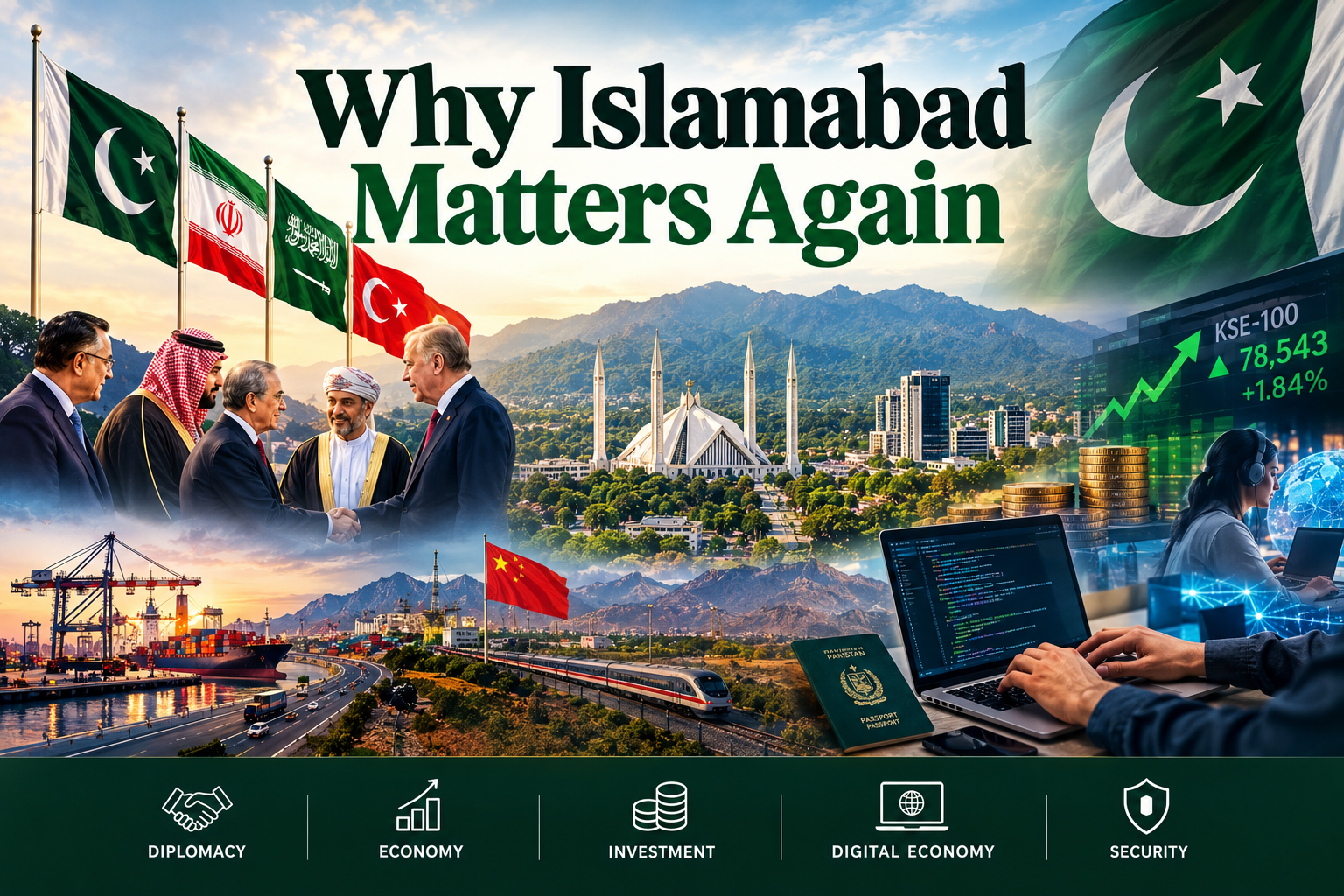
Why Islamabad Matters Again
On August 25, 2026, Pakistan’s Field Marshal Asim Munir landed in Tehran. Days later, senior officials from Oman and Qatar followed him there. By August 31, foreign and defence ministers from...
On August 25, 2026, Pakistan’s Field Marshal Asim Munir landed in Tehran. Days later, senior officials from Oman and Qatar followed him there. By August 31, foreign and defence ministers from Pakistan, Saudi Arabia, and Türkiye were sitting together in Istanbul, putting their names to a joint statement on regional peace. The visit helped generate diplomatic momentum that was followed by high-level engagements involving Oman, Qatar, Saudi Arabia and Türkiye.
International relations scholars have a term for this kind of behavior, broker diplomacy, a state converting geography, relationships, and trust rather than military or economic weight into what network theorists call convening power, the ability to sit at the center of a web of actors who won’t talk to each other directly but will talk through you. It’s a logic closely tied to status-seeking theory, the idea that states pursue prestige and recognition as a distinct national interest, not just security or wealth. Read that way, Pakistan’s summer wasn’t just about de-escalating a war, it was about claiming a role, and having the world confirm it by showing up. Capital after capital followed Islamabad’s lead that week, not out of sentiment, but because it had made itself the address everyone needed.
That single week is a small window into something much bigger unfolding in Pakistan in 2026, a quiet, deliberate transformation, years in the making, now impossible to ignore.
A Mediator the World Actually Needed
When the US-Iran war pushed the region to the brink in early 2026, it was Pakistan that stepped into the breach. On 8 April, Prime Minister Shehbaz Sharif announced that the United States, Iran, and their allies had agreed to an immediate ceasefire covering Lebanon and beyond, brokered through weeks of shuttle diplomacy led by Shehbaz Sharif and Chief of Defence Forces Field Marshal Syed Asim Munir. Islamabad went on to host direct US-Iran talks, the highest-level engagement between Washington and Tehran since 1979.
The international response was telling. The UN Secretary-General appreciated the ceasefire. The Prime Minister of Malaysia conveyed his “sincere congratulations” to Pakistan for its “tireless and courageous diplomacy.” The President of Kazakhstan commended the peace accord reached as a result of the mediation efforts of Sharif and Munir. Other countries, including Egypt, Oman, and New Zealand, also joined in the praise. The Council on Foreign Relations described Pakistan as an ‘essential mediator’ and highlighted the remarkable change in its diplomatic role. As tensions persisted, Pakistan continued to advocate restraint and dialogue while simultaneously deepening its strategic cooperation with Saudi Arabia and Türkiye under the Makkah Agreement.
The Numbers Tell a Quiet Success Story
Skeptics often assume that diplomatic ambition cannot coexist with the economic challenges that Pakistan has been steadily overcoming. The economy grew 3.7 percent in fiscal year 2025-26, pushing its economic size to $452.1 billion, the largest in the country’s history. Foreign exchange reserves reached $17.2 billion by late May 2026, up 49 percent year-on-year, moving the country closer to the internationally recognized three-month import-cover benchmark. The Pakistan Stock Exchange logged 11 IPOs in FY26, the most in two decades, while the benchmark KSE-100 index climbed 18.4 percent between July and March, a vote of confidence from investors who don’t reward chaos.
The IMF’s own reporting credits this to “strong policy implementation” that has “continued to support Pakistan’s economic recovery” and “build confidence,” noting that reserve rebuilding has exceeded earlier projections. This reflects a country pursuing greater economic stability through sustained policy implementation and institutional reforms. It is a state methodically rebuilding fiscal credibility while simultaneously punching above its weight diplomatically, a combination that should command more attention than it currently receives.
The Rating Agencies Are Coming Around, Too
Perhaps the most definitive outside affirmation of Pakistan’s transformation is provided by those organizations least likely to butter it up; credit rating agencies around the world. The rating agency Moody’s rated Pakistan at B3 up from Caa1 on 24 August 2026, due to an improvement in governance and belief that the country is capable of sustaining the recently achieved improvement in its external and fiscal situation, the highest rating Pakistan has had from Moody’s since 2022 and its best status since November 2007. This happened after the rating agency S&P Global upgraded Pakistan to B-, and Fitch’s own decision to rate the country at B- in 2025.
The underlying numbers back up the sentiment. Pakistan posted a current account surplus in fiscal year 2025, its first in 14 years, powered by record remittances of $39 billion, equivalent to 9.5 percent of GDP. Debt affordability has also improved sharply: interest payments consumed about 35 percent of government revenue in fiscal 2026, down from 49 percent the year before, largely thanks to falling inflation and a lower policy rate. These gains also provide a stronger foundation for further progress in export diversification and foreign direct investment, areas that offer Pakistan significant opportunities for future growth.
A Digital Economy Firing on All Cylinders
📄 POLICY WIRE WHITEPAPER PUBLISHED: PAKISTAN'S NATIONAL SECURITY POLICY PRIORITIES
👉 READ BY CLICKING HEREBeyond remittances, Pakistan is quietly building a new export engine. Technology exports hit a record $4.6 billion in FY2026, up 21 percent from $3.8 billion the year before, according to State Bank of Pakistan data, making IT the country’s largest services export category. June 2026 alone generated $416 million, the highest single month on record. Freelancers were a major driver of that surge; Pakistani freelancers earned a record $1.76 billion in FY2026, a 78 percent jump from $984 million the previous year, with IT and computer services crossing the billion-dollar mark for the first time. Non-IT freelance earnings, spanning digital marketing, design, and content work, nearly tripled to $592 million.
Nearly two-thirds of Pakistan’s population is under 30, broadband penetration has crossed 64 percent, and the government extended preferential tax treatment for IT exporters and freelancers for three more years in the FY27 budget, treating this sector as a long-term national strategy rather than a stopgap. With an official target of $10 billion in freelance exports on the horizon, Pakistan’s youth are converting a demographic reality into a genuine dollar-earning asset.
Gulf and Chinese Capital Are Betting on Pakistan
Foreign capital is voting with its wallet, too. The first phase of the China-Pakistan Economic Corridor delivered more than $46 billion in projects, added over 8,000 megawatts of power generation capacity, and created roughly 200,000 jobs, according to Pakistani officials, addressing chronic energy shortages that once throttled industry. CPEC’s second phase, formally launched in 2025, is shifting the focus from raw infrastructure to industrialization, agricultural modernization, and special economic zones, with Pakistan inviting Chinese firms into agriculture, textiles, renewable energy, and consumer goods.
Gulf capital is following a similar trajectory. Saudi Arabia has confirmed continued interest in a $10 billion investment package for Pakistan, while a high-level Saudi business delegation explored stakes in major motorway projects including the Karachi Port and Kharian-Rawalpindi corridors. Pakistani and Saudi businesses have already signed tens of agreements worth billions of dollars to deepen trade, investment, and energy cooperation. None of this happens without investor confidence, and investor confidence does not flow into countries perceived as adrift.
Taking the Fight to Terrorism
Pakistan’s security forces have also shown it can act decisively against internal threats. When the Baloch Liberation Army also known as Fitna-al-Hindustan launched one of its most extensive attacks in years, Pakistani forces responded with a coordinated week-long operation, killing 216 terrorists using intelligence-driven precision strikes, helicopters, and drones. This is a state exercising the monopoly on force that stability requires, while pairing it with tangible investment. The federal government has committed Rs415 billion to transform the Karachi-Chaman highway into a corridor of commerce, and Balochistan’s provincial government has allocated nearly Rs250 billion toward development projects, including public-private partnerships aimed at unlocking a resource-rich province’s vast economic and development potential..
A Country Writing Its Own Narrative
Pakistan’s rise as a diplomatic actor did not happen by accident, it reflects state with 250 million people, a geographically pivotal location bridging South Asia, Central Asia, and the Middle East, and leadership willing to put in the unglamorous, round-the-clock work that mediation demands.
The old perception of Pakistan as a country defined by recurring challenges is increasingly giving way to recognition of its growing economic and diplomatic potential. An economy showing renewed stability, a diplomacy capable of bringing adversaries to the table, and deeper partnerships with Riyadh and Ankara point to a country moving in a different direction. Pakistan is not simply managing its challenges anymore; it is positioning itself to shape the regional and global conversation.
Author