

Islamabad Has Earned Its Case for Provincial Status
A committee led by Planning Minister Ahsan Iqbal has given Prime Minister Shehbaz Sharif a draft plan for a 27-member elected assembly, a chief executive and provincial-style autonomy for Islamabad....

A committee led by Planning Minister Ahsan Iqbal has given Prime Minister Shehbaz Sharif a draft plan for a 27-member elected assembly, a chief executive and provincial-style autonomy for Islamabad. Parliament should pass it without delay. The capital’s residents have waited nearly six decades for a government that answers to them rather than to an appointed bureaucrat.
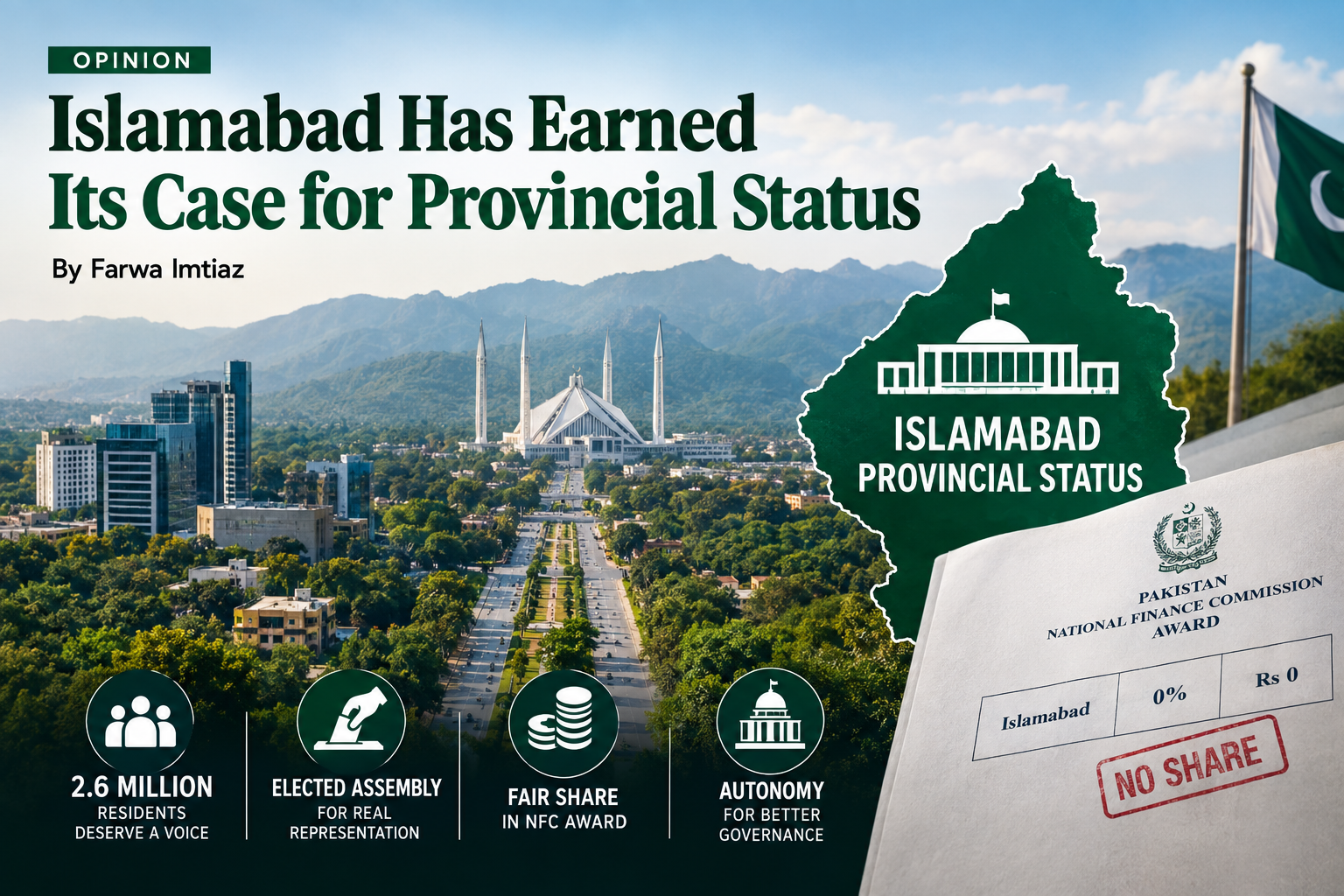
Islamabad today runs on a structure built for a city with a few hundred thousand residents. The Capital Development Authority was created by presidential ordinance in 1960 to build the city, not to govern a metropolis of more than 2 million people six decades later. A single Grade-20 officer chairs the authority and doubles as chief commissioner, a dual role that leaves no elected figure accountable for schools, sanitation or roads. Iqbal has said this arrangement leaves the territory’s residents, whom he put at 2.6 million, with no voice in decisions that shape their daily lives. The 2023 census recorded 2,283,244 people across Islamabad Capital Territory’s urban and rural union councils, a population larger than three sitting provincial capitals.
The fiscal case is just as strong. The National Finance Commission divides federal tax revenue among Punjab, Sindh, Khyber Pakhtunkhwa and Balochistan. Islamabad, despite hosting federal ministries, diplomatic missions and thousands of tax-paying households and businesses, receives no share at all. Interior Minister Mohsin Naqvi has pointed out that Islamabad residents pay every category of federal tax yet get nothing back through the award that funds basic services elsewhere.
Table 1: National Finance Commission Award, fiscal year 2025-26
| Recipient | NFC share | FY2025-26 amount | Elected assembly |
| Punjab | 51.74% | Rs4.07 trillion | Yes |
| Sindh | 24.55% | Rs2.04 trillion | Yes |
| Khyber Pakhtunkhwa | 14.62% | Rs1.34 trillion | Yes |
| Balochistan | 9.09% | Rs743 billion | Yes |
| Islamabad | 0% | Rs0 | No |
Critics of provincial status point to the population formula that drives 82 percent of NFC allocations, a weighting Iqbal himself has argued rewards provinces for growth rather than performance. That argument cuts the other way for Islamabad. A territory of more than 2 million people, taxed at federal rates and governed by presidential order, is exactly the kind of anomaly a fiscal formula should not be allowed to ignore. The 10th NFC expired in July 2025 without producing a new award, and the last full award dates to 2010. As the 11th commission takes shape, lawmakers have a rare chance to write Islamabad into the federation’s fiscal architecture for the first time.
The governance plan itself is carefully bounded. It proposes an Islamabad Capital Territory Government Act, passed as an ordinary act of Parliament rather than a constitutional amendment, folding the existing ICT Local Government Act and the 1960 Capital Development Authority Ordinance into one law. The assembly would seat 21 directly elected members alongside five reserved seats for women and one for a minority representative, a structure comparable to New Delhi’s 70-seat territorial assembly, which pairs an elected chief minister with continued federal control over police and land. Islamabad’s plan follows the same logic that local government for local matters, with the federal government retaining oversight where the capital’s national role requires it. Delhi’s assembly took decades of litigation and one Supreme Court ruling to settle the boundary between local and federal authority; Islamabad’s drafters can write those boundaries into the law from the outset rather than litigate them later.
The Pakistan Muslim League-Nawaz’s Islamabad chapter has already endorsed the proposal, and Raja Khurram Shahzad Nawaz, the sitting lawmaker who chairs the National Assembly’s interior committee, has said rural parts of the territory are left pleading for federal development packages they often do not get, while urban projects depend on the authority’s land sales. Provincial status would replace both problems with a predictable revenue stream and a government residents actually elect.
Islamabad was built to represent the federation. It should not be the one part of it with no vote in its own affairs. Parliament should move the draft law forward this session.
Author