


The Makkah Pact: Deterrence as a Path to Regional Stability
In an environment where calculations regarding security are increasingly informed by uncertainty, the Makkah Joint Defense Agreement signed between Pakistan, Saudi Arabia and Türkiye is a notable...

In an environment where calculations regarding security are increasingly informed by uncertainty, the Makkah Joint Defense Agreement signed between Pakistan, Saudi Arabia and Türkiye is a notable effort to make deterrence and collective security a cornerstone of regional stability. The agreement signed on August 7 in Makkah has now shifted from being a symbolic act to an institutionalized one. The holding of the first meeting of the Strategic Political and Defense Committee in Istanbul on August 31, with the attendance of foreign and defense ministers and militaries of the three countries, indicates that the agreement has now matured to take the shape of a framework rather than being a political document.
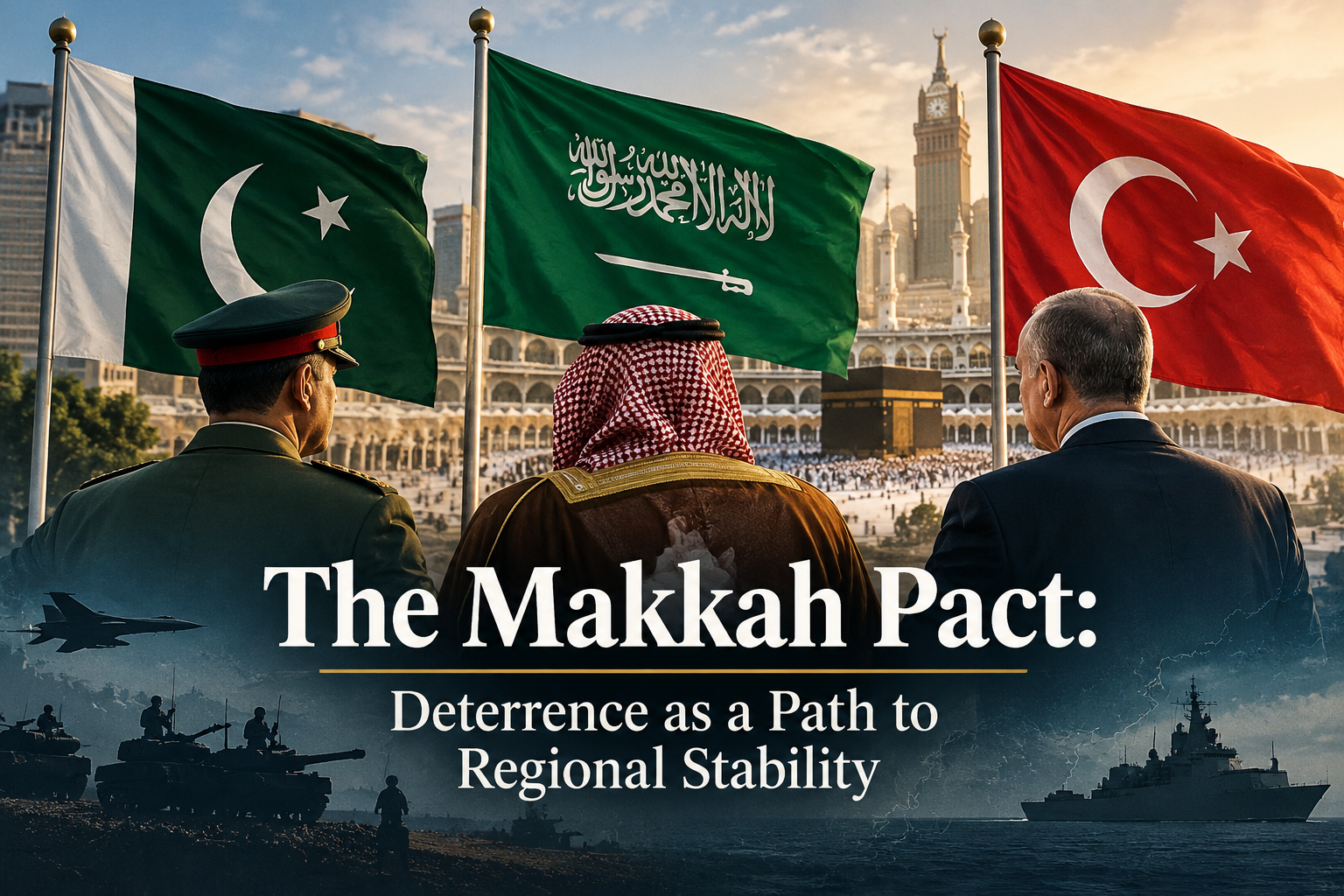
The key aspect of the agreement is the one which needs to be clearly understood strategically. The agreement is defensive in nature. The agreement states that an attack on one of the members of the pact will be seen as an attack on all of them. Thus, there is a collective deterrent effect through the agreement. Pakistan has time and again stated that the agreement is not aimed at any country. Pakistan’s Foreign Ministry spokesperson Tahir Andrabi stated that the agreement is meant for peace and stability rather than war. This is an important aspect considering the fact that the Middle East along with its surrounding areas faces the problem of existing alliance and security problems.
The reasoning is simple enough. Deterrence succeeds whenever the expected cost of aggression becomes large enough to make military force seem more costly than inaction. The agreement is designed in such a way that, by uniting three nations of considerable political, economic and military strength, it can affect the calculations of all those who contemplate coercion toward any of the three. Pakistan offers considerable military expertise and capability, Turkey provides considerable defense industrial base and NATO experience, while Saudi Arabia offers economic and geopolitical clout. Together, their potential may provide the basis of a wider security architecture without projecting power.
Importantly, the importance of the agreement goes far beyond the three countries. The joint statement issued at the end of the Istanbul talks specifically mentions sustainable peace and stability, de-escalation, restraint and peaceful resolution of crises as part of the agreement’s objectives. In addition, the three countries have agreed to establish a permanent secretariat in Saudi Arabia, with the first three years headed by a Pakistani secretary-general, and to enhance cooperation in defense industry, including research and production. Such measures are essential for effective deterrence, which cannot be achieved through mere declarations of policy.
However, the aspect related to the defense industry may turn out to be one of the most important provisions of the agreement in the future. Thus, in recent years, Türkiye has become a more advanced manufacturer of its indigenous defense technologies, whereas Pakistan has vast experience in the sphere of military manufacturing and technologies. Finally, for Saudi Arabia, the issue of defense localization and development of technologies was raised to the list of strategic priorities. Therefore, the tripartite cooperation in this sphere can evolve from purely practical exercises to cooperation in research, manufacturing, technology transfer and capacity building.
As well as the military sphere of activity, there is another important factor that should be noted regarding the signing of the Makkah Agreement. Namely, the region still remains sensitive to any escalation of events, as evidenced by new tensions between Washington and Tehran. In its turn, Pakistan has managed to combine its efforts to ensure readiness for potential threats with diplomatic activity. Therefore, it continues its policy of mediation and continues participating in the process of bringing the United States and Iran to negotiations. The fact of meeting of Prime Minister Shehbaz Sharif and Iranian President Masoud Pezeshkian confirms it.
📄 POLICY WIRE WHITEPAPER PUBLISHED: PAKISTAN'S NATIONAL SECURITY POLICY PRIORITIES
👉 READ BY CLICKING HEREPerhaps, the combination of both deterrence and diplomacy will define the contribution of Pakistan in the context of Makkah Agreement. The former provides strategic space for the latter, and vice versa, while at the same time making it less likely for the latter to be misinterpreted as preparing for conflict. Thus, the two strategies are not mutually exclusive.
The agreement also carries certain implications for the structure of security in the Islamic world. Pakistan’s approach to possible requests from other countries to join the agreement will be consultative and will involve the participation of both Saudi Arabia and Türkiye, rather than unilateral expansion of the pact. The aforementioned strategy is strategically wise because rapid expansion of such a security mechanism will inevitably lead to its becoming a controversial political entity with conflicting threat perceptions. Gradual expansion with the focus on common security concerns is more likely to maintain the unity of the organization.
Additionally, there is a message within the agreement that applies to the region itself. It is not always necessary to entrust security matters to some outside powers. States in the region can devise their own ways of defending themselves while at the same time continuing to maintain their relations with other major players in the international arena. It is not always necessary to see the Makkah Agreement as an alignment of countries against a particular power or another. What will make it work is its ability to demonstrate a principle that aggression against states in the region has repercussions.
In the end, the effectiveness of the Makkah Agreement will not hinge on how often the parties showcase their military capabilities but on how well they use those capabilities to prevent confrontation. Its greatest success, however, will come from a seemingly paradoxical position – from having a system of defence that minimizes the likelihood of force being used. If Pakistan, Saudi Arabia and Türkiye are able to turn cooperation into institutions and create viable defence industry linkages, enhance interoperability and maintain a dedication to diplomacy, the Makkah framework can go beyond just being a trilateral security arrangement.
Author