


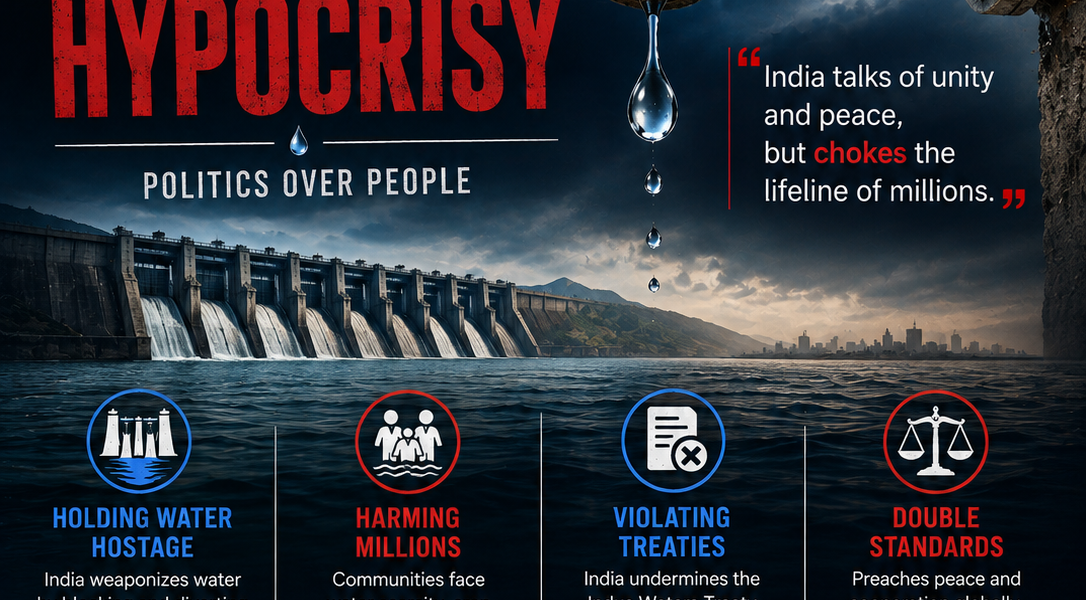
India’s Water Hypocrisy
Pakistan’s right to the waters of the Indus system is not a concession from India. It is a right established under an international treaty that both countries signed and honoured for decades,...

Pakistan’s right to the waters of the Indus system is not a concession from India. It is a right established under an international treaty that both countries signed and honoured for decades, including through periods of war. The Indus Waters Treaty gives Pakistan the exclusive use of the waters of the Indus, Jhelum and Chenab, subject to the limited uses permitted to India on those western rivers, while allocating the Ravi, Beas and Sutlej primarily to India. For Pakistan, therefore, access to the Indus system is not a matter of political goodwill. It is a matter of international law.
That distinction has become increasingly important as India attempts to place the treaty in “abeyance” and restrict the mechanisms through which Pakistan’s rights are protected.
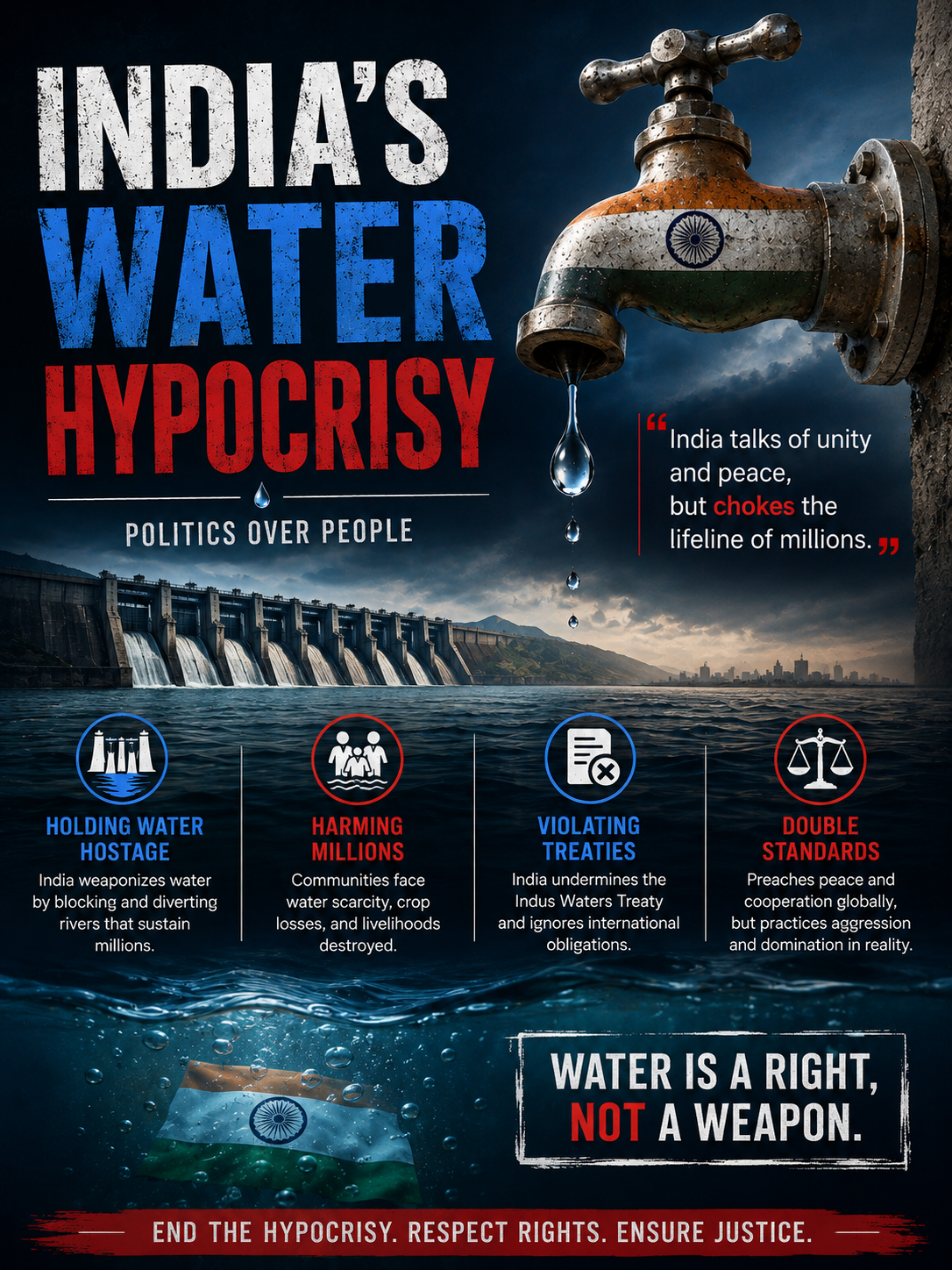
The Indus Basin Irrigation System supports the overwhelming majority of Pakistan’s food production and underpins a substantial share of its economy. The Indus, Jhelum and Chenab carry roughly 80% of the Indus system’s flow and are the principal rivers on which Pakistan’s agriculture and water security depend. Pakistan is a downstream country with limited control over the headwaters. The treaty therefore provides something essential: predictability.
India cannot unilaterally transform a treaty-based Pakistani right into a discretionary arrangement that depends on the political climate between Islamabad and New Delhi.
On August 31, the Court of Arbitration in The Hague told India something it did not want to hear. The Indus Waters Treaty is still in force, and no state can place a binding treaty in “abeyance” simply because it has decided to. The ruling was unanimous. It rejected every ground New Delhi had offered, from sovereignty to alleged material breach, finding no basis for suspension in the treaty or in customary international law. It also ordered India to stop concreting the Ratle dam wall and power intake above specified levels until 90 days after the Neutral Expert’s final decision, expected around July 2027. India’s foreign ministry rejected the ruling within hours, calling the court illegally constituted and its award void.
Six days earlier, Indian and Chinese Special Representatives had met in Beijing and agreed to convene their Expert Level Mechanism on trans-border rivers in September, with the lapsed data-sharing arrangements on the agenda. The Sutlej memorandum expired in November 2020 and the Brahmaputra memorandum in June 2023, and neither has been renewed. India pays Beijing an annual fee of 850,000 yuan for flood-season readings from stations in Tibet, and has received little since. On Aug. 6, at the 36th round of border consultations, New Delhi again asked China to resume the data and disclose technical details of the Medog project, a dam at the Great Bend of the Yarlung Tsangpo that Beijing approved in late 2024 as part of its 14th Five-Year Plan. The project carries a price tag near $137 billion, a generating capacity of 60 gigawatts and projected output around 300 billion kilowatt-hours a year, roughly three times what the Three Gorges Dam produces. Beijing’s answer has been that the river’s development falls within its sovereign affairs.
India’s objection to that answer is correct. A state sitting at the top of a river does not get to decide alone what happens to the water below it, and downstream populations have a right to know what is being built above them. That is precisely what Pakistan has been arguing about the Chenab. India rejects it there.
The asymmetry is not subtle. Against China, India’s complaint is that nothing binds Beijing. The Expert Level Mechanism created in 2006 is voluntary, the memoranda are not treaties, and there is no forum in which a Chinese refusal can be tested. Against Pakistan, India has a binding treaty, a Permanent Indus Commission that meets by obligation rather than invitation, an express duty to notify design changes on the western rivers, and the dispute machinery it lacks with China. Since April 2025 it has suspended the treaty, stopped the commission and halted hydrological data. It has also carried out drawdown flushing at Salal and Baglihar without prior notice, removing more than 7.5 million cubic meters of sediment in the first exercise alone, the first such operation at either dam since they were built in 1987 and 2008-09. The Central Water Commission has recommended the flushing become monthly.
📄 POLICY WIRE WHITEPAPER PUBLISHED: PAKISTAN'S NATIONAL SECURITY POLICY PRIORITIES
👉 READ BY CLICKING HERENew Delhi is asking Beijing for exactly the architecture it is dismantling with Islamabad, and it is doing so while accelerating its own construction downstream. The tenders issued in May for the Chenab-Beas link tunnel put the project at roughly 2,352 crore rupees, an 8.7-kilometer bore under the Pir Panjal designed to carry up to 1.9 million acre-feet of Chandra River water a year out of the Chenab system and into the Beas basin, where it becomes India’s to use freely under the treaty’s own eastern-river allocation. A separate 268 crore rupee package funds sediment works at Salal. Kiru, at 624 megawatts, and Kwar, at 540, are moving alongside the larger Pakal Dul and Ratle projects, at 1,000 and 850 megawatts, and behind them sits the proposed Sawalkote dam, with 1.8 million acre-feet of storage. A proposed extension would stretch the Ranbir canal to 120 kilometers.
India’s legal argument deserves a fair hearing rather than caricature. It says the treaty’s clauses run in sequence, that a Neutral Expert must finish before a Court of Arbitration may sit, and that the World Bank breached the treaty by letting both proceed at once. The difficulty is that the question has been answered repeatedly. The tribunal upheld its own competence in 2023 and confirmed it in a supplemental award on June 27, 2025, after the abeyance announcement. In August 2025 it ruled on the general interpretation of the treaty, finding that India must let the western rivers flow so as to leave Pakistan their unrestricted use. In May 2026 it issued an award limiting maximum pondage at Kishenganga and Ratle. The World Bank has said the two tracks are independent and that the treaty gives it no authority to rank them, and the Neutral Expert, Michel Lino, has separately found himself competent on the technical points. A tribunal ruling on the scope of its own jurisdiction is not an irregularity. It is the ordinary rule, and a state does not escape it by declining to appear.
Nor is India a stranger to these forums when the outcome suits it. It argued Baglihar before a Neutral Expert and accepted the outcome. It appeared throughout the Kishenganga arbitration that ended in 2013 and cited the findings that went its way. In July 2014, when a Permanent Court of Arbitration tribunal in the Bay of Bengal awarded Bangladesh roughly 106,600 square kilometers of a disputed area of some 406,800, India accepted and implemented the result. In 2017 it went to the International Court of Justice itself, against Pakistan, in the Kulbhushan Jadhav case. What emerges is not a principled objection to international adjudication. It is an objection to losing.
The cost of that objection falls on people with no part in it. Pakistan’s Indus Water Commissioner has said no notice came before the Salal gates were opened, and that flood data now has to be bought from third parties. The 2022 floods killed more than 1,700 people, affected 33 million and cost about $30 billion. The 2025 monsoon season, running from late June into September, killed 1,037 people and displaced two million, with nearly 6.9 million people affected nationwide and Punjab enduring its worst flooding in almost four decades, worsened when gates at the Madhopur barrage on the Ravi gave way upstream. By late July this year the 2026 toll had already passed 100, with the disaster authority forecasting rainfall a fifth above last season. A lost warning window is measured in drowned villages, not in diplomatic points.
India honored this treaty through the wars of 1965 and 1971, and through Kargil. Eisenhower, present at its signing, called it one bright spot in a depressing world picture. That endurance belonged to India as much as to Pakistan, and walking away from it sets a precedent that will not stay in South Asia. If a water treaty can be suspended by press statement whenever the political weather turns, India’s own case against Beijing collapses at the moment it is made. China can say the same words back, from further upstream, with more water and fewer obligations.
Author