


Nepal-China Floods: Over 1,000 Dead, Thousands Missing in Himalayan Disaster
POLICY WIRE — Kathmandu, Nepal — Rescue teams, aided by search dogs, meticulously searched through mud, rocks, and debris in Nepal and China on Tuesday, striving to locate thousands of individuals...

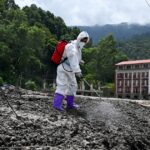
POLICY WIRE — Kathmandu, Nepal — Rescue teams, aided by search dogs, meticulously searched through mud, rocks, and debris in Nepal and China on Tuesday, striving to locate thousands of individuals still unaccounted for following the devastating floods that swept through Himalayan communities, resulting in over 1,000 fatalities.
Nepal’s disaster management agency reported 987 deaths within its borders, with 3,916 people missing, including 583 foreigners. Chinese authorities confirmed 16 deaths and 546 missing individuals, comprising 261 foreigners, in their latest update on Sunday.
The extensive scale of the disaster has significantly impeded rescue operations in both regions. Landslides, destroyed roads, and widespread damage have isolated remote areas, making it challenging for crews to navigate unstable terrain and heaps of debris. There is growing concern that the death toll may increase as rescuers reach more isolated communities.
In Nepal, rescue efforts are concentrated on reaching hundreds of workers believed to be trapped inside tunnels at hydropower projects damaged by the floods. Approximately 900 workers are missing from 12 projects, with around 500 thought to be trapped in tunnels, according to Nepalese authorities.
Brig. Gen. Raja Ram Basnet, spokesperson for Nepal’s army, stated that teams, including foreign experts, are working at several hydropower sites. Visuals from the army depict rescue teams navigating dark, debris-filled tunnels, wading through mud and water, and climbing over rocks in search of survivors.
On the Chinese side, rescue crews are focusing on areas affected by mudslides, particularly around the Gyirong Port border crossing, which was obliterated by the disaster. Some rescuers, with the help of search dogs, are searching through gaps among rocks and debris for signs of life. Other teams are using heavy machinery to clear a major highway leading to Gyirong Port, aiming to facilitate the passage of equipment, personnel, and supplies to the disaster zone.
At least 11,814 people have been rescued so far, according to Nepalese authorities. Emergency services are utilizing helicopters and other aircraft to reach stranded communities in areas where roads and bridges have been destroyed by the flooding and landslides.
Authorities have intensified efforts to provide assistance to survivors in areas where roads and other transportation routes have been damaged or cut off. China’s Foreign Ministry spokesperson, Guo Jiakun, announced that the second batch of relief supplies for Nepal, including drones, DNA testing, and water purification equipment, is expected to be shipped on Tuesday. Chinese DNA testing experts will also assist Nepal in identifying bodies.
📄 POLICY WIRE WHITEPAPER PUBLISHED: PAKISTAN’S NATIONAL SECURITY POLICY PRIORITIES
Bimal Sharma, a helicopter pilot involved in rescue and relief missions since the disaster began, expressed shock at the devastation in Timure, a border town near Tibet that he has known for years. “It felt like I was flying over an entirely different landscape,” he said. Sharma noted the profound impact of the disaster on the people he has rescued, evident in their expressions.
The disaster, which began on August 26, was triggered by a glacial collapse high in the Himalayas, sending large amounts of rock, ice, and meltwater into valleys below and causing powerful floods downstream. Scientists studying satellite imagery suggest that the collapse involved the failure of bedrock beneath a glacier in the Himalayan region, with the rockfall registering as a magnitude 5.2 seismic event.
The surge of water and debris entered rivers that flow through valleys in Tibet and Nepal, causing them to rise rapidly. Floodwaters swept away homes, buildings, roads, and bridges, carrying mud and rocks downstream.
Nepal’s Prime Minister Balendra Shah emphasized the need for action to combat climate change, stating that the disaster highlights the increasing risks in the Himalayan region due to climate change. He called for international attention to be raised on the issue of disasters caused by climate change.
Reporting by Policy-Wire (PW)