

Despair and Death: Nepal’s Rescue Efforts Overwhelmed as Fatalities Surpass 1,000
POLICY WIRE — Bidur, Nepal — The pervasive odor of death is dampening the prospects of finding additional survivors in Bidur, a Nepalese town ravaged by last week’s catastrophic floods....

POLICY WIRE — Bidur, Nepal — The pervasive odor of death is dampening the prospects of finding additional survivors in Bidur, a Nepalese town ravaged by last week’s catastrophic floods.
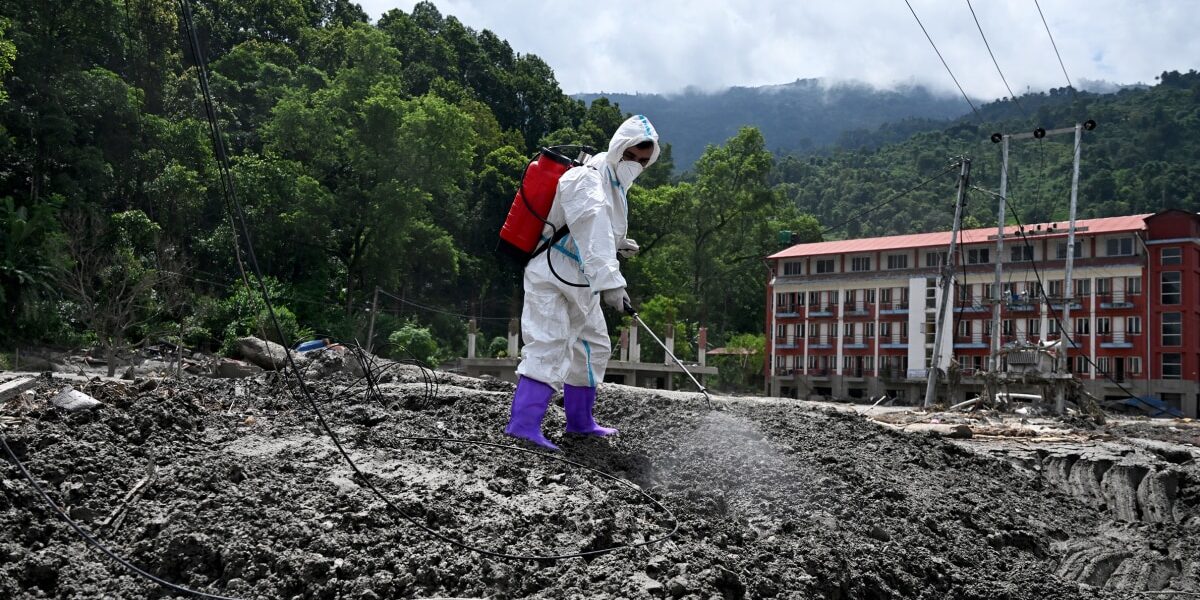
Personnel clad in white protective gear are continuously removing bodies from a succession of ambulances in Bidur, situated in Nepal’s Nuwakot district. The corpses, wrapped securely, are placed on blue tarps within a designated, restricted area.
Helicopters, a mix of military and civilian aircraft that once served commercial tours, are now ferrying aid and returning with survivors requiring medical attention.
Kalpana Shrestha, a nurse from Kathmandu, is in a state of desperation. Ten of her family members, including her two sisters and their children, are unaccounted for.
I’ve posted so much that my fingers have started to shake and tremble, Shrestha, 35, revealed. My mind has ceased to function. Yet, we persist in posting.
The National Disaster Risk Reduction and Management Authority of Nepal has confirmed over 1,000 fatalities from the recent floods. Additionally, more than 3,915 individuals remain missing, including at least 583 foreign nationals. In Tibet, the death toll stands at 16, with 546 individuals missing, as reported by CGTN, China’s English-language satellite news channel.
At least 80 Americans are among those missing in Nepal.
The United Nations reports that over 10,000 people have been rescued thus far, including 252 foreign nationals.
This disaster, initiated by a glacier collapse and landslide on Nepal’s border with China, is now regarded as Nepal’s most lethal natural calamity since the April 2015 earthquake, which claimed approximately 9,000 lives.
📄 POLICY WIRE WHITEPAPER PUBLISHED: PAKISTAN’S NATIONAL SECURITY POLICY PRIORITIES
Shrestha expressed her belief that the government is not exerting sufficient effort in search and rescue operations to locate her family. She also pointed out the ongoing difficulty in accessing her village post-floods.
Our brothers attempted to reach them but were unsuccessful and had to return home, she stated. The road is obliterated, there is absolutely no access.
Access remains the paramount challenge to response initiatives, with roads only passable up to Nuwakot and certain sections of the highway connecting Kathmandu to the most affected regions still entirely obstructed, according to the United Nations Office for the Coordination of Humanitarian Affairs.
The recovered bodies present a significant dilemma for authorities, who are utilizing at least 21 hospitals across various districts to store remains, as per Nepal’s disaster agency. In certain instances, bodies are being interred to avert any risk of infection, with the hope that they will be identified later, allowing the remains to be returned to their families.
Relatives of the missing can submit blood samples for DNA testing, and if a match is identified, the body can be exhumed from the burial site and given to the family for a funeral.
Reporting by Policy-Wire (PW)