


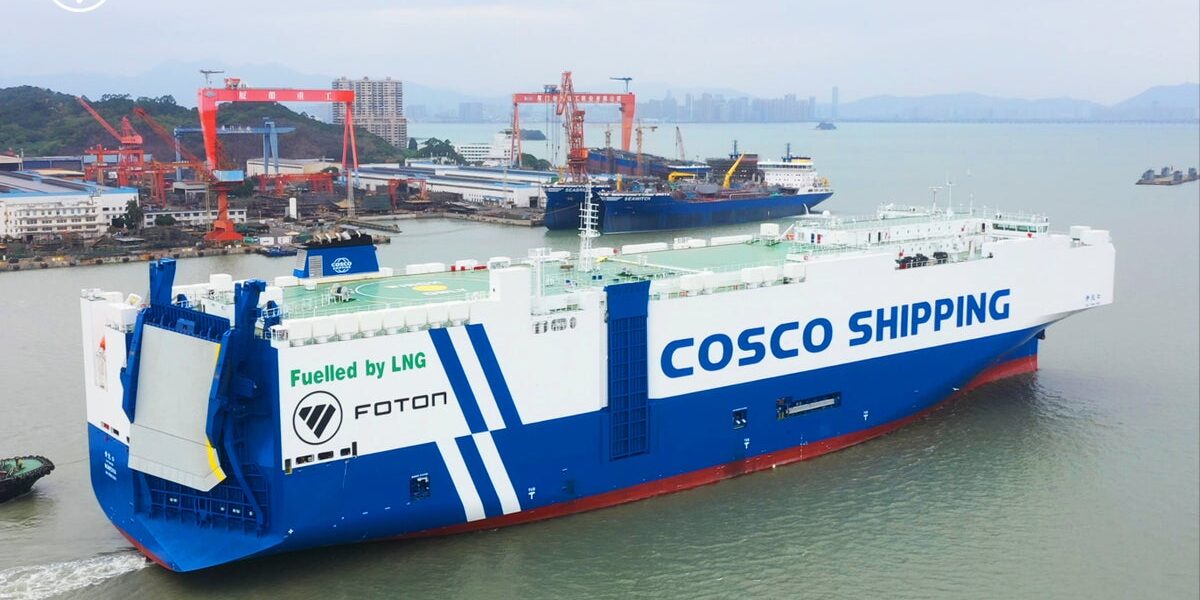
Chinese State-Owned COSCO Accused of Intercepting U.S. Military Communications
POLICY WIRE — Washington, D.C. — Senior Trump administration officials have revealed that China’s state-owned shipping giant, COSCO, employs covert onboard devices to intercept military...

POLICY WIRE — Washington, D.C. — Senior Trump administration officials have revealed that China’s state-owned shipping giant, COSCO, employs covert onboard devices to intercept military communications near the coastlines of targeted nations, including the United States.
These officials, who chose to remain anonymous to discuss the intelligence assessment, stated that COSCO has maintained a long-standing espionage collaboration with Beijing.
This partnership allegedly allows China to collect signal communications from both commercial and military ships and aircraft across North America, Europe, and Asia.
One official highlighted that the specialized equipment installed on COSCO vessels is intended to help Beijing acquire information on “military communications technologies and encryption developments,” as well as monitor critical maritime transit routes vital for global trade and defense.
COSCO has not responded to inquiries regarding these allegations. However, the Chinese embassy in Washington has denied the accusations.
The claims emerge just before President Donald Trump and Chinese leader Xi Jinping are set to meet in Washington for a summit later this month, where they are expected to tackle sensitive economic and national security matters.
Although the officials did not disclose the specific hardware used on COSCO ships, they described the systems as “sophisticated signals intelligence collection” platforms rather than standard maritime navigation devices.
They further explained that Beijing uses the gathered intelligence to bolster its position in maritime territorial disputes, conduct sea reconnaissance, and obtain early warning indicators concerning foreign military forces.
In response, China’s embassy in Washington asserted that the Chinese government would never direct any enterprise or individual to collect or provide data, information, or intelligence located abroad against local laws. We oppose vilifying China by spreading the so-called ‘intelligence collection’ narrative, which is entirely baseless, embassy spokesperson Liu Chang told Reuters.
📄 POLICY WIRE WHITEPAPER PUBLISHED: PAKISTAN’S NATIONAL SECURITY POLICY PRIORITIES
A study released by the U.S. Naval War College in April 2025 concluded that China’s People’s Liberation Army (PLA) likely utilizes the nation’s commercial shipping and fishing fleets to support military surveillance and intelligence gathering.
In January 2025, the Pentagon added COSCO to its list of companies linked to China’s military. This designation imposes U.S. government procurement bans and significant reputational damage, though it falls short of full economic sanctions.
Chinese law mandates domestic corporations to support state intelligence operations. Despite this, COSCO remains one of the largest ocean carriers docking at American ports and maintains several container terminal joint ventures across the country.
To help revive domestic maritime and shipbuilding industries, the Trump administration outlined plans last year to impose billions of dollars in port fees on Chinese ocean carriers, including COSCO. However, that measure was put on hold after Trump and Xi reached an agreement last October for a year-long trade dispute truce. That arrangement is set to expire in November, and a potential extension is expected to be a key topic during the leaders’ September summit.
Isaac Kardon, an expert in Chinese maritime strategy at Johns Hopkins School of Advanced International Studies, noted that Washington faces significant challenges in countering these security risks due to COSCO’s deep integration into American trade networks. Removing COSCO from our supply chains and transporter networks could be life-threatening surgery to U.S. trade networks, Kardon said.
Reporting by Policy-Wire (PW)