


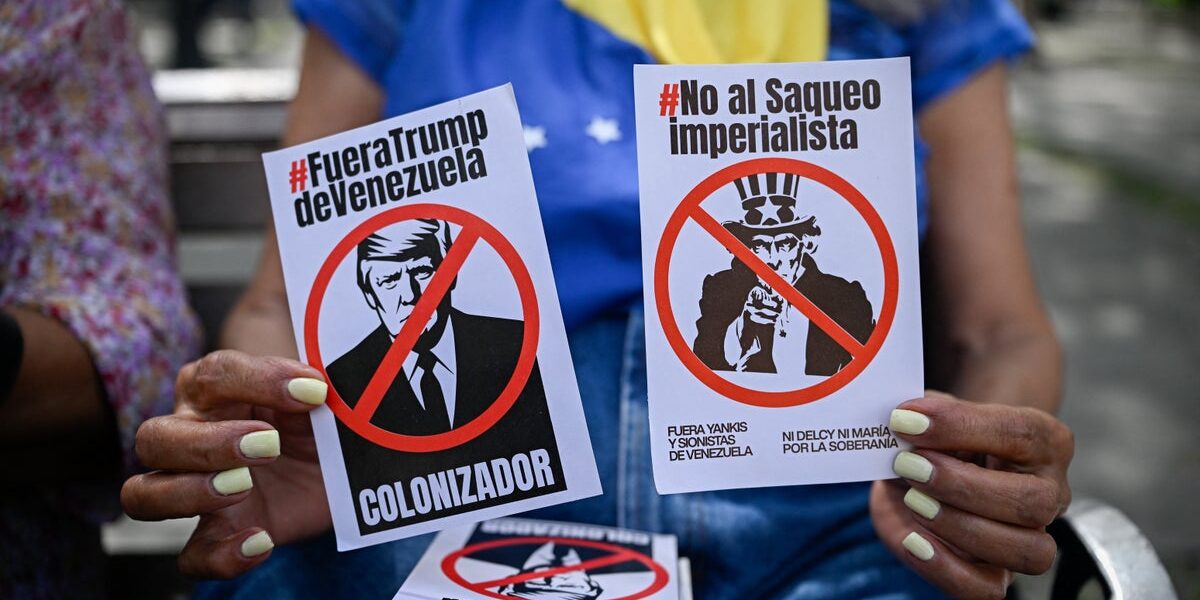
Trump Unveils Bold Plan for US Control Over Venezuela’s Oil Reserves
POLICY WIRE — Washington, USA — President Donald Trump has revealed an innovative strategy for the United States to assume control over a substantial segment of Venezuela’s oil reserves. This...

POLICY WIRE — Washington, USA — President Donald Trump has revealed an innovative strategy for the United States to assume control over a substantial segment of Venezuela’s oil reserves. This initiative is designed to revitalize Venezuela’s ailing energy sector through American corporate involvement, with the added benefit of reducing US fuel expenses.
Trump provided limited specifics about the agreement but confirmed that the US has gained predominant authority over more than 65 billion barrels of Venezuela’s verified oil reserves through collaborations with private sector entities.
The Venezuelan government, led by its interim president, has expressed support for the deal, anticipating an enhancement in state revenues and economic uplift.
This agreement signifies a notable expansion of US influence in Venezuela’s energy landscape, as the Trump administration strives to augment local production and secure additional oil supplies for US refineries. Despite holding the world’s largest proven oil reserves, Venezuela’s current output of 1.25 million barrels per day falls significantly short of its potential due to prolonged underinvestment, mismanagement, and sanctions.
Trump announced on Truth Social that, under his guidance, Secretary of State Marco Rubio and Secretary of War Pete Hegseth, in conjunction with Venezuela’s Highly Respected Interim President Delcy Rodriguez and private sector partners, have ensured majority US control over Venezuela’s vast oil reserves, with no financial burden to American taxpayers.
This announcement concludes weeks of negotiations between the US and Venezuela, aiming to grant American companies extended access to Venezuelan oilfields and assure a steady crude supply to the United States.
Venezuelan authorities are set to finalize agreements next week, granting new oil exploration and production rights to several companies, with a focus on US firms.
Sources indicate that a lease model is being considered, with fields possibly auctioned to US producers. However, this arrangement may encounter legal and constitutional obstacles in Venezuela, where the state maintains control over essential oil industry operations.
Trump did not elaborate on the agreement’s structure, the specific fields or companies involved, or the mechanism through which the US would exert majority control over the reserves. According to a list viewed by Reuters, the fields are situated in the Orinoco Belt and Lake Maracaibo regions.
Rubio hailed the agreement as beneficial for both nations, stating on X that it would ensure a stable, affordable oil supply for the US and contribute to lowering gasoline prices.
For Venezuela, Rubio projected that the deal would attract nearly $100 billion in private investment, create thousands of high-paying jobs, and aid in the country’s economic reconstruction.
Rodriguez, who assumed the interim leadership following the US’s capture of President Nicolas Maduro in January, asserted that the agreement would enable a substantial production increase through the development of 17 strategic fields, generating $209 billion in tax revenue for the nation.
These investments will not only contribute to the recovery and modernization of our industry but also to our country’s economic growth, the energy security of our hemisphere, and greater balance in international markets, she stated.
📄 POLICY WIRE WHITEPAPER PUBLISHED: PAKISTAN’S NATIONAL SECURITY POLICY PRIORITIES
Analysts emphasized the need for more detailed information on the agreement’s legal and financial framework before assessing its potential to attract significant investment.
The immediate impact on gasoline prices remains uncertain, as the infrastructure required to produce, transport, and refine Venezuela’s heavy crude may take years to develop.
David Goldwyn, president of Goldwyn Global Strategies, questioned the legal basis of a US government lease under Venezuela’s constitution and new hydrocarbons law, noting the absence of precedent for such an arrangement.
Goldwyn also doubted the plan’s ability to overcome long-standing investment deterrents in Venezuela, including political instability, an inadequate power grid, limited export capacity, and government control over the industry.
Since Maduro’s removal, Washington has sought to establish a consistent flow of Venezuelan crude for US refineries while encouraging American investment in the country’s oil sector.
The Trump administration faces pressure ahead of the November midterm elections to address consumer concerns over escalating gasoline prices. Increased oil supplies and production could provide relief.
The US is also exploring options to replenish its Strategic Petroleum Reserve, including potential crude swaps with US producers.
Venezuela nationalized its oil industry in the 1970s, centralizing it under state-run PDVSA. Under President Hugo Chavez, the government strengthened its control, compelling foreign producers into state-led joint ventures and later expropriating assets, including projects operated by ExxonMobil and ConocoPhillips.
Venezuela’s production declined sharply under Maduro’s leadership.
Reporting by Policy-Wire (PW)