

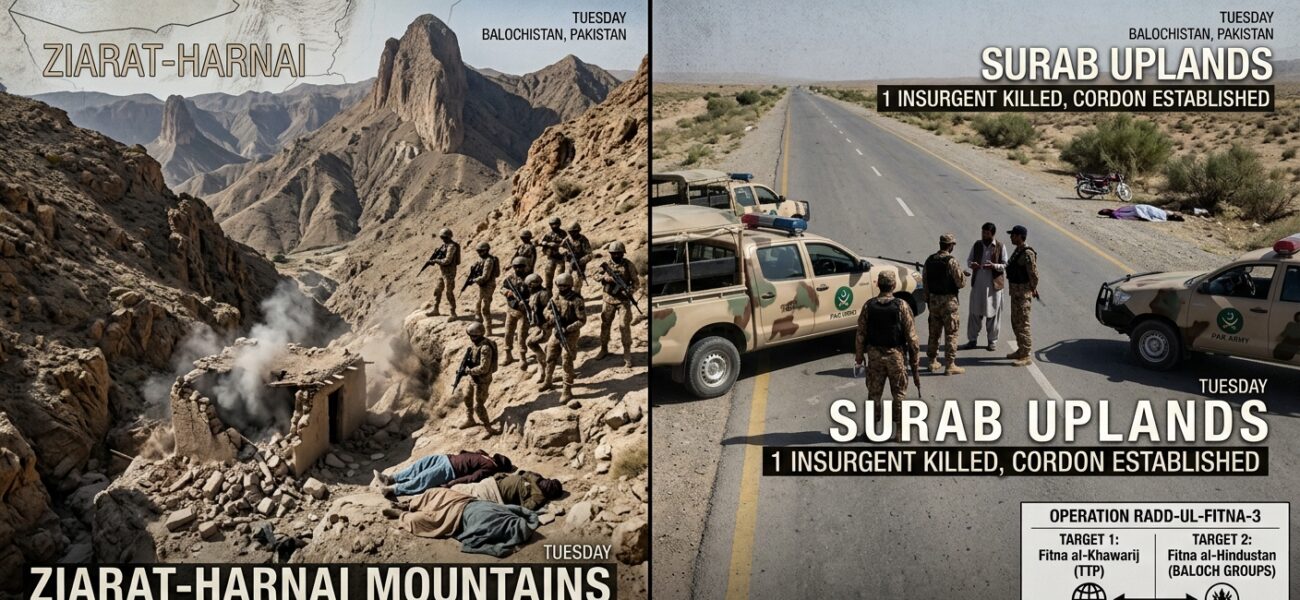
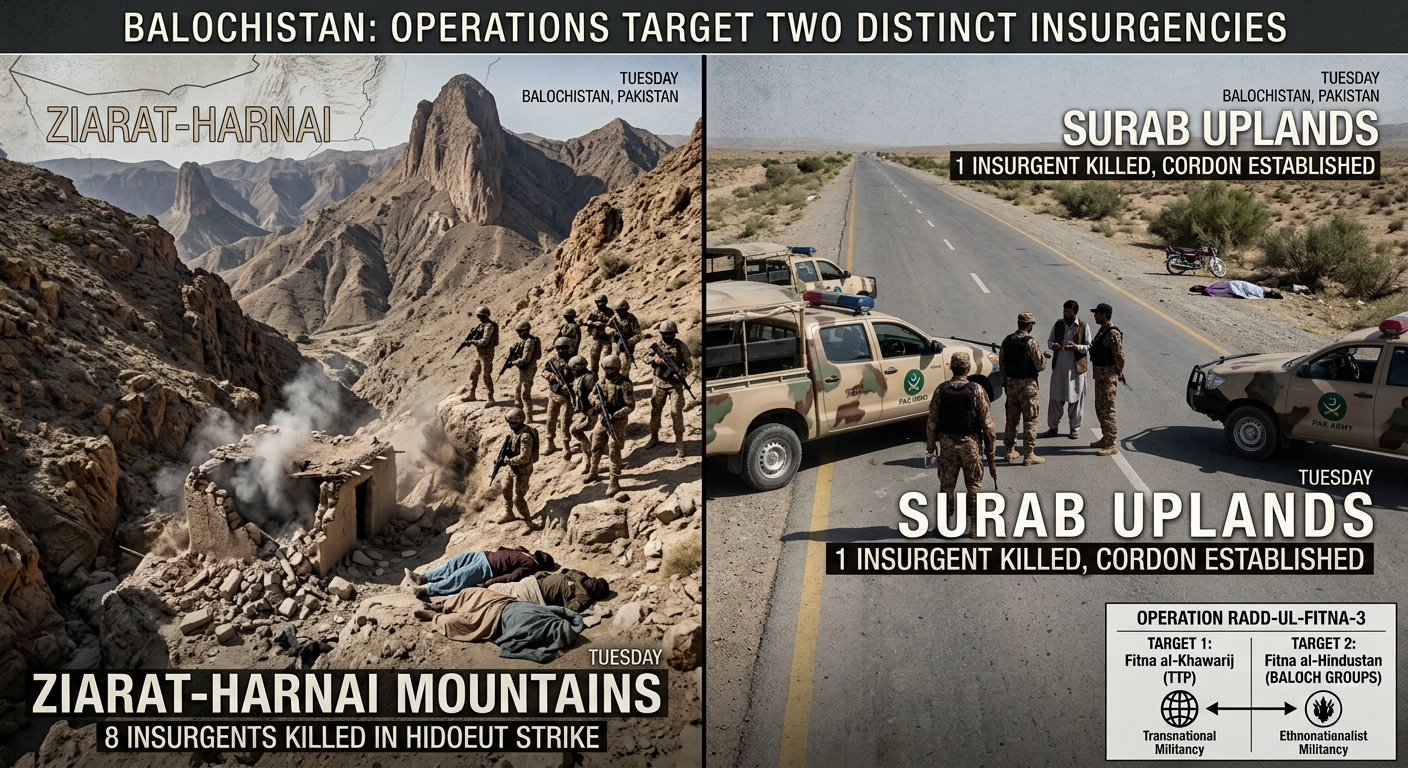
On Tuesday, Pakistani security forces reported killing more than nine militants in intelligence-based operations across three districts of Balochistan. Eight died in the mountainous belt between Ziarat and Harnai, where troops surrounded and destroyed a hideout, and one was killed near Hajika village in Surab district after forces tracked his movement and closed a cordon. Weapons, grenades, a walkie-talkie, and a motorcycle were recovered. The operations came two days after Pakistani authorities reported killing seventeen militants in the same broad region, eight of them when their own explosives detonated prematurely. The tempo is worth noting. The geography is worth more.
The three districts named on Tuesday do not describe a single place or a single enemy. Ziarat and Harnai sit in the rugged northeastern hill country where Balochistan shades into the Pashtun belt that runs up toward Zhob and the Afghan frontier. Surab lies well to the southwest, in the Brahui uplands of the Kalat division along the highway to Karachi. The ground between them is not merely distance. It is the space between two different insurgencies.
In the central and southern reaches of the province, the dominant threat is Baloch ethnonationalism. The Balochistan Liberation Army and its allied groups pursue separation from Pakistan, drawing on grievances that analysts at institutions such as West Point’s Combating Terrorism Center have traced to enforced disappearances and decades of political marginalisation. Whatever those roots, the movement’s recent conduct has turned heavily toward attacks on security forces and, at its worst, on civilians selected by ethnicity on the highways. It is a nationalist insurgency with a territorial claim, and its most ambitious operations, among them the hijacking of the Jaffar Express last year, have been designed to seize attention as much as ground. Its centre of gravity lies in the Baloch heartland of Makran, Kalat, and the districts around them. Surab belongs to that map, and the lone militant killed near Hajika fits its pattern.
The northeast wears a different face. Since 2022, the Tehreek-e-Taliban Pakistan has expanded into Balochistan, absorbing several local militant outfits and building Balochi-language propaganda networks to recruit beyond its Pashtun base. The hill districts running from Zhob down through Harnai and Ziarat have carried the signature of that expansion, assaults on security posts mounted by a movement whose ideology is transnational jihadism rather than Baloch nationalism. Its financing, its command structure, and above all its sanctuaries across the border in Afghanistan set it apart from the separatist groups. Where Surab reflects the Baloch insurgency, the belt between Ziarat and Harnai increasingly reflects this second one, and the eight killed there this week most likely answered to it rather than to any Baloch front.
The state’s own framing acknowledges the split. The campaign under which Tuesday’s operations were conducted, Radd-ul-Fitna-3, is directed at two separately named adversaries. One is what the authorities term Fitna al-Hindustan, their designation for the Baloch groups. The other is Fitna al-Khawarij, the official label for the TTP. The first name carries an implication of Indian sponsorship that lies beyond what public evidence can establish, and it can be set aside here without weakening the point. What survives, whatever one makes of the terminology, is the recognition built into it that Balochistan now contains two militancies rather than one.
The distinction is not academic, and getting it wrong carries a cost. A great deal of international commentary flattens the province into a single story, the Baloch insurgency, and reads every operation through that one lens. The flattening misses half of what is happening on the ground. The two currents have different drivers, different recruitment pools, and different external links, and they call for different responses. The Baloch separatist problem has a political dimension, rooted in questions of representation, rights, and development, that in principle admits a political answer alongside the security one. The TTP’s presence is a sanctuary problem bound up with Afghanistan, and it will not yield to provincial politics at all. A remedy designed for one does very little against the other, and a policy that treats them as the same threat is likely to underperform against both.
There is a further reason to watch the northeast, which is that the two maps have begun to overlap. When an ethnonationalist insurgency and a jihadist network operate in the same districts, they need not share an ideology to share terrain, smuggling routes, or the occasional target. The hill country stretching between Ziarat and Zhob is precisely the kind of ground where such overlap becomes possible, and where the state finds itself fighting both adversaries in the same operation. The intensity there is not in doubt. The Pakistan Institute for Conflict and Security Studies recorded a sharp deterioration in Balochistan through July, with the province’s overall death toll rising more than threefold over the previous month, and with security personnel losses climbing steeply alongside militant ones. The Centre for Research and Security Studies, assessing the second quarter of the year, found that Balochistan and Khyber Pakhtunkhwa together accounted for the overwhelming majority of the country’s violence, which places these two districts inside the most contested belt of ground in Pakistan.
The operations will continue, and by the state’s account they have been frequent and effective. But the significance of Tuesday’s actions is not captured by the figure of nine. It lies in where the nine fell. The eight killed in the mountains above Ziarat and the one killed near Surab died in the same province on the same day, and in all likelihood belonged to two different wars. Reading Balochistan correctly begins with refusing to merge them. The record of a single day’s operations is, in miniature, the record of a province confronting two insurgencies at once, and the first step toward countering either is to see them clearly as the separate problems they are.
Author