


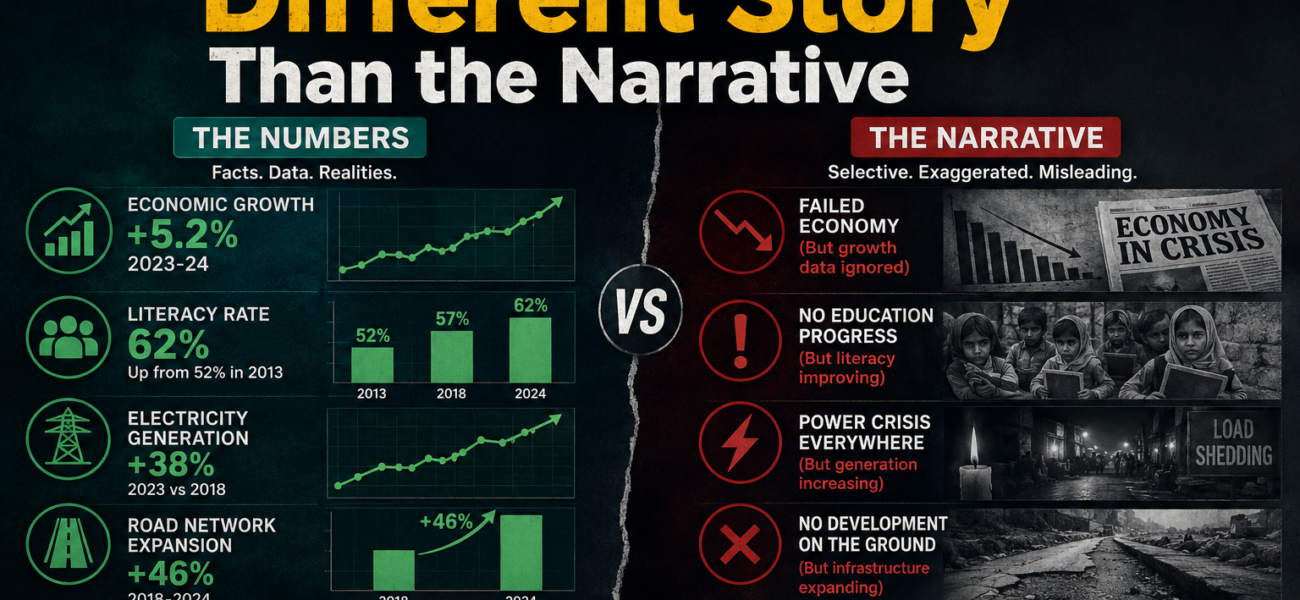
The Numbers Tell a Different Story Than the Narrative
In modern warfare, battles are fought on two fronts. One is the physical battlefield, where soldiers confront armed groups. The other is the information space, where perceptions are shaped,...

In modern warfare, battles are fought on two fronts. One is the physical battlefield, where soldiers confront armed groups. The other is the information space, where perceptions are shaped, narratives are amplified, and public confidence becomes a strategic target. Pakistan today finds itself engaged on both fronts. While terrorists seek to inflict casualties, their sponsors seek something even more valuable: convincing the world that the Pakistani state is losing control. The latest briefing by the Director General of ISPR sought to challenge precisely that narrative.

Statistics, by themselves, do not tell the entire story, but they often expose misleading ones. According to the figures presented, Pakistan has carried out more than 40,000 Intelligence-Based Operations (IBOs) in 2026 alone, with over 31,000 conducted in Balochistan. That translates into nearly 200 intelligence-led operations every single day involving the armed forces, police, intelligence agencies, and civil armed forces. Such numbers do not reflect a passive state reacting to terrorism; they reflect one that is relentlessly pursuing it.
Critics frequently point to the rise in reported terrorist incidents as evidence of deteriorating security. Yet this interpretation overlooks an important operational reality. A state that conducts more intelligence-driven raids will inevitably experience more armed engagements because it is actively disrupting terrorist networks rather than waiting for attacks to occur. Increased contact between security forces and militants is often the consequence of proactive counterterrorism, not necessarily proof of strategic failure. Measuring success solely by incident counts ignores the broader operational picture.
Perhaps the most telling figure in the briefing was the elimination of 2,084 confirmed terrorists so far this year, averaging roughly ten militants neutralised every day. Even more significant is the improving kill ratio. In 2025, approximately two terrorists were killed for every Pakistani martyr. That ratio has now increased to 2.5 terrorists for every martyr in 2026. This suggests that while the threat remains serious, the effectiveness of Pakistan’s counterterrorism operations has continued to improve.
None of these figures diminish the painful human cost. The loss of 819 Pakistanis, including soldiers, police personnel, and civilians, is a profound national tragedy. Every martyr represents a grieving family and a reminder that terrorism remains Pakistan’s greatest internal security challenge. However, these sacrifices also underscore the determination of those on the front lines who continue to confront extremist violence despite enormous risks. Their commitment deserves recognition beyond statistics.
The concentration of violence in Khyber Pakhtunkhwa and Balochistan also deserves careful analysis. These provinces share long, difficult borders and face unique security dynamics shaped by cross-border militancy, rugged terrain, and decades of regional instability. The DG ISPR’s assertion that many suicide attacks involve Afghan nationals or individuals linked to Afghan security structures raises questions that require sustained diplomatic engagement alongside effective border management. Counterterrorism today cannot rely solely on military force; it demands regional cooperation and credible accountability.
One of the more thought-provoking elements of the briefing concerned the concept of a “hard state.” The phrase is often misunderstood as implying authoritarian rule. Instead, the argument presented was that a hard state is one where the Constitution and the law apply equally to every citizen without exception. This distinction matters. Strong states are not defined by the dominance of their militaries but by the consistent enforcement of the rule of law, equal justice, and effective governance.
The reference to Article 5 of Pakistan’s Constitution also invites broader reflection. Democracies function through a reciprocal relationship between the citizen and the state. Citizens possess fundamental rights, but they also carry constitutional responsibilities, including loyalty to the state and obedience to the law. Equally, the state has a corresponding obligation to protect those rights, deliver justice, ensure transparency, and respond to legitimate grievances. Security and civil liberties should reinforce one another rather than exist in perpetual tension.
Balochistan illustrates why this balance is essential. Socioeconomic grievances, uneven development, and political concerns should not be exploited by violent actors seeking to fragment the state. Sustainable peace requires both uncompromising action against terrorism and meaningful efforts to address concerns through constitutional and democratic means.
Pakistan’s counterterrorism campaign is far from over, and no responsible observer should underestimate the seriousness of the challenge. Yet neither should the country accept simplistic narratives that portray every security incident as evidence of failure while ignoring thousands of successful operations that prevent attacks before they occur. A mature assessment requires acknowledging both the sacrifices and the successes.
In an era where perception often travels faster than facts, numbers alone cannot win the information war, but they can expose false impressions. The latest operational data suggest that Pakistan remains engaged in an intensive and increasingly effective counterterrorism campaign, and aims to protect and safeguard its citizens.
Author